
Who Controls the Tap?
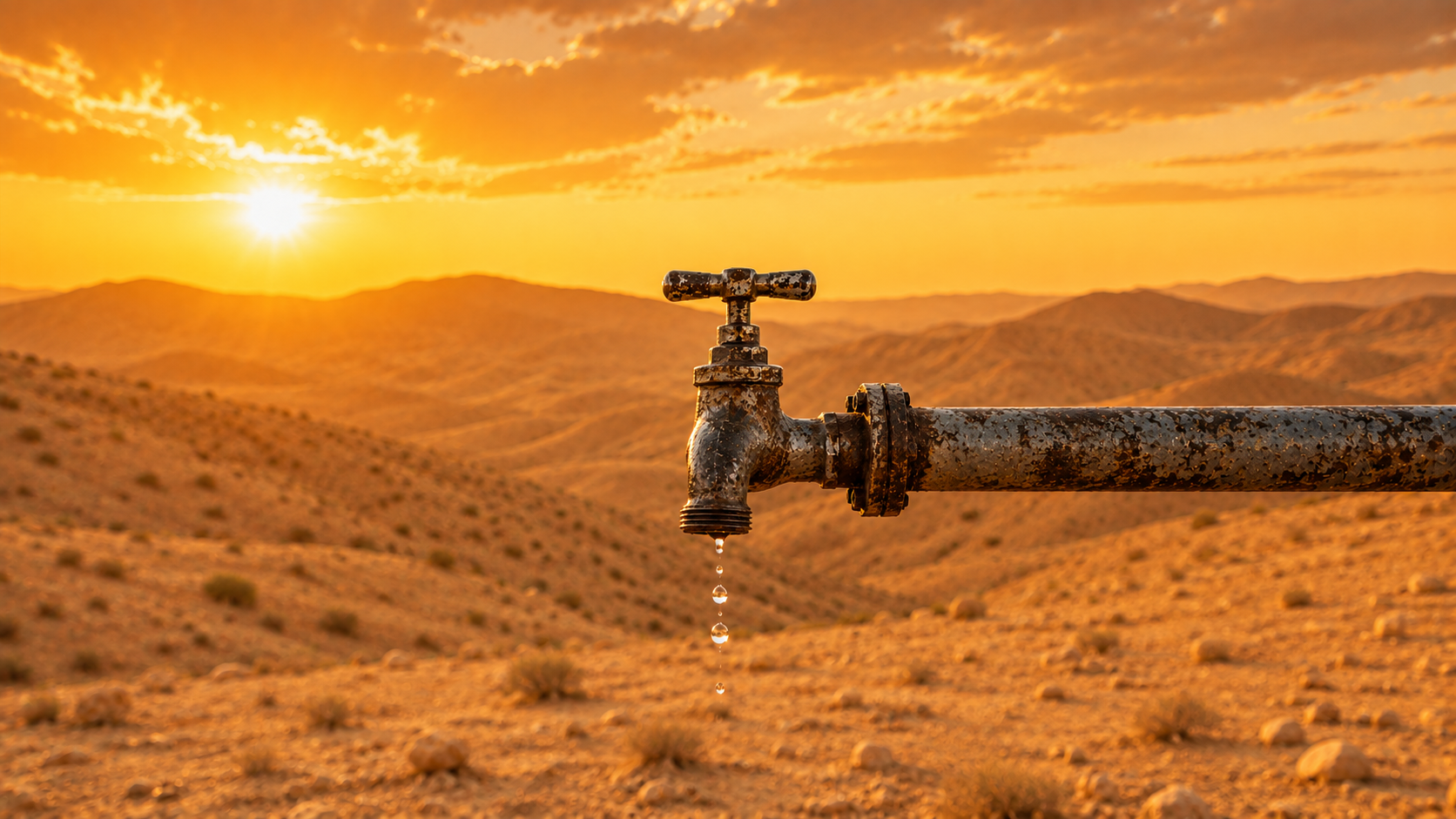
For more than a century, the Middle East has been synonymous with oil. It has shaped economies, redrawn alliances, funded wars, built cities and drawn the attention of the world’s great powers.
Yet the defining strategic prize of the twenty-first century may no longer lie beneath the earth. It may be found in something far more fundamental to human survival.
Water is quietly becoming the Middle East’s next strategic currency.
Unlike oil, there is no substitute for water. Economies can adapt to new sources of energy. Technology can replace one fuel with another. But no nation can function, no agriculture can endure, and no civilisation can survive without a reliable supply of fresh water.
According to the World Bank, climate-driven water scarcity could reduce economic output across the Middle East by as much as 14 percent by 2050—the greatest projected regional impact anywhere in the world.
Could the next major conflict in the Middle East be fought not over land, oil or even nuclear ambition, but over water?
History suggests it would not be without precedent.
Long before desalination transformed Israel’s coastline, control of water was already recognised as a strategic necessity. During the 1960s, attempts to divert the headwaters of the Jordan River became one of the defining confrontations preceding the Six-Day War. Israel regarded the diversion not simply as an engineering project, but as a direct threat to its national survival. Water was never merely a natural resource; it was security, sovereignty and survival.
That same dynamic continues to shape the region today. Turkey’s vast network of upstream dams on the Euphrates and Tigris increasingly influences the fortunes of Syria and Iraq, while Ethiopia’s Grand Ethiopian Renaissance Dam has altered the strategic balance along the Nile, raising profound concerns for Egypt, whose civilisation has depended upon its waters for millennia. The resource shaping tomorrow’s diplomacy may no longer be measured in barrels, but in cubic metres.
Jordan brings this changing reality into particularly sharp focus.
One of the most water-scarce nations on earth has become increasingly dependent upon water supplied by Israel through successive agreements. What began as a treaty obligation has evolved into something far more significant. Water is no longer simply exchanged between neighbours; it has become an instrument of regional stability and a source of strategic influence, creating a level of interdependence that few other commodities can match.
Born into scarcity, Israel had little choice but to innovate. It first secured its water, then learned to manage it, and ultimately learned how to create it. What began as necessity became one of the quiet revolutions of the modern State of Israel.
Seawater was transformed into drinking water on a national scale. Wastewater recycling reached world-leading levels, allowing agriculture to flourish despite chronic scarcity. Drip irrigation reshaped farming across arid landscapes, demonstrating that innovation could often compensate for geography. Israeli technology has also helped develop systems capable of extracting drinking water directly from moisture in the atmosphere itself.
Israel once fought to secure water.
Today, it helps produce it.
Important as these achievements are, they do not alter one fundamental reality. Desalination demands immense energy. Recycling cannot produce rainfall. Atmospheric water generation offers remarkable possibilities, but it cannot replace the rivers, reservoirs and aquifers upon which millions still depend.
Technology expands resilience.
It does not replace nature.
Elsewhere, the search for solutions has become increasingly ambitious. Among the more remarkable proposals has been the UAE Iceberg Project—a vision to tow Antarctic icebergs thousands of kilometres to the Gulf to supplement freshwater supplies.
The proposal itself speaks volumes.
Climate change, population growth and rapid urbanisation continue to intensify the pressure. Aquifers are declining, rainfall is becoming less predictable, and demand continues to outpace natural supply. The world is not running out of water; it is running out of water that is accessible, affordable and reliable.
This is where Israel occupies a distinctive position.
The country is already recognised for exporting cybersecurity, defence systems, medical innovation, artificial intelligence, agricultural technology and natural gas. Yet its most valuable export may ultimately prove to be something less tangible: the accumulated knowledge of how a dry nation learned not merely to survive, but to flourish.
It is no longer difficult to imagine a Middle East in which pipelines carrying fresh water become every bit as strategically important as those carrying oil or gas. Such infrastructure could reshape regional relationships as profoundly as the pipelines that once carried energy across the region.
In a hotter, drier and more densely populated Middle East, stability may depend less upon what lies beneath the desert than upon what flows through it. Water will not eliminate conflict. In some places, it may intensify existing tensions. As scarcity deepens, rivers, dams and aquifers will assume even greater strategic significance.
Yet scarcity also creates incentives that abundance never could. Nations dependent upon one another for life’s most essential resource acquire powerful reasons to think beyond slogans, short-term politics and temporary advantage.
Oil transformed the Middle East.
Water is reshaping its future.
For generations, the region’s strategic map was drawn around oilfields, shipping lanes and pipelines. Another map is already emerging beneath it—a map of rivers, aquifers, desalination plants, reservoirs and future water corridors.
Civilisations have always risen where water could sustain life and declined where it could not. Modern technology has delayed that ancient reality, but it has not overturned it.
The twentieth century taught the Middle East that oil shaped economies.
The twenty-first century is teaching it that water shapes civilisations.
The question is no longer simply who controls the oil.
It is who controls the tap.