Waves and waves of love: An Orthodox ally at Pride
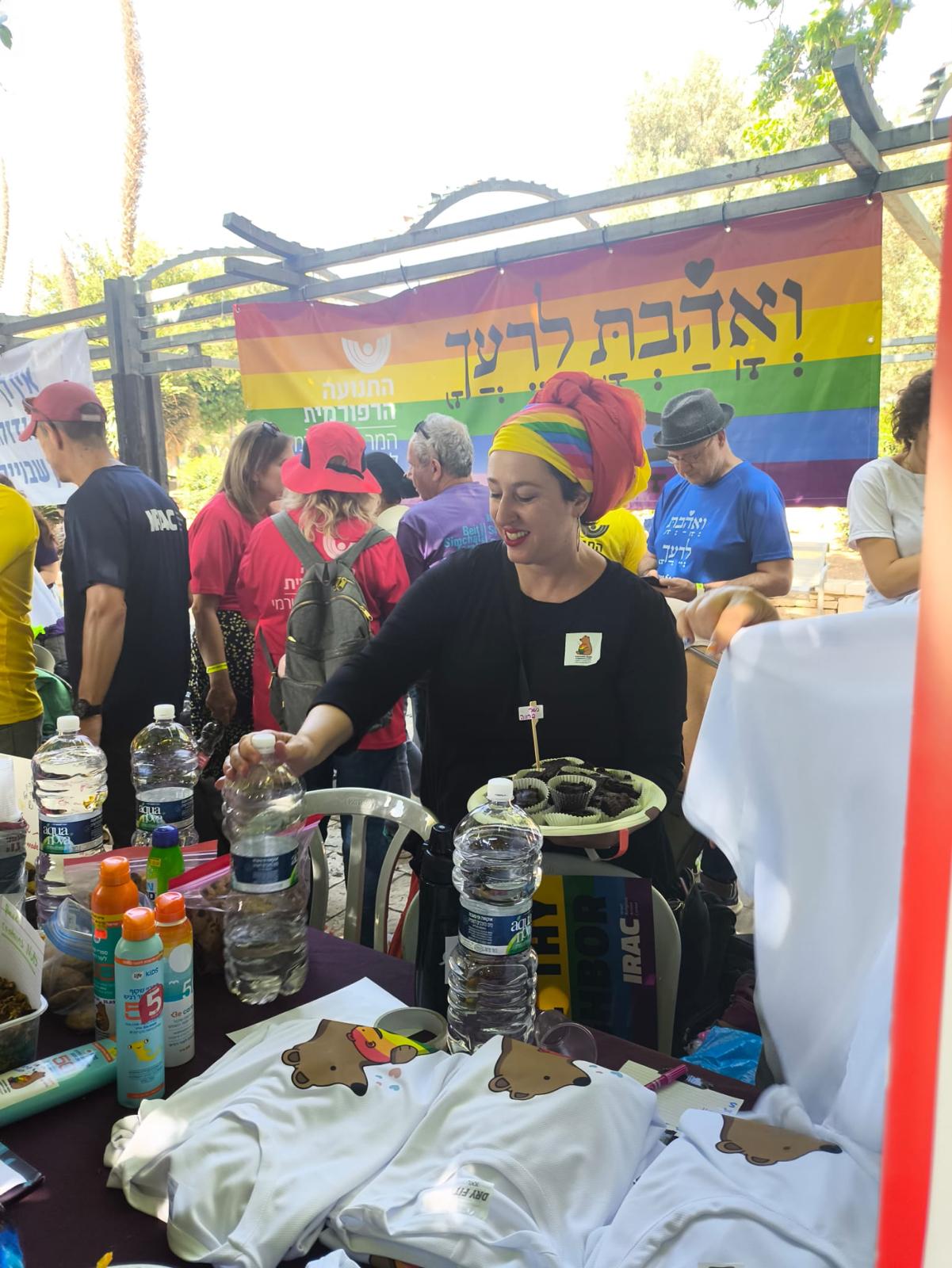
The Jerusalem March for Pride and Tolerance will be held on Thursday, June 5, at Liberty Bell Park (Gan HaPa’amon). As in past years, I will be there with Free Parent Hugs, an organization of volunteers who bring parental warmth and nurturing to the event. We hand out home-baked cookies and nudge participants to put on sunscreen and stay hydrated. As the name suggests, we also give out lots of hugs.
I get some curious looks when I attend Pride. Although there are more and more visibly-religious participants each year, we are still the minority. With my headscarf and black dress, I look more like the people on the other side of the police barricade: religious Jewish demonstrators who oppose any public acknowledgment of the LGBTQ community in Jerusalem, and protest the fact that this march is happening at all.
I wasn’t always Orthodox. I grew up in a liberal Jewish community, where I was raised with an affirming attitude toward gay and bisexual people. Homophobia was ever-present in the mainstream American culture of the 1990s, but it was something to be resisted and challenged, like racism and antisemitism. In my worldview, speaking up for tolerance and understanding was an obvious imperative.
At 18, I fell in love with Torah and with the discipline of religious life. I attended seminaries for the newly-religious, where I sat through classes on Orthodox values and beliefs. I mostly liked these sessions, with one glaring exception. Whenever the topic of the Torah’s position on homosexuality came up, I couldn’t engage. Any discussion of the issue filled me with furious despair.
I had come to understand the Torah as a God-given corpus, eternal and binding in its particulars. At the same time, prohibitions on homosexuality contradicted something equally true and just within me. My teachers offered smug platitudes and bizarre metaphors (I’ll spare you the pain of articulating them), and I could not find peace. I wanted to be religious, but I could not rationalize or contextualize the Torah’s demands in a way that felt satisfying.
So I stopped trying. I set the matter aside and let it remain unresolved. I had the luxury of doing this because it didn’t affect me personally. Or so I thought.
I continued on my journey toward halachic observance and ideological transformation. I met and married my husband. I became a kallah-instructor (pre-marriage counselor, for Orthodox women) and then a sex educator. I moved to Israel with my growing family and became increasingly politically active. I immersed myself in Torah study, in teaching and writing. The conflict remained unsettled, a sore spot deep within, and one that I avoided at all costs.
In 2015, 16-year-old Shira Banki was stabbed to death at the Jerusalem Pride Parade. The deranged extremist who took her life was a self-identified Orthodox Jew. In the wake of Shira’s murder, people of all religious persuasions gathered in Jerusalem’s Zion Square on a Saturday evening to hear speeches and participate in dialogue circles.
That evening, Rabbi Benny Lau spoke words that changed me forever. I am grateful that the Eshel organization published a translation of his speech, which I revisit frequently. I will share some of the remarks that affected me so profoundly. I encourage everyone to read the speech in full, which can be found here, in the original Hebrew.
Rabbi Lau decried Shira’s murder, as well as two crimes by Jews against Palestinian victims around that time: the kidnapping and murder of 16-year-old Mohammed Abu Khdeir, and the arson death of baby Ali Dawabsheh and his parents. Rabbi Lau did not reserve condemnation only for their murderers. He implicated all of us.
It is not possible to say ‘our hands did not spill this blood.’ Anyone who ever sat at a Shabbat table, in a school classroom, in a synagogue, on a soccer field, at a club or community center, who heard those racist jokes, who heard those homophobic jokes, who heard the crude language and did not stand up to stop it, they are an accomplice to this bloodshed.
I knew Rabbi Lau was right. I had been content to stay silent when I heard dehumanizing statements about gay people, about Arabs. I didn’t laugh at offensive jokes, but I didn’t challenge people who made them.
Everyone has their own reasons for failing to speak up. I dislike confrontation and disharmony in general. I didn’t want to create awkwardness and discord.
When it came to homophobia, however, there was another reason. I was still confused. The old dissonance remained within me, the sense that I couldn’t reconcile the Torah’s prohibitions with my own sense of what was right and true.
So I didn’t speak up when I encountered homophobic speech in my community. I just let it happen around me, over and over again. I was complicit, and standing there in Zion Square, I felt profound shame. I was filled with a desire to change, and I took my direction from Rabbi Lau’s words:
We must create waves and waves of love. We need to release people from fear. We need to stand with our faces exposed. Without hesitating, and without stammering, if our ears hear someone—and it doesn’t matter if they are a rabbi or educator, or counselor or parent. If we hear the slightest sound that can hurt, we must stop them in the first moment. The fire begins there—it begins with the first insult, with the small racial slur—and not in the big inferno.
Since that night, I have tried to speak up for my values, to risk confrontation. I’m no longer willing to allow hatred to grow unchallenged. And each year since, I have tried to honor Shira Banki’s life, and Rabbi Lau’s clarion call, by participating in the annual Jerusalem Pride March.
Walking a spiritual path means seeking awareness of what is being asked of me, specifically and personally, in each moment. Perhaps my friends in the LGBTQ community who strive to fulfill the Torah with integrity might need to negotiate the paradox I have described. That is not my personal challenge. I didn’t create this tension, and I won’t be the one to resolve it. When I accept this, I can focus on what is actually within my power: to create the waves of love that Rabbi Lau described.
So let me not stammer or hesitate: I love you. I stand with you, this month and forever. When you need a hug from a sister, I will be your sister. If you are longing for a mother to love you, to see your beauty and accept you exactly as you are, I will be your mother. And if you feel you can’t be your full self and live all of your values in your community right now, we will build community together.
—
I hope you will join me at the Jerusalem Pride and Tolerance March this Thursday, June 5. If you spot the Free Parent Hugs table, stop by and say hi. Wishing everyone a blessed and meaningful Pride Month.