CFO | Empower Society for Good I Author
We All Want to Live. What Do We Owe One Another?
My wife and I went to a traditional boutique restaurant after seeing a video of it on Instagram. The food looked appealing. The presentation had done its job.
Then we opened the menu.
We chose two starters. One arrived nicely presented and tasted much as expected: pleasant enough, but nothing to write home about.
Choosing the main course took more thought. Something familiar, whose ingredients suited me? Or something different that looked promising, even if I had reservations about the recipe?
It struck me that choosing a political party involved much the same dilemma.
There were things I liked on several menus: a candidate here, an idea there, values closer to my own somewhere else. I would have liked to assemble a choice from several parties.
Do you choose a new item on the menu or go with what you know? New can be appealing, different and exciting, but risky. It can be hit or miss,
With the starters, we could choose two. When voting, we had to choose one.
In the end, I did not choose the party closest to me religiously. I chose a party that did not align with all my views, because I was looking for change.
That involved compromise. My principles had not suddenly become unimportant. But I also wanted accountability, better judgement and a willingness to take responsibility. Religious familiarity could not, on its own, settle the choice.
I wanted people who could acknowledge what had gone wrong, recognise their own part and explain what they would do differently—people with a track record of taking responsibility and turning words into action.
Those thoughts followed me when we went to spend Shabbat with our grandchildren in a Haredi neighbourhood in Ramat Beit Shemesh.
There were election posters around the streets. Some troubled me deeply. To my eyes, the attacks on others crossed into lashon hara. I wondered what children absorbed when those were the messages surrounding them.
A simpler poster stayed with me. I cannot recall its exact wording, but I understood its message as:
We just want to live our Haredi lives.
I could understand that wish.
My wife observed that we, too, wanted to get on with our lives as Israelis.
We all want to raise our children, practise our faith, earn a living and enjoy our families. But what do we owe the people who help make that life possible?
I disagree with plenty of things the government does. That does not release me from paying taxes, contributing my fair share or recognising the obligation of military service and the sacrifices it demands.
Preserving a way of life requires concern for the wider society that sustains it.
In shul, I received an aliyah. During the blessing afterwards, I asked that the soldiers be blessed—and the yeshiva students too, in the same blessing.
Both deserve our prayers. Both belong to our people. I wanted to express that shared belonging.
But shared belonging brings shared obligations. The blessing also left me asking how we care for one another, what each of us contributes and whether the burdens are being carried fairly.
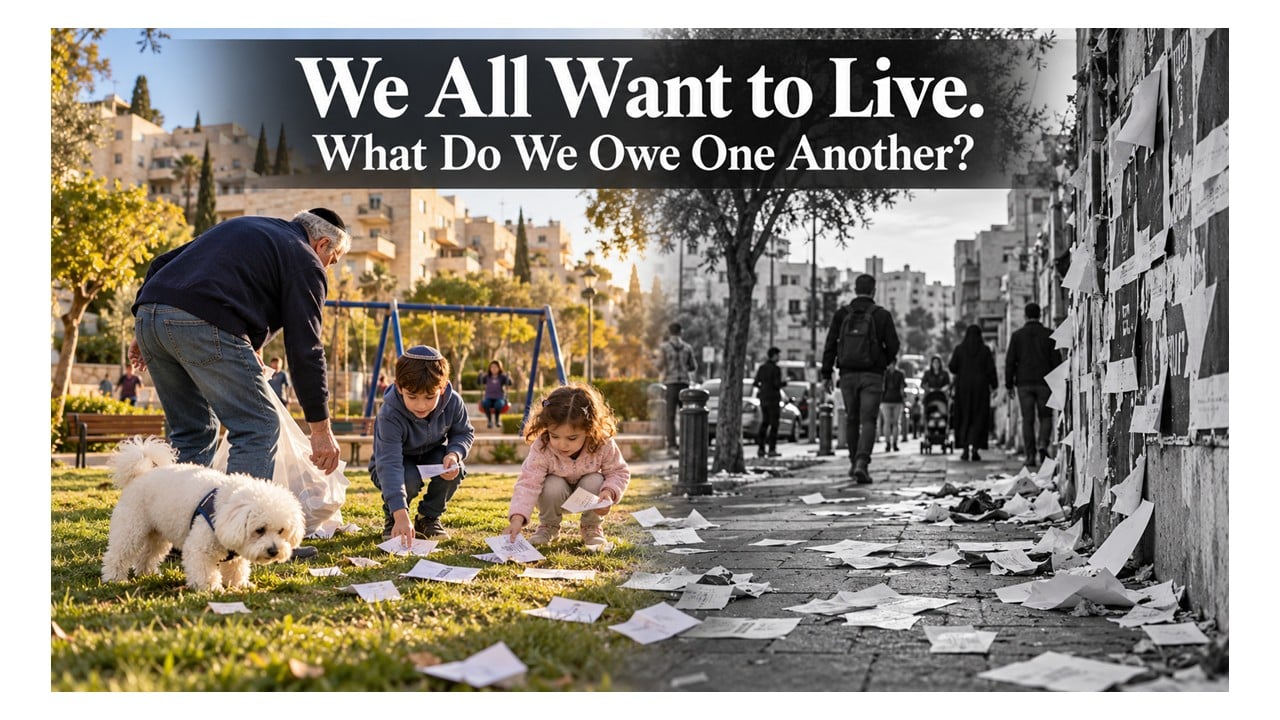
Earlier that Shabbat morning, we took Daisy for a walk with two of our grandchildren and went to the park. As we sat on the various swings, I thought about what to write for the following week’s parsha.
My thoughts turned to Sodom.
God tells Abraham what is about to happen, and Abraham pleads for Sodom. Why bring him into the conversation? The commentary I was reading suggests that the encounter reveals his character. He could remain silent. These are not his people, and their society is deeply corrupt. Yet he speaks up.
Abraham cannot accept that the righteous should perish with the wicked. His sense of justice does not extinguish his compassion. Innocent people have suffered throughout history, and his question still troubles us: how can this be just?
He questions even God. Surely faith and loyalty leave room for us to question our leaders, our communities and ourselves.
The commentary also recounts a tradition about a girl cruelly punished for feeding a poor stranger. Sodom treated kindness as an offence. Today, I feel that too much of the world treats Jewish insistence on our right to live in the land of Israel as an offence. That makes the question of what kind of society we build here all the more urgent.
Sitting on a swing, I thought about what reveals a society’s character: what it encourages, what it excuses and whose needs it notices.
Then I looked around the park.
Packets, plastic cups and pieces of paper were scattered across the ground.
I could complain about the municipality or blame whoever had been there before us. There would have been no shortage of people to hold responsible.
“Why don’t we help tidy this up?” I asked the grandchildren.
They were not particularly keen. They had come to play, and picking up rubbish was hardly an attractive alternative.
But they helped.
We were not going to transform the neighbourhood. But we could leave that corner of the park cleaner.
On the way home, we saw more paper and plastic on the street. We picked those up as well.
We had not dropped it. We could still take responsibility for clearing it away.
Responsibility often asks us to do something we would rather leave to someone else. That morning, we had a small opportunity to practise it together.
It reminded me of Rabbi Shlomo Carlebach’s story of “The Holy Hunchback.”
In Carlebach’s telling, he meets a street cleaner in Tel Aviv, a Holocaust survivor whose body bears the consequences of terrible suffering. The man had been a pupil of Rabbi Kalonymus Kalman Shapira, the Piaseczner Rebbe, known for Esh Kodesh.
Carlebach begs him to share one teaching he remembers.
Eventually, the man recalls the words his Rebbe repeated to the children:
“The greatest thing in the world is to do somebody else a favour.”
In the story, those words had helped him carry on in Auschwitz. He could comfort someone, listen to their sorrow and ease their loneliness. Later, alone in Tel Aviv, he could still find someone to help.
I shared that story years ago. That Shabbat morning, its message returned to me. Helping another person can give them hope and give us purpose.
It also brought me back to the burdens carried around us.
When we speak about soldiers, we must see their wives, children and parents: the repeated absences, interrupted livelihoods, worry and exhaustion.
Gratitude should move us towards practical support. It should also make us examine what more we ought to carry ourselves.
At the restaurant, dessert offers a moment to sit back and ask whether we chose well.
We will judge our political choices too. Did those we trusted deliver? Did they accept responsibility? Did anything change?
But at a restaurant, we can pay the bill and leave. A country asks more of us. Whoever leads it, we still have a share of the work.
The grandchildren were not particularly keen to pick up rubbish. They helped anyway.
We all want to live our lives.
What are we willing to do so that others can live theirs?
Part Two: A Wake-Up Call
The election results were a wake-up call for all of us. They brought me back to the question I had been thinking about over Shabbat: what responsibility do we each carry for the society we are building here?
It looks as though we have interesting days ahead. In Israel, there are no easy choices. Deciding what to order is child’s play. Building a responsible government is a different matter altogether. There seem to be no easy choices. Nothing in Israel is straightforward, and we will need to make difficult decisions. Whatever government emerges, we will still need to work together.
These elections have brought our differences into focus. Diverse people share this land, with different beliefs, identities and hopes for the future. We do not have to agree on everything, but we need enough common ground to work for everyone’s betterment.
That is part of what it means to build a Good Society.
Secular, religious and Haredi Jews need to be able to speak honestly about our shared future. Jewish solidarity must include difficult conversations about service, contribution and carrying the burden together. Respecting each other’s differences also requires a willingness to compromise.
If every community expects the others to make all the changes, how do we move forward?
Israel’s Arab citizens belong in this conversation too. Their hopes, concerns and responsibilities are part of the country’s future. Fair opportunities, fair treatment and meaningful contribution concern all of us.
I am not offering a formula for how those responsibilities should be organised. But wanting to live our own lives cannot mean leaving the work of sustaining the country to somebody else.
The same applies to leadership. Whoever forms the next government will have to govern for people who did not vote for it as well as those who did. We need leaders who can earn trust beyond their own camp, listen to uncomfortable truths and turn commitments into action.
We have responsibilities in how we respond too. We can challenge a government, demand accountability and argue firmly for change while recognising that people who voted differently also care about this country.
There are painful realities and deep disagreements behind that question. Even so, leadership carries a responsibility to consider what will make life better for the people who must live with the consequences of its decisions.
The world is watching, and our decisions and actions will go a long way in how we are viewed and judged.
In my JNS article, “We must not be caught with our pants down again,” I argued that Israel’s extraordinary resilience needs to become effective national action: preparation, clear priorities, resources and accountable delivery.
The willingness of ordinary people to give so much deserves leadership that prepares, listens, learns and follows through.
And it asks something of us. Can we recognise a worthwhile contribution from someone whose politics we dislike? Can we acknowledge a failure within our own camp? Can we accept a difficult compromise when it serves our shared future?
Those are questions I have to ask myself too.
Back in the park, there was something within reach that we could do. The choices facing the country are far more complicated. But the question of responsibility remains.
The election results give us plenty to discuss. What matters now is what we do with them.
We all want to live our lives. We need to work together so that others can live theirs too. That is how we begin to build a Good Society.
Related Topics
Related Posts