
We Are, After All, Kin
More than 1 in 4 American adults are estranged from a family member.
That’s not a guess. It’s based on data collected by the Cornell Family Estrangement & Reconciliation Project. “I began to notice in these interviews I was conducting with very old people that among the regrets that the oldest Americans have, one of the truly strongest is an unresolved family estrangement,” the project’s lead, Karl Pillemer, said in an interview. “It does come back to sort of haunt you at the end of life.”
This is a topic I have a vested interest in. My family tree is all snapped branches and dead leaves; both sides of my family contain many fraught relationships and estrangements. It’s no surprise, perhaps, that when my parents and I had a series of terrible arguments during the Covid-19 pandemic, I went “no-contact” with them for almost three years. I didn’t know there was another option.
In this week’s parasha, our forefather Abram explores the alternative to estrangement.
Abram and Lot’s households travel side-by-side, and suddenly “the land could not support them staying together; their possessions were so great they could not remain together.” Perhaps that is simply a description of capacity, as Rashi suggests: there was not enough pasture for their sheep to graze. Or maybe, as the Old Western adage goes, “this town ain’t big enough for the both of us” — the two households could no longer co-exist peacefully.
Whatever it means, Abram handles the beginning of conflict between the households’ herders gently. “Let there be no strife between you and me, between my herders and yours,” he tells his nephew. “We are, after all, kin.”
Rabbi Samson Raphael Hirsch notes the repetition of the word bein (between). “Our quarrel is mutual,” he imagines Abram saying. “I do not like several things of yours and you, too, do not like certain things which I do; through this, strife occurs also between our people.”
But Abram also sees clearly: the status quo isn’t working.
***
What are Abram’s options?
Even just in Parashat Lech-Lecha, Abram manages plenty of conflict.
He can try to avoid it, as he does when he lies about Sarai’s identity before entering Egypt. He can yield to Sarai, as he does later in the parasha when she accuses him of responsibility for her maidservant’s disobedience. He also goes to war against the four kings when it becomes necessary.
But here Abram chooses, instead, to create space without estrangement. “Let us separate,” he tells Lot. “If you go north, I will go south; and if you go south, I will go north.”
“Where there is no union, separation brings peace,” Rav Hirsch writes of Abram’s approach. “Even if we separate as men, no longer live the same kind of lives, we are still relations.”
Lot accepts Abram’s proposal and turns his face in the direction of the fertile grounds of Sodom. The first decision Lot makes as an independent man is to pursue more wealth, regardless of the sinfulness of his environment. Sodom’s residents are so wicked that the Torah, in an aside, makes sure the reader knows it: “Now the inhabitants of Sodom were very wicked and sinned a lot against God.”
With pastures between them, their relationship seems to have improved. Abram rescues Lot from the kings who kidnap him and advocates for the life of Lot’s fellow citizens when God promises to destroy Sodom. In each of those moments, Abram’s interactions with Lot appear to have been brief. He stays long enough to save the day, but there is no emotional reunion or continued conflict.
***
My father-in-law, who died of pancreatic cancer slightly over two years ago, pushed me to reconcile with my parents in the last months of his life. His life was a deeply painful one — he had lost his own father to the same disease, and in the year after that loss, his mother and brother both died, leaving him an orphan and only child.
His illness made him more reflective, and perhaps made me more willing to listen. When he first brought it up, I brushed it off; I had been no-contact with my parents for over two years. But months later, when his illness intensified, I finally reached out to my mother and father.
Restarting that relationship was very, very painful. They had missed several years of my life and my oldest daughter’s birth. My parents’ friends, people I grew up with, believed I was a villain; the people who had witnessed the conflict from my end viewed my parents as the villains.
During that first call, I didn’t know what my parents would want my daughter — their first grandchild — to call them. That memory, itself, makes me cry again.
I will never get those days and months and years back.
Yes, I protected myself. Yes, no-contact was encouraged by therapists and rabbis whose support I am so grateful for. But I know now that I was stronger than I believed I was at the time. I could have backed away without turning my back.
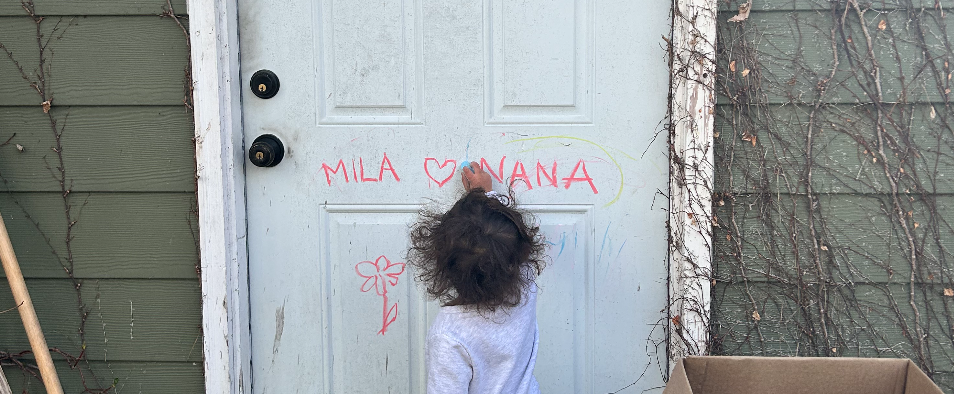
For my daughters, the separation will never be anything but a story. My girls love their grandparents — their “Nanapapa,” as my older daughter coined. Nothing gives me greater joy, today, than watching my father hold my second daughter, who he met days after she was born. Nothing gives me greater gratitude, today, than seeing my daughter baking challah with her grandmother. I pray that this is what my daughters remember: the commitment to one another.
“Severing ties can cause harm,” wrote journalist Anna Russell in a 2024 article for the New Yorker. “What is lost when we render our families optional?”
That question, I can answer.