
We are all Jews of Yom Kippur
Yom Kippur, A Sanctuary of Time
In almost every Jewish community, there are people known as the “Jews of Yom Kippur”: those who never enter a synagogue during the year except on that day. Some come as soon as Kol Nidrei, others arrive only for Yizkor or Neilah. They may not keep kosher, observe Shabbat, or otherwise appear connected to Jewish religious life. Yet on this one day, they show up.
Calling someone a “Jew of Yom Kippur” is no compliment. It is a derogatory statement, implying a somewhat lesser degree of Jewishness, as if religious commitment could be measured by the number of days one spends in synagogue. But such judgment is inconsistent with the meaning of Yom Kippur itself.
According to the Midrashic tradition, Yom Kippur was the day that Moses descended with the second tablets, signifying God’s forgiveness after the sin of the Golden Calf. But while Yom Kippur is known as the day of Atonement and Forgiveness, it is also the day of the great gathering of the Jewish people. It is the one moment in the Jewish calendar when ALL Jews, regardless of their levels of observance, identification, and location in Israel or the Diaspora, are called upon to gather together and turn toward God. Just like they did when Moses came down Mount Sinai for the second time, uniting in awe and collective repentance to witness and accept the renewed Covenant, and start anew.
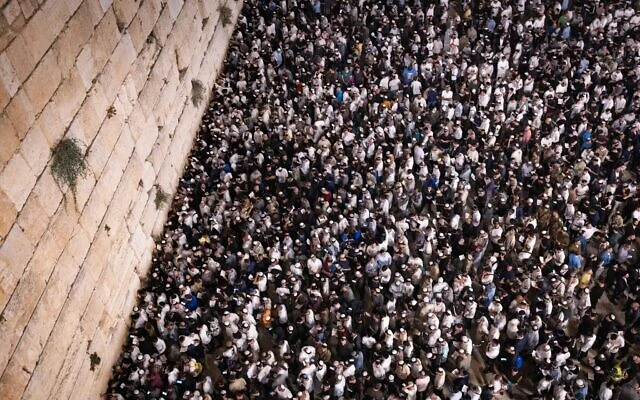
This dimension of fraternity and unity is however often overlooked as we insist on repentance and expiation. Almost three years on from October 7th, it has acquired a far more tangible meaning, as we witness the incredible unity that our people is capable of despite its deep fractures and great differences. And yet, despite those differences, on Yom Kippur, everyone (or almost everyone) becomes part of the great congregation of Israel – not only spiritually, but physically, standing side by side. Not that differences disappear, but or one day they are contained within something larger. On Yom Kippur, unity – one of the Jewish people’s most important values – is not simply invoked as a slogan or cheapened by cynicism, it actually and physically happens.
This moment recalls Hakhel, the gathering that took place in Jerusalem every seven years, following the shmita year. Men, women, children and gerim were commanded to gather and hear the Torah. The entire people came together at a particular point in time and space.
But Hakhel required space: Jerusalem, the Temple, a physical journey to one place. Yom Kippur requires more time than geography. On Yom Kippur, a Jew, wherever he is, enters the sanctuary of time.
If Shabbat is a “palace in time,” as Rabbi Abraham Joshua Heschel put it, emphasizing the sanctification of time in Judaism, Yom Kippur is a Mishkan built of hours instead. Without a supreme location other than the neighborhood synagogue, no Jew can be too far away to enter it.
This is also why Yom Kippur is quite paradoxical. It is perhaps the most inward day of the Jewish year. Each person stands before God with his own failures, memories, regrets and hopes. Yet this private reckoning is articulated collectively. We do not say the vidui (prayer of confession) alone: Ashamnu (the short vidui) and Al Chet (the longer version) are articulated in the plural. The central prayers are communal. The individual turns inward, but he does so while standing among other Jews. He thus turns towards God while standing within a people.
This is why, at the very beginning of the Kippur services, just before Kol Nidrei, the officiant declares that it is permitted to pray together with “the transgressors.” Only when all Jews unite, righteous and less so, do they reach together a higher spiritual level. The machzorim (prayer books) explain this either through the analogy of the four species of Sukkot, which must be bound together as one to fulfill the mitzvah (Menachot 27a), or through the foul-smelling spice (galbanum) in the Temple incense, without which the offering was invalid (Keritot 6b). The Jewish people’s prayers on this day are effective only when bound together. The Jews’ strength and power appear when they are united.
And Yom Kippur does not connect the living only to one another. Through Yizkor, the day also opens a connection between the living and those who are no longer in this world. We stand among the living, yet we pronounce the names and memories of those who came before us, asking that their souls be bound in the bond of life. For a few moments, the boundaries between generations, past and present and perhaps between the visible and the invisible become less absolute. This too is what a sanctuary made of time can do. It can hold anybody regardless of where they are in space and time.
By showing up individually and collectively, the Jewish people reaffirm once again, as one, the Covenant, renewing their relationship with God and with one another, like they did at the bottom of Mount Sinai.
This may help explain the phenomenon of the Jew who comes to synagogue only on Yom Kippur. Why does he come? Some will invoke childhood memories, family, tradition, guilt, habit, a desire to be with other Jews. Each individual reason is different. But often, there’s no need to elaborate: they come because they are Jewish and because that is what Jews do. They talk of a connection, one difficult to explain.
According to Hasidic thought, this connection is nothing less than the bond between the Jewish soul and God, a bond that exists very deeply within the soul, at a level deeper than the level at which sin, distance and digressions occur. The transgressions for which a person seeks atonement on Yom Kippur do not exhaust the relationship between the soul and its source. In other words: no Jew is too far gone to come back.
The “Jew of Yom Kippur” makes this otherwise invisible bond almost visible. As he enters the synagogue on that day, he is recognized by others and by himself as belonging – no matter how diligent he was about going there throughout the year. This mutual recognition matters because Jewish identity is not only an individual relationship with God. It is also a relationship with a people. The Jew of Yom Kippur reminds us that there is a dimension of Jewish belonging that can survive long periods of distance.
And then the day ends. According to Rashi’s chronology, when Moses came down with the second tablets, he gathered the people the very next morning and gave them their first instruction as a forgiven nation: “Let them make Me a sanctuary, and I will dwell among them.” The sanctuary in time is followed immediately by the sanctuary in space. Atonement is sealed in the material world; teshuva comes with building.
Having gathered as one people in time, that same people is now asked to gather in space: to take the unity Yom Kippur made possible and build it, individually and collectively, into something material. A people scattered across the world can be gathered in time — that is what tonight is. But the gathering that time makes possible is meant to become a gathering in space: repentance in exile, and then the ingathering to the Land, home of the sanctuary, home of the united people. Not two chronological stages so much as two dimensions of one movement.
When we realize what mystery they reveal, we will stop speaking of the “Jews of Yom Kippur” as though they were someone else. We are all Jews of Yom Kippur.