
An Engineer’s Perspective on Israel and Jewish Life
We Are Not Defined by Those Who Hate Us
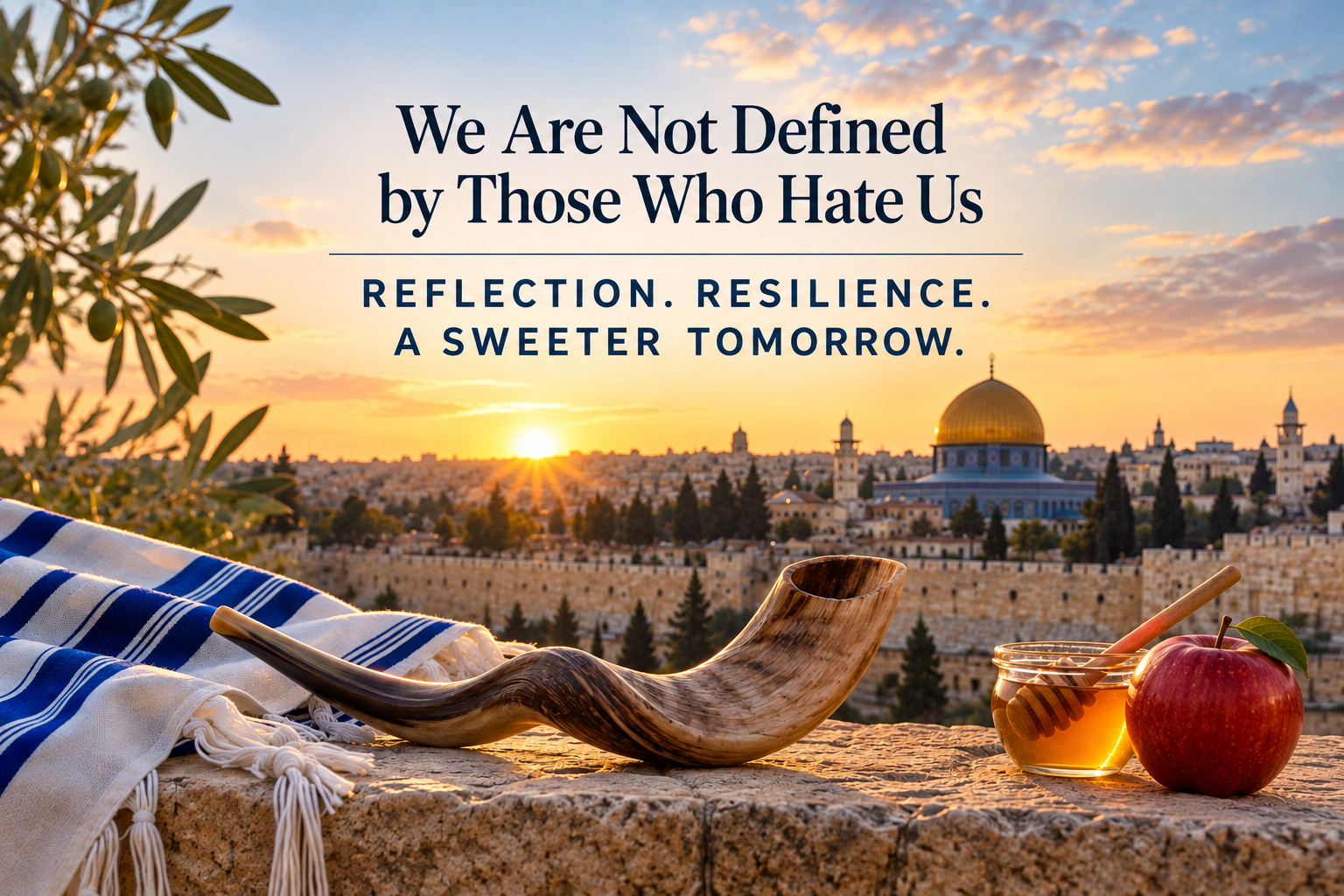
The Jewish High Holy Days ask us to do something unusual: look backward and forward at the same time. We reflect on the year that has passed, but we also ask what kind of people we want to be in the year ahead.
This year, looking backward is especially difficult.
Nearly three years have passed since October 7, a day that forever changed Israel and Jews throughout the world. We remember those who were murdered, the families whose lives were shattered, those who endured captivity and finally returned home, the families of those who did not return alive, and the extraordinary sacrifices made by the people of Israel.
Much has changed since then. The large-scale phase of the war in Gaza has ended, but peace and security have not fully arrived. Violence continues, the wounds of war remain deep, and Israel’s quest for a secure and peaceful future remains unfinished.
Iran has moved dramatically to center stage. Direct warfare involving Iran, Israel, and the United States reminded us that Israel faces a powerful regime that has repeatedly threatened its existence. Iran’s nuclear ambitions remain unresolved, and its support for terrorist proxies continues.
And throughout the world, October 7 was followed by a resurgence of antisemitism on a scale that shocked many Jews.
We have watched ancient hatred reappear in modern forms, in our streets, on social media, in our institutions, and on college campuses. Too often, legitimate criticism of Israeli policies has crossed the line into anti-Zionism, intimidation of Jewish students, and hatred directed at Jews simply because they are Jews.
We must recognize these threats clearly. Jewish history teaches us the danger of complacency.
But Jewish history teaches us something else that is equally important:
We are not defined by those who hate us.
That may be one of the most important lessons for Jews to remember during these High Holy Days.
There is a danger that antisemitism can become so consuming that we allow those who hate us to occupy too much space in our Jewish identity. We count antisemitic incidents. We study campus protests. We watch what politicians say about Israel. We worry about whether our children and grandchildren will feel comfortable identifying publicly as Jews.
All of that vigilance is necessary. But if our Jewish identity becomes primarily a response to antisemitism, then, in a strange way, we have allowed antisemites to determine what it means for us to be Jewish.
Antisemitism is something that happens to Jews. Judaism is what Jews choose to be.
And Judaism is far larger, richer, and more joyous than hatred directed against us.
For thousands of years, when hatred has risen, Jews have responded not simply by retreating or hiding, but by embracing Judaism more deeply, with courage, pride, faith, family, community, learning, and an extraordinary commitment to life.
That should be our response again.
We should respond to antisemitism by becoming more knowledgeable and proud Jews. We should respond to efforts to delegitimize Israel by understanding and explaining Zionism rather than apologizing for it. We should respond to intimidation by strengthening Jewish communities and our relationships with people of goodwill. And we should respond to those who glorify death and destruction by reaffirming Judaism’s ancient commitment to life.
That does not mean ignoring danger. Quite the opposite. Resilience begins with understanding the environment in which we live.
My professional life has been spent in engineering, research, and innovation. Engineers think a great deal about resilience. A resilient system is not one that never experiences a shock or failure. Such a system does not exist. A resilient system anticipates shocks, withstands them, adapts to changed conditions, recovers, and continues to perform its essential functions.
The crucial point is that resilience is not simply survival. A resilient system adapts to a changed environment without losing its essential purpose.
By that measure, Jewish civilization may be one of history’s most extraordinary examples of resilience.
For more than three thousand years, kingdoms and empires have risen and fallen. Jews have been conquered, expelled, persecuted, attacked, and told repeatedly that we would disappear.
Yet here we are.
That survival was not accidental. Jews adapted without surrendering the essential elements of Jewish identity. We carried our traditions across continents. We rebuilt communities after expulsions and massacres. We preserved texts, rituals, memories, and values. We argued with one another, sometimes endlessly, but remained part of the same remarkable historical conversation.
And, after nearly two thousand years without sovereignty, the Jewish people rebuilt a state in our ancestral homeland.
That is resilience.
The lesson is particularly important for American Jews. We have experienced an extraordinary period of acceptance, freedom, accomplishment, and prosperity in the United States. America has allowed Jews to participate fully in national life while remaining proudly Jewish, an achievement almost without precedent in the long history of the Diaspora.
We should be profoundly grateful for that.
But gratitude should never become complacency.
October 7 and its aftermath reminded us that attitudes can change more quickly than we imagine. Institutions we believed would instinctively recognize antisemitism sometimes struggled even to define it. Jewish students at some universities discovered that acceptance could become conditional when Israel and Zionism entered the conversation.
The answer is not for Jews to withdraw from American life. Nor is it to regard everyone who criticizes Israel as an enemy. America remains our home, and we should continue to participate confidently and fully in its civic life while strengthening relationships with Americans of every background who share our commitment to pluralism, democracy, and religious freedom.
But neither should we hide who we are.
Our children and grandchildren should know not merely the history of antisemitism, but the history of Judaism. They should understand not merely why Israel needs defending, but why Israel exists and why the return of the Jewish people to their ancestral homeland is one of the most remarkable stories in human history.
They should inherit not simply our fears, but our confidence.
That is why the imagery of the High Holy Days seems particularly meaningful this year.
When we dip apples in honey, we express our hope for a sweet New Year. But sweetness is not something we simply wish for. It is something we help create through kindness, friendship, family, courage, generosity, learning, and community.
And when we hear the Tekiah Gedolah, the shofar’s great, final blast, perhaps we should hear something more than the conclusion of a familiar ritual.
We should hear the sound of Jewish resilience.
It is a sound that has echoed across thousands of years, through periods of extraordinary achievement and terrible persecution, through exile and return, through destruction and rebuilding.
Our generation has now been given its own test.
We cannot control all the forces around us. We cannot eliminate antisemitism. We cannot guarantee Israel’s security. We cannot know what challenges the coming years will bring.
But we can control how we respond.
We can remember without allowing memory to imprison us. We can remain vigilant without allowing fear to define us. We can defend ourselves without abandoning our values. We can strengthen Israel while strengthening Jewish life in America. And we can make sure that our children and grandchildren inherit a Judaism characterized not primarily by anxiety about those who hate us, but by pride in who we are.
For more than three thousand years, others have predicted our disappearance.
Yet here we are.
We remember. We endure. We rebuild. And we thrive.
That is the Jewish response to those who hate us.
And as we enter 5787, that is reason enough to believe in a sweet New Year.
Related Topics