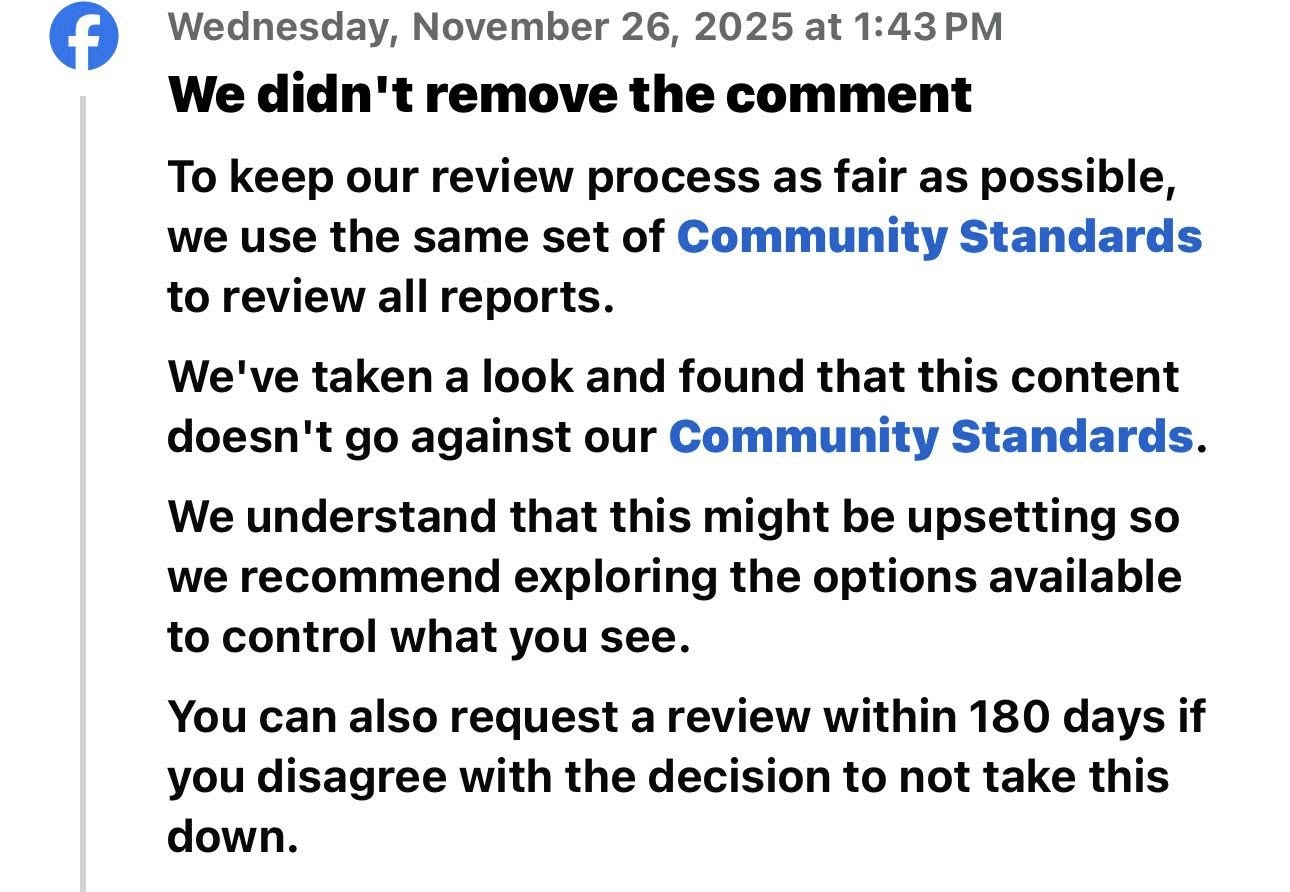
There is a sentence Jewish Facebook users have learned to recognize immediately. It arrives after reporting content that is openly antisemitic, violent in implication, or celebratory of Jewish hatred. It is always calm, procedural, and in most cases, final:
“We didn’t remove the post.”
Facebook insists that this language of hate does not violate their community standards. Jews reading it understand the real meaning instantly: this kind of speech is acceptable here.
It is important to state clearly what this is not about. Much of the content being allowed has nothing to do with Israel, Zionism, or any political debate whatsoever. This is not a disagreement over policy or ideology. A significant share of what remains online is classic, unambiguous Jew-hatred, the same old tropes and incitements, repackaged for modern platforms.
Consider the kinds of posts that have been reported, reviewed, and explicitly allowed to remain.
In one case, a commenter states plainly: “Anti-Semitism = peace.” There is no reference to Israel. No geopolitical framing. Just hatred of Jews presented as a moral good. The platform reviewed the report and found no violation.
In another, a user says “blessed Austrian painter was right” – a widely recognized euphemism for Adolf Hitler, chosen precisely because it signals Nazi glorification while attempting to evade filters. It was reviewed and left standing.
Elsewhere, users proudly declare that “being called antisemitic is a badge of honor,” while another asks, without irony, “What’s wrong with being antisemitic?” These are not critiques of Zionism. They are endorsements of Jew-hatred itself.
In another example, a slur is deployed as a barely disguised call to violence: “jill the kews.” The misspelling is intentional. The meaning is unmistakable. It was reported. It was reviewed. It was not removed.
Then there are images. A widely shared photo shows students arranging themselves into a human swastika on a football field. The symbol predates the State of Israel by decades and has nothing to do with Middle Eastern politics. The comments beneath it include praise, minimization, and mockery of Jewish concern. These comments too were reviewed and allowed to remain.
Taken together, these examples establish something critical: this is not about over-policing anti-Zionism or silencing political speech. What is being tolerated is old-fashioned antisemitism – Nazi symbolism, slurs, glorification of genocide, and explicit pride in hating Jews.
It is also important to be explicit about the technology. This is not a limitation of artificial intelligence. Modern AI systems are fully capable of identifying hate speech, euphemistic Nazi references, coded slurs, and calls to violence – especially when they are this direct. Platforms already rely on such systems to moderate other forms of hate, extremist content, and brand-sensitive material. When antisemitic content remains online, it is not because AI cannot recognize it. It is because enforcement thresholds and policy choices allow it to stay.
At the same time, Jews who respond emotionally or forcefully often see their own comments removed, their reach restricted, or their accounts penalized. The resulting message is hard to miss: hating Jews is tolerated; objecting to that hatred is risky.
Users are then advised to manage their own experience. Mute. Block. Scroll past. Control what you see. Responsibility is shifted onto the targets of abuse, as if antisemitism were merely an unpleasant viewpoint rather than a historically proven driver of violence.
History – and recent events – show where this leads. Jew hate does not remain rhetorical. It spreads, normalizes, and escalates. When institutions refuse to draw clear moral lines, they help create the conditions in which hatred becomes socially acceptable – and eventually actionable.
“We didn’t remove the post” is not a neutral statement. It is a decision. A decision to leave Jew-hatred visible, validated, and emboldened. A decision to signal that even now, even after everything history has taught us, this still does not cross the line.
The line, it seems, is reserved for us.