We Have Been Here Before
The Green Party conference has voted to declare that Zionism is racism. The party adopted the motion on Simchat Torah. In 2023, October 7th fell on Simchat Torah, so for many Jews this week marked the anniversary of the attacks.
David Davidi-Brown [Almost everyone is wrong about Zionism and anti-Zionism, Prospect Magazine] and others have already talked about the challenges with the motion’s content. I want to look at what happened the last time a serious political body adopted these words.
Relatively universal condemnation for the motion has come from Jewish community leadership. From Progressive Judaism, the Chief Rabbi, the Board of Deputies and well beyond. The party’s press team has worked hard to insist that the policy targets an ideology and not Jews themselves. Party conference made their lives particularly difficult when it undercut that message. Delegates voted down an amendment stating that the motion should not be used to “pressure, proscribe or discipline members based on affiliation with Jewish community institutions”. A party with no intention of acting against its Jewish members would have accepted that wording without debate. By rejecting it, the Greens have left the door open, and members of synagogues, communal organisations and youth movements have every reason to ask what comes next.
But we don’t need to guess. Sadly, we have been here before. And History offers a fairly clear answer.
On 10 November 1975 the UN General Assembly adopted Resolution 3379, stating that Zionism is “a form of racism and racial discrimination”. The Assembly took sixteen years to revoke it.
In those 16 years, the resolution strengthened a formula that Soviet and Arab diplomacy had pushed since the late 1960s. Once the General Assembly had declared Zionism a form of racism, activists could present hostility to Jewish national identity as simply another form of admirable anti-racism. That framing outlived the 1991 repeal. It fed directly into the NGO Forum at Durban in 2001 and the Durban follow-up conferences, and antisemitism has dogged that process ever since.
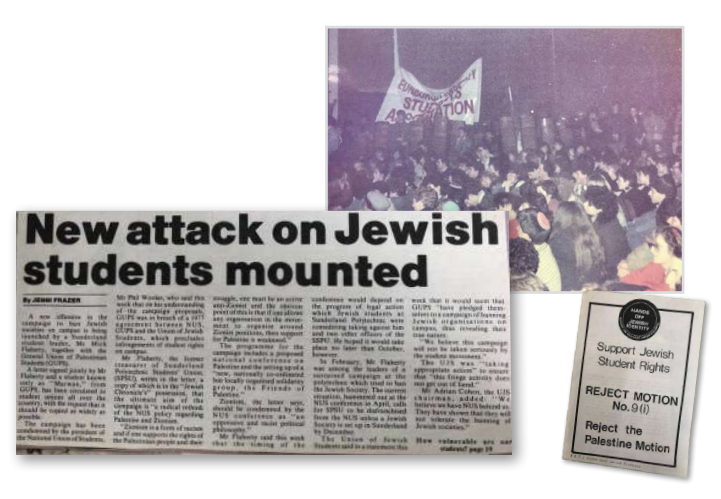
Jewish students felt the effect too. In the spring of 1977, eleven British student unions passed motions equating Zionism with racism. Salford banned Zionist meetings and stopped the Jewish Society running a bookstall. At York, the union declared the Jewish Society “not Zionist”. When the society rewrote its constitution to say it was, the union struck it off the register until the university forced a reversal. In 1985, more than a thousand students at Sunderland Polytechnic attended the general meeting that banned the Jewish Society for supporting Israel.
The same pattern travelled across the Commonwealth. In 1982 Ontario’s provincial student body declared Zionism to be racism and refused to admit Jewish student groups, and Ottawa University’s student federation tried to stop the Jewish students’ organisation meeting on campus. In Quebec, an anti-racism coalition led by the head of the provincial teachers’ union told a Jewish group it could join only if it renounced Zionism. In Australia, Jewish students spent 1974 and 1975 fighting anti-Israel motions in their own national union, and won a national student vote against them. Working with Jewish communities across the Commonwealth today, I see how quickly language adopted in one country turns up in another, actions from one Government are replicated by others.
As with other dark moments in Jewish history, 1975 also brought a silver lining. The resolution united the diaspora to a degree not seen since 1967. Chaim Herzog tore up the text at the podium and reminded the Assembly that the vote fell on the anniversary of Kristallnacht. Around 100,000 people rallied in New York the next day, and communities in Britain, Canada, Australia and South Africa held protests and solidarity events. Many Jews who had held Zionism loosely before 1975 were pushed closer to it, “owning” it in a way they would never have before.
A party conference carries nowhere near the weight of the UN General Assembly. It does not need it. Resolution 3379 did its damage by handing a respectable label to people who already wanted Zionists, and with them most Jews, out of progressive spaces. The student unions in Salford, York and Sunderland acted on their own initiative and used the UN’s words as cover. A growing party with councillors, MPs and a large young membership can provide the same cover in council chambers, trade union branches and on campus. The rejected amendment shows that the party considered this risk and chose simply to ignore it.
Jewish institutions have responded with a unity similar to 1975, and that matters. The next step belongs to Green members and leaders who say this policy has nothing to do with Jews. They can “prove” it by adopting the protection their conference refused. It won’t change the fact that the majority of the Jewish community will disagree with the very premise of the motion, indeed with the (I would argue false) definition of Zionism that have used to justify it. But until they at least recognise the hurt and adopt the protection afforded by that amendment, there is no basis to that claim. This is a party with aspirations of genuine leadership, over 1,300 local councillors and lead 21 councils – 3 of their London councils have sizeable Jewish communities – has a duty of clarity for British Jews and beyond.
In 1975 it took the world sixteen years to undo three words. I would rather the Greens didn’t make us wait that long.