
We helped build Nick Fuentes. Here’s how we can take him down
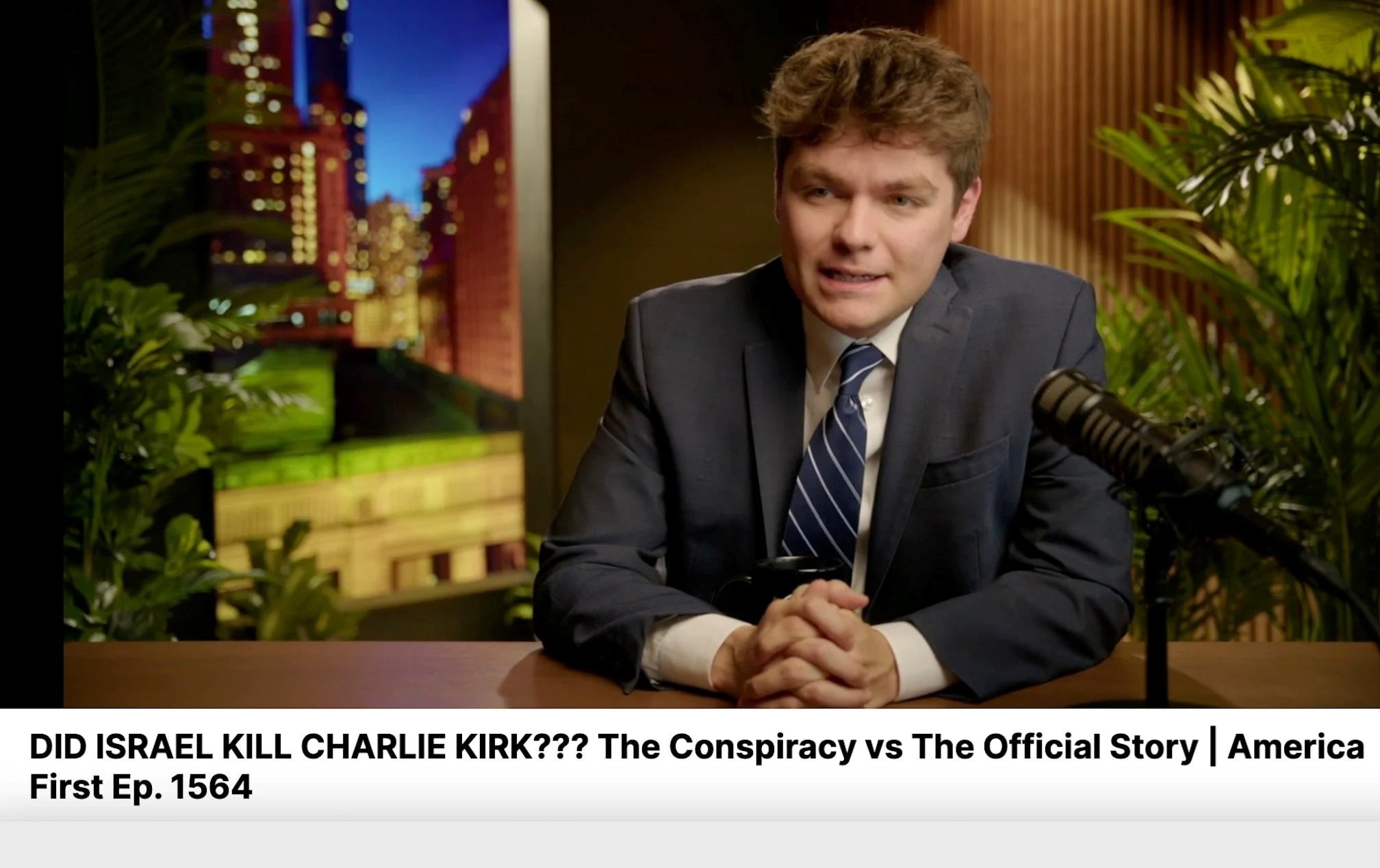
If you listen closely to right-wing influencer Nick Fuentes describe his political journey, you hear a story built on one central grievance. In his own words, he has explained that his rise is not about economics, culture, or foreign policy. It is about Zionists and Jews “canceling” him for refusing to prioritize Israel within the conservative movement. The truth of his assertion isn’t what matters. What matters is that he believes it, and millions of young people now believe it, too.
For years, many insisted that anti-Jewish sentiment was a fringe phenomenon. Fuentes shows how wrong that assumption was. His voice, his platforms with over one million followers on X and hundreds of thousands of viewers on his Rumble livestreams, and his willingness to say what others keep private reflect something larger and more dangerous emerging within the youth culture of the American right.
There is a power struggle unfolding in conservative politics. Charlie Kirk’s influence has waned, Trump’s second term will be his last, and figures like Ted Cruz and JD Vance are jockeying for position. At the same time, a far more important battle is raging, and it’s not happening on a debate stage or in the corridors of Congress. It’s happening at the vast grassroots level of the blogosphere and social media-centered world, where millions, particularly young men, are forming the value system and worldview that will drive their votes, their view of neighbors and strangers alike, and, most importantly, how they act.
This is precisely where Fuentes matters most. He is not just a provocateur. He is a mirror.
A cultural shift long in the making
The war of October 7th did not create the antisemitic sentiments he champions, but it did give him and countless others permission to publicly assert their views and unabashedly recruit others to join their cause. Their disdain for Jews and hatred for Israel and all things Zionist grew from the soil of resentment that has nothing to do with any Israeli policies and everything to do with how young Americans now perceive power, identity, and loyalty.
Bari Weiss, CEO of the Free Press, recently observed that what happens online, especially within progressive spaces, tends to appear in the real world a decade later. The same is now true on the right. The memes, jokes, grievances, and conspiracies circulating on anonymous message boards over the last decade have finally spilled into mainstream consciousness.
Fuentes is not an aberration. He is a preview.
How the fight against antisemitism failed to adapt
For two decades, institutions poured time and money into employing familiar tools to fight antisemitism: condemnations, highlighting moral outrage, and public shaming. Yet these tools increasingly backfired. Instead of marginalizing hateful ideas, they created the perception that Jews rely on censorship rather than persuasion. This perception became central to the worldview of people like Fuentes.
There is a painful possibility we must confront. The fight against antisemitism, as it has been traditionally waged, may have done more to entrench resentment and Jew hatred than to reduce it.
If we want to be in a stronger position 20 years from now, we cannot keep reading from a playbook written for a different era.
Theory of change
The Jewish organizational landscape operates from within an overwhelmingly top-down structure.
Most of the largest Jewish institutions focus on influence at the policy, lawmaker, and elite leadership levels. This critical work matters and is absolutely necessary, yet when one looks at where the overwhelming majority of funding goes, the imbalance becomes impossible to ignore.
Conservatively, the Jewish world spends between $700 million and $1.2 billion per year on top-down advocacy, including lobbying, institutional diplomacy, legal defense, and elite-facing influence. By contrast, bottom-up, grassroots, and youth-driven advocacy efforts collectively receive roughly $30 to $70 million per year.
That is a 20-to-1 funding gap.
Hundreds of millions of dollars are invested in shaping outcomes at the top, while a small fraction is allocated to shaping culture, identity, and values at the base. Bottom-up movements are treated as secondary, experimental, or optional
Lasting cultural and political shifts only occur when top-down leadership is met by bottom-up momentum. Today, in the Jewish world, that bottom-up force largely does not exist at scale, and the former approach is no longer viable.
Grassroots organizing has never been our native strength. It does not fit neatly into traditional institutional models, so it has been underfunded, underdeveloped, and often ignored.
If we want real change, we cannot fight with only half the battlefield. Top-down influence without bottom-up power is fragile. Bottom-up energy without structure dissipates.
Positive alternatives, not weaponized accusations
We need a fundamentally different strategy, one that doesn’t rely on policing speech but on reshaping culture.
We need spaces where real conversations can happen, where Jews and non-Jews can talk honestly about identity, history, power, and the modern reality of Israel. We need to stop responding with outrage and start offering compelling alternatives that young people actually want to be part of.
A generation is searching for meaning, belonging, courage, and clarity. If the only people speaking their language are extremists, we should not be surprised when they listen.
What’s missing is not awareness. It is infrastructure.
A new way forward
Fuentes is dangerous. His worldview is dangerous. But the most dangerous thing of all is the truth he reflects: young Americans have changed, are continuing to change and morph, and we are out of sync and have been left behind.
If we continue fighting this cultural battle with the tools of the past, we will lose the future. If we build new models rooted in confidence, openness, Jewish pride, and cultural relevance, we can begin to shape the conversation and shift the tide.
The coming decade will not be shaped by the loudest voices in Washington, but by the ideas taking hold among young Americans today. The question is not whether those ideas will change because they already have.
The question is whether we will meet this moment with bold new thinking of our own, or not.