
We Need a Carrot for Peace, Not Just the Stick
Israelis typically pride themselves on the country’s capacity to defend and deter our enemies. You often hear it in speeches from the political echelon, applauding our military’s ability to fight off enemies, gather intelligence against them, and strike a devastating blow. They aren’t wrong, from infiltrating pagers that handicapped (literally and figuratively) the leadership of Hezbollah to pulling off a targeted strike on the leader of the Islamic Republic of Iran.
Israel’s posture in the Middle East is tipped toward wielding the proverbial stick over carrots. And this path may be the only option with some of its neighbors, especially in the case of Iran where ideological opposition to the state of Israel and the United States is in the very fabric of its founding since the 1979 revolution. But Israel has a lot more neighbors than Iran alone, many of whom have proven to be valuable allies in shooting down ballistic missiles and calling out Iran in global diplomacy.
However, it seems the state doesn’t pay nearly as much attention to its friends as it does to its foes. If Israel’s goal is truly peace and stability in a Jewish state, then it’s time to start employing more carrots, not just the stick.
Carrots have worked, and continue to work to this day. Egypt got one of the biggest carrots with the return of the oil-rich Sinai peninsula, becoming the first Arab state to formally recognize Israel and has maintained relatively good relations since. Jordan signed a peace treaty with Israel in 1994 and receives a yearly allotment of Israeli water, thanks in part to Israel’s investments in resilient infrastructure. In return, Jordan has shot down Iranian ballistic missiles bound for Israel and hosts US bases that are critical in the fight against Iran. In order to get more Gulf States, and especially Saudi Arabia, to coordinate for stability, Israel needs to offer them a carrot too.
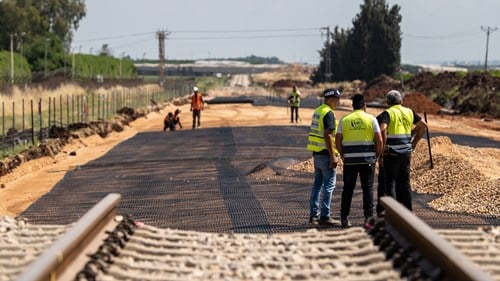
In fact, the state, and Benjamin Netanyahu, already know we need a big carrot and what that carrot should be. They have been speaking about laying the tracks to peace with Gulf neighbors for years. These tracks in particular are a railway to Eilat, a city sitting at a point of major geopolitical importance. The government has offered a plan to build a rail line to Eilat at least three times: 2003, 2012, and 2023.
It has been over twenty years of talk without a single spike in the ground or concrete plan drafted. Netanyahu’s last proposal, the ‘One Israel Project’, would have been a massive investment to the tune of $27 billion. It promised to bring huge economic benefits to the country, connecting the north and south to the center of the country, where the majority of economic activity takes place, with high-speed rail and act as both a freight and passenger system. The plan was announced following a US official visit to Saudi Arabia to advance a possible forging of formal relations with Israel, timing that was not merely a coincidence.
This would have connected Eilat, and more importantly, its port on the Red Sea, to the Mediterranean to open a new global shipping route. Moreover, it could have given the Gulf countries a critical alternative to get the oil they pump to global markets, especially as the Strait of Hormuz remains effectively blocked.
Gulf states are already aggressively investing in alternatives, building out new pipelines, railways, ports, and storage in other parts of the world in order to ensure they can continue selling their oil and simultaneously eroding Iran’s leverage over the region in the long term. On top of that, there is already an understanding that the Strait of Hormuz will never carry the same share of oil as it did before the war, and no country wants to rely as heavily on this vulnerable choke point. So why isn’t the Israeli government stepping up to become a part of the solution?
One rail line won’t be a silver bullet to open new peace agreements, but it can be a powerful incentive to reinforce relationships forged in the Abraham Accords. The Saudis have been abundantly consistent that normalization of relations with Israel will only come with a Palestinian state. But given the dire effect the war is wreaking on the Saudi economy that remains heavily reliant on its oil, a connection to global markets could have tipped the scale to formalize peace with Israel. If this rail line existed today, it’s doubtful that the Crown Prince of Saudi Arabia would stick to the narrative of Palestinian solidarity at the cost of his own economy.
Clearly, there’s no railway to dangle as a carrot of peace at the moment, but even concrete steps toward that goal would be seen favorably in the region as other states work on massive, multi-year infrastructure projects to create a lasting alternative to the Strait of Hormuz. The best time to act was back in 2003, but with an election coming up it is timely to remind voters what the Prime Minister promised to fulfill, and advocate for him or any other politician to pick up the mantle of this behemoth project to lay the tracks to peace in the region. It’s time for Israel to get back to the carrots that worked so well for us in the past.