
Founder of The Ninth Candle
Featured Post
In these dark days, remembrance is not enough
When US democracy was strong, International Holocaust Remembrance Day was just a reminder of past atrocities. Times have changed
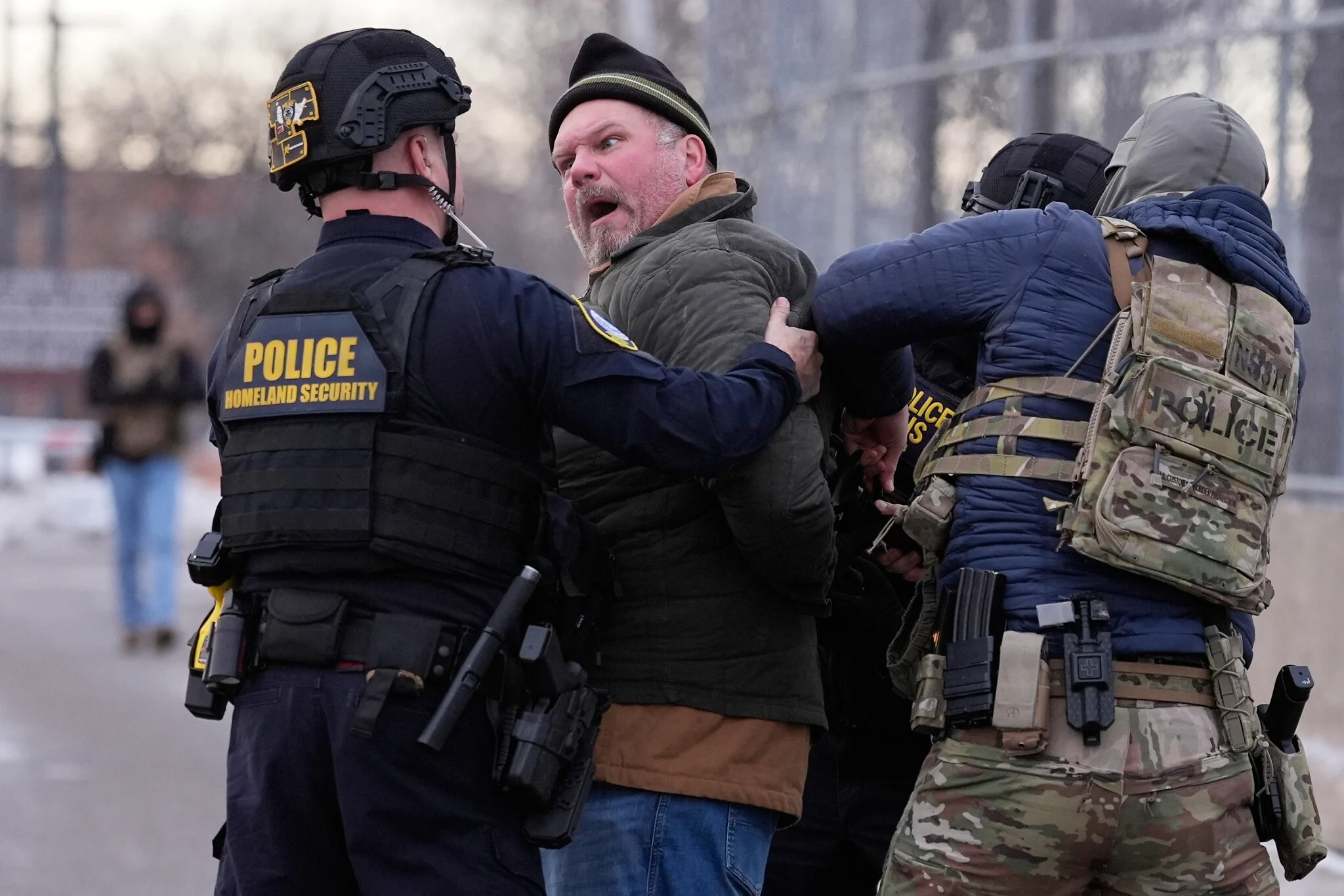
Law enforcement detain a man outside the Bishop Henry Whipple Federal Building during a protest on Saturday, Jan. 17, 2026, in Minneapolis. (AP Photo/Yuki Iwamura)
International Holocaust Remembrance Day was observed for the first time on January 27th, 2006. Its goals were clear. It was meant to “pay tribute” to the Nazis’ victims, principally the six million Jews murdered in Europe between 1941 and 1945. In paying that tribute, it would keep us “vigilant for new outbreaks of antisemitism and other forms of intolerance” in the future.
When democracy held strong in the United States, these goals felt attainable. International Holocaust Remembrance Day invited us to look back on a terrible past and express gratitude for the hard-won stability of the present. It also invited us to renew the solemn promise that we made after 1945 to never allow such a disaster to happen again.
Since 2006, though, the United States has shifted to the far right. As is always the case for a country undergoing such a shift, the driving force is a myth about a glorious lost past that must be restored. And, as is always the case, the use of excessive violence has become normal in law enforcement, the pursuit of knowledge and the pursuit of science have both come under attack, and our leaders have expressed imperialist ambitions to conquer foreign lands.
But perhaps the most alarming indication of our shift to the far right is the normalization of hatred in everyday life. Since January 2025, antisemitism, homophobia, misogyny, racism, and transphobia have all become routine. Jewish Americans have been brutally assaulted in the streets, arsonists have set synagogues ablaze, and President Trump’s government has ordered universities to create lists of Jewish staff, allegedly for their own protection. Schools are increasingly unsafe places for LGBTQ students. Women’s rights have been rolled back by decades. Federal diversity, equity, and inclusion programs have been terminated, which has poured new fuel onto discrimination against people of color. The list goes on.
These circumstances have put the original goals of International Holocaust Remembrance Day so far out of reach that we must rethink the Day itself.
Right now, the only way to pay tribute to the past is to condemn the ongoing dismantling of American democracy in its name. Anything less would leave the Day as little more than an empty spectacle – a spectacle that falsely assures us of our own safety and enlightenment.
Perhaps the need to rethink International Holocaust Remembrance Day shouldn’t come as a surprise. Historians have expressed misgivings about the ways that we remember and teach the Holocaust for decades.
Professor Peter Novick argued that museums portrayed Jewish suffering as a path to wisdom in ways that mirrored Christian ideas about martyrdom – and that this crushed Jews into American culture by “Christianizing” them. Professor David Cesarani warned against overreliance on survivor stories, fearing that we may end up misrepresenting the Holocaust as something that was fundamentally survivable. Professor Tim Cole said that we were superimposing self-congratulatory meanings for the present onto a past that was defined by its brutal meaninglessness.
Arguments like these have sometimes been criticized as eggheaded or curmudgeonly, or both. But maybe there’s something to them. After all, everything that Holocaust education has done to try and prevent the rise of far-right extremism this century has failed.
This year, instead of a day of remembrance, what we need is a day of action. A day in which we honor the past by coming together to instigate meaningful change in the here and now, if only on our street or on our block. After years of studying and writing about Nazism and the Holocaust, I’ve realized that change is only ever partially made by the lone acts of heroism that get played and replayed in the movies. For the most part, it relies on enough everyday folks resolving to do something to make the world a slightly better place – no matter how small their actions, and regardless of whether their stories will ever be told.
Related Topics
Related Posts