We Prefer the Jews Dead: The Obscenity at the Heart of Yom HaShoah
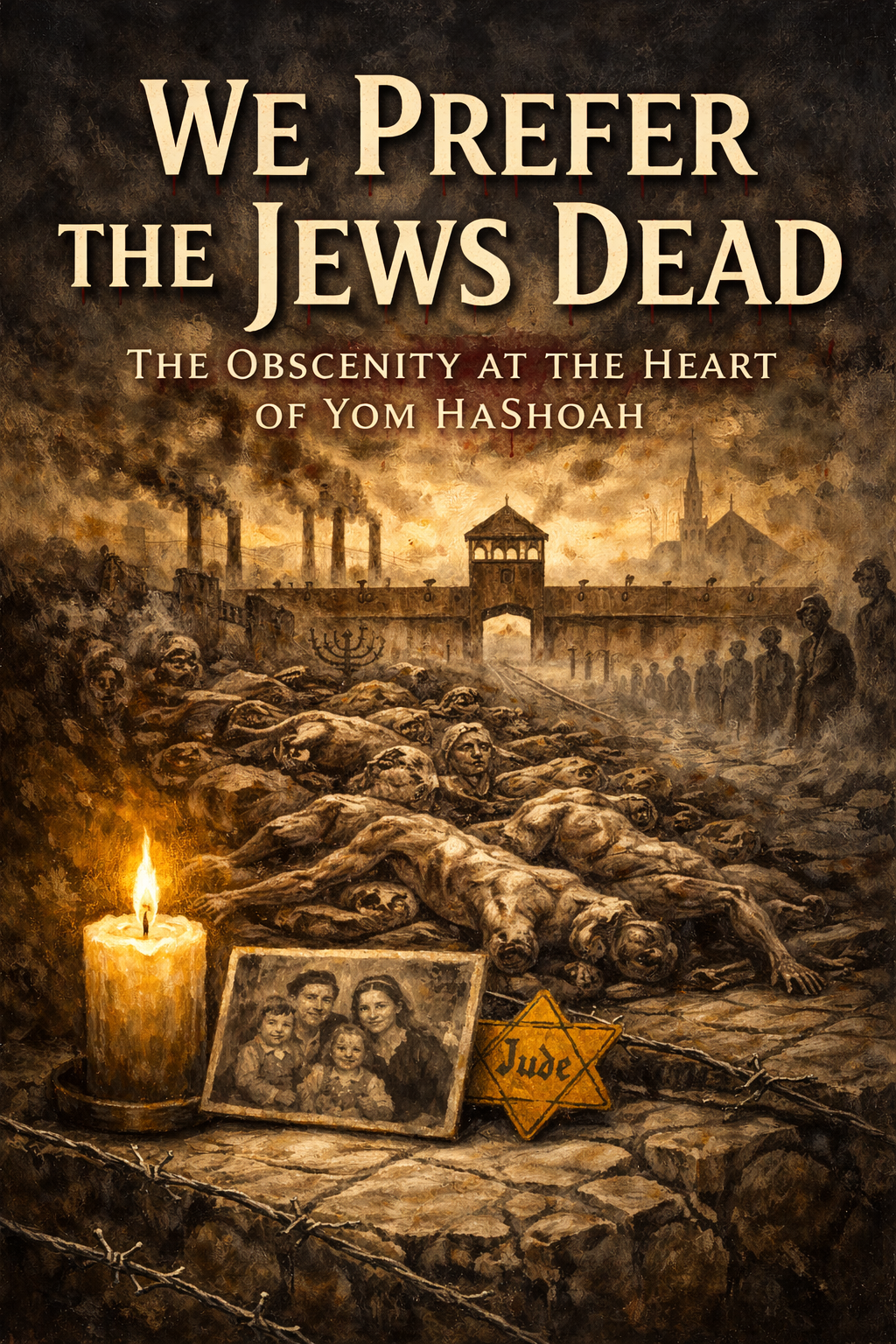
There is one aspect of Yom HaShoah that polite society almost never touches, because it is indecent, because it is awkward, and because it ruins the choreography of our annual pieties.
It is this: we prefer the Jews dead.
Not all Jews, not all the time, of course. But we have developed a distinct taste for the safe, silent, posthumous Jew – the Jew of candlelit ceremonies, of trembling violin music over archival footage, of school trips to camps that smell of disinfected history. We are intensely moved by Jews in black‑and‑white. We are far less comfortable with Jews in color, who insist on being alive, armed, opinionated and unwilling to die on cue.
That is the angle you almost never hear on Yom HaShoah: the monstrous transaction in which dead Jews are adored while living Jews are interrogated. The way we have built a culture that can cry at Schindler’s List on Sunday and then, on Monday, mutter darkly about Israel being “a mistake” or “an experiment whose time has passed.”
We love the Jew who cannot answer back.
Look at our public ritual. On Yom HaShoah, dignitaries place wreaths with tragic faces honed by years of media training. Heads of state shuffle through Auschwitz in scarves and overcoats, nodding gravely at the piles of shoes they will later mention in speeches crafted by advisers. They speak of “the darkest chapter”, of “unthinkable evil”, and – always – of “lessons learned”.
Then, having completed this compulsory séance, they return to capitals where living Jews are instructed that their only state is uniquely illegitimate, uniquely provocative, uniquely to blame for the unhappiness of its neighbours. The same mouths that say “Never again” in the morning will, in the afternoon, explain that Jews must show more “restraint” when attacked, that their sovereignty is negotiable, that their capital is a provocation, that their very existence is a “complication”.
We now inhabit a moral universe where Anne Frank has more friends than the State of Israel. The dead girl in the attic is universally loved; the actual Jew with a passport, an army, and a country is regarded as a nuisance, a problem to be managed.
This, then, is the unspoken obscenity of Yom HaShoah: the way it allows the non‑Jewish world to congratulate itself on having mastered antisemitism in its most photogenic form, while indulging it in its modern one.
The Shoah has been turned into a sort of moral Disneyland. You go in, you queue for the exhibits of horror, you emerge shaken and uplifted, conveniently forgetting that every frame of that newsreel has a sequel, and that the sequel wears an Israeli uniform or walks past a London synagogue under police protection. We have separated the Jewish corpse from the Jewish citizen and declared unconditional love for the former and conditional tolerance for the latter.
In this arrangement, Yom HaShoah performs a very specific service. It provides a cheap absolution. Once a year, the West proves its virtue by remembering six million dead; the remaining sixteen million living can then be judged, scolded and, if need be, abandoned with a clear conscience.
There is a line that should chill the blood: “They hate us when we are weak and despise us when we are strong.” It captures perfectly the contempt in which Jews are held at both ends of the spectrum. For centuries, the Jew was derided as the pale, bookish, defenceless outsider – a parasite on nations, a wanderer, an object of pity or contempt. When, after the greatest massacre in its history, this same people decided that it might be time to acquire tanks, aircraft and a sliver of land where it would not have to ask anyone’s permission to exist, the charge sheet flipped but the verdict did not.
Now the Jew is too strong. Too assertive. Too national, too armed, too capable of doing to others what was once done to him. The defenceless Jew was unbearable; the defended Jew is intolerable.
So we arrive at the perverse ideal of much of modern opinion: the Jew as eternal victim. Bleeding, but not too much. Dead, but instructive. Suffering, but edifying. We like our Jews with violin music and barbed wire, not with F‑16s and border fences.
Yom HaShoah, if it were honest, would force us to look at this preference and admit what it says about us.
Consider the survivors. The men and women still walking among us with numbers on their arms are treated as portable scenery for our remorse. We wheel them out for ceremonies, applaud them on cue, wipe away a tasteful tear and then—having used them as a sort of moral air freshener—send them back to their retirement homes. Yet many of these people will tell you, very clearly, that the most important word in “Never again” is not “Never”. It is “Again”.
They know that the only barrier between Auschwitz and Again is power: the prosaic, unromantic ability to say “no” and make it stick. A border, a siren, an interceptor missile, a soldier at a checkpoint. They understand, with a clarity we prefer not to share, that memorials do nothing against men with knives, and that no murderer has ever been deterred by the existence of a museum.
The angle about Yom HaShoah that has not been written enough is that its central message is not “Be sad”. It is “Accept what it means that the Jews are alive, armed and home.”
This means you do not get to treat Israel as a sort of optional extra, an unfortunate political side effect of a tragedy you otherwise find very moving. You do not get the dead Jews without the Jewish state. You do not get the moral glow without the iron dome.
To honour Yom HaShoah while denying Israel the right to exist securely is like weeping over a man’s bruises while insisting he has no right to learn to box.
And here is where the heartache ought to begin.
Because when crowds in London, Paris, New York – cities that consider themselves enlightened – march unashamedly under banners calling for the abolition of the only Jewish state, they are not merely “criticising policy”. They are offering a horrifying answer to the question posed by Yom HaShoah: “If the Jews come back with a flag and an army, will you accept them?”
The answer, increasingly, is: only if they are quiet, compliant, and wrong.
They must bleed decorously. They must not respond too forcefully when attacked. They must live within borders that make them strategically vulnerable. They must accept lectures from countries whose last experiment in dealing with Jews ended in chimneys. They must forever apologise for existing in the first place.
The old antisemite said: “You have no right to live among us as Jews.” The new version says: “You have no right to live among yourselves as Jews.” The first rejected Jews as neighbours; the second rejects them as a nation. The melody is different. The tune is the same.
So let us strip Yom HaShoah of its string section and ask the question properly.
When we say “Never again”, do we mean it enough to accept Jewish strength? Jewish borders? Jewish soldiers who do not obligingly die? Do we mean it enough to endure the discomfort of a people that refuses to be only a moral lesson, and insists on being, God help us, normal – with elections, scandals, mistakes and, yes, wars?
Or is “Never again” simply the polite way of saying: “Never again like that – next time, do try to keep it off camera”?
The heart‑rending truth is that for all our ceremonies, the world has not quite decided whether it prefers the Jew as victim or as equal. And until it does, Yom HaShoah will remain what it has become: an annual test we keep failing.
If you want to know whether a society has understood the Shoah, do not look at its memorials. Look at its streets when a synagogue needs guarding. Look at its newspapers when Israel buries its dead. Look at how quickly the sympathy congeals into irritation, how rapidly the wreath turns into a wagging finger.
Yom HaShoah is not asking us to feel more. It is asking us to choose. Between a world that keeps Jews safely embalmed in memory, and a world that accepts them, at last, as a people with the unremarkable, scandalous right to live and to defend themselves.
We have cried enough over Jewish corpses. The question – the only question that matters now – is whether we can bring ourselves to stand, even once, without flinching, beside the living Jew who refuses to join them.