‘We Protest’: Courageous Voices Against Art Theft
‘We Protest This Theft’: The Courageous Appeals of Holocaust Victims Against Hungary’s Cultural Plunder, 1944
By: Jonathan H. Schwartz
 In the shadow of Auschwitz, as Hungarian Jews faced mass deportation in 1944, a quieter but no less devastating atrocity unfolded: the systematic looting of their cultural heritage. Newly unearthed archival documents from Hungarian government microfilm reels 143, 144, and 145—preserved by the late Holocaust scholar Randolph L. Braham at the Zekelman Holocaust Center, and translated over a decade by survivor and researcher Clara Garbon-Radnoti—reveal a powerful yet overlooked form of resistance. Jewish victims, under the shadow of persecution, lodged formal, written appeals to reclaim their stolen possessions, meticulously documenting their losses and naming the Hungarian institutions complicit in this theft. Analyzed by our team at the Holocaust Art Recovery Initiative using advanced digitization and AI, these archives expose not only the scale of cultural devastation but also the indomitable spirit of those who dared to demand justice.
These eyewitness appeals—meticulously recorded yet callously ignored—stand as a testament to Jewish resilience. Families like the Herzogs and the Knorrs cataloged stolen artworks, rare books, and heirlooms, appealing to authorities with a courage that defied the gallows of genocide. Their protests illuminate the profound cultural loss inflicted and the institutional machinery that perpetuated it, from local museums to Budapest’s grandest galleries.
Verified Archival Cases of Resistance
The Knorr Family’s Library Plea (Reel 143, Slides 41–45)
In May 1944, Knorr Istvánné of Gyoma reported the seizure of her family’s 9,000-volume library—containing rare incunabula and printing history treasures—to Hungarian authorities, requesting state protection. Dr. Pitz József, director of the National Széchényi Library, evaluated the collection and facilitated its transfer, while Dr. Dénes Csánky, the government commissioner, dispatched Dr. Bándy Vilmos to secure it. Despite this formal appeal, the library was confiscated and absorbed into state custody, its cultural value exploited under the guise of preservation.
Dr. Delmár Emil’s Desperate Appeal (Reel 143, Slides 36–40)
Dr. Delmár Emil, a Jewish collector interned in the U.S., had exported 60 industrial and fine art objects to Bern in 1938 for exhibition. In 1944, Hungarian authorities revoked his ownership under anti-Jewish laws, demanding their seizure via embassy coordination. His legal representative, Dr. Pázsit István, submitted lengthy petitions citing wartime disruptions and Delmár’s cultural contributions, yet these appeals were dismissed, and the collection was targeted for confiscation.
Mrs. Sándor Sváb’s Recorded Seizure (Reel 143, Slides 56–57)
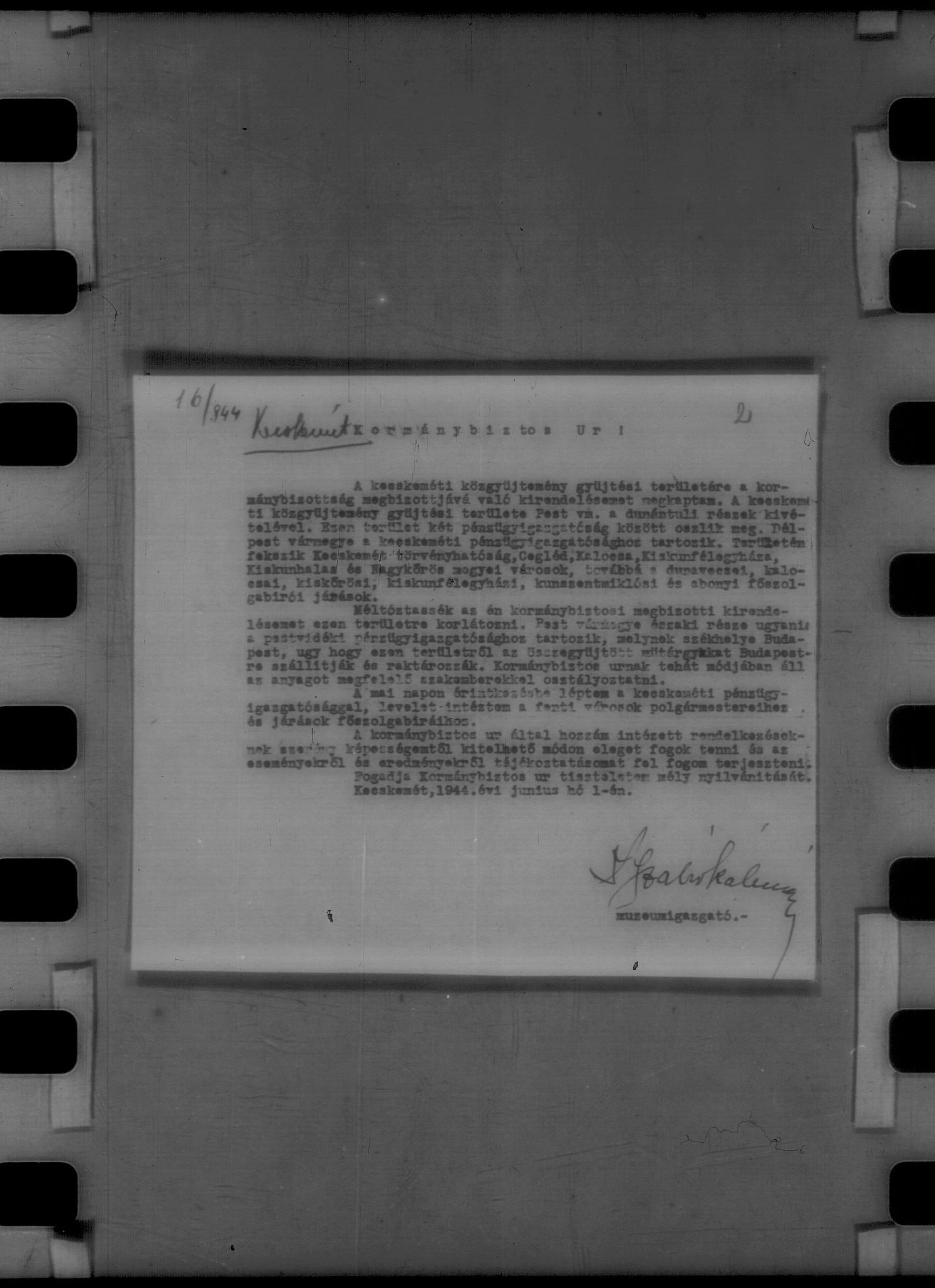
On June 1, 1944, the museum director in Kecskemét reported the seizure of artworks from Mrs. Sándor Sváb’s home, transferred for “safekeeping” under government regulations, with ownership explicitly noted (Reel 143, Slide 56). On June 3, 1944, the government commissioner acknowledged this action under Decree 1830/1944 M.E., requesting careful record-keeping (Reel 143, Slide 57). Despite formal documentation of this seizure, no restitution followed, reflecting state complicity.
Fränk Ede’s Contested Seizure (Reel 143, Slides 71–80)
In November 1942, Fränk Ede of Nagyszombat challenged the judicial seizure of his 60+ items—artworks, furniture, and antiques valued at 20,805 pengő—documented by judicial executor Tóth Artur and appraiser Bard Mihály. His objections to valuations were noted, but the Royal District Court upheld the expropriation, transferring his cultural treasures into state hands.
Wolfner Gyula’s Recorded Protest (Reel 143, Slides 86–90)
Wolfner Gyula of Budapest documented the seizure of his tapestries, gobelins, and oriental carpets (valued at 3,500 pengő) by the Ministry of Finance, with the Museum of Fine Arts (Szépművészeti Múzeum) acknowledging receipt. His appeals, preserved in government correspondence, were ignored, cementing the museum’s role in this plunder.
The Herzog Family’s Lost Legacy (Reel 145, Slides 471–530)
The internationally renowned Herzog family’s collection—featuring masterpieces by El Greco, Mihály Munkácsy, and Jan van Goyen—was seized from their Andrássy út 93 palace in 1944. Transferred to the Szépművészeti Múzeum, this cultural treasure trove was meticulously inventoried, yet no formal appeal or restitution effort altered its fate, reflecting the state’s deliberate erasure of Jewish ownership.
Institutional Complicity Unveiled
The archives expose a chilling bureaucracy. Reel 143, Slides 63–65, detail Ministry of Finance orders to secure silk, porcelain, silver, and paintings from Jewish homes, with police-escorted shipments to Budapest depots. Slides 66–70 reveal museum personnel, under Dr. Csánky’s direction, coordinating the intake of looted art into permanent collections. Reel 145, Slides 531–566, document Mikolay Ferenc’s inventories of Baja victims like Klein Emil and Bruck Árminné, with items destined for local museums. This was no rogue operation but a state-sanctioned machine, driven by decrees like 1830/1944 M.E., that stripped Jewish identity alongside their possessions.
A Survivor’s Legacy
Clara Garbon-Radnoti’s decade-long translation of these microfilms, preserved by Professor Braham, unlocked these silenced voices. Her work, now enhanced by our AI analysis, demands we confront this history. As she asserts, “We now know who took our cultural heritage. The question is: what will we do about it?”
Call to Action
These appeals compel urgent action under the proposed Holocaust Expropriated Art Recovery (HEAR) Act of 2025 and the Washington Principles:
- Legal: Courts must recognize these archival records as prima facie evidence, easing restitution claims by removing evidentiary barriers.
- Museums: Institutions like the Szépművészeti Múzeum must conduct provenance research and disclose Holocaust-era holdings.
- Legislative: Strengthen the HEAR Act with explicit archival standards to ensure accountability and justice.
The cries of the Knorrs, Delmárs, and Herzogs echo through these documents, a clarion call to restore their legacy. We owe them not just remembrance but restitution—justice carved from the stone of their stolen heritage.
Jonathan H. Schwartz is an attorney at Taft–Detroit, co-founder of the Jewish Bar Association of Michigan, and founder of the Holocaust Art Recovery Initiative. He collaborates with Holocaust survivor and researcher Clara Garbon-Radnoti to document and advocate for the restitution of Holocaust-era looted Jewish cultural property.
Verified Archival Citations (Endnotes)
- Hungarian archival microfilm, Reel 143, Slides 41–45 (Knorr Istvánné’s library seizure and appeal)..
- Hungarian archival microfilm, Reel 143, Slides 36–40 (Dr. Delmár Emil’s appeal and collection seizure).
- Hungarian archival microfilm, Reel 143, Slides 56–57 (Mrs. Sándor Sváb’s recorded seizure and documentation)
- Hungarian archival microfilm, Reel 143, Slides 71–80 (Fränk Ede’s contested seizure)
- Hungarian archival microfilm, Reel 143, Slides 86–90 (Wolfner Gyula’s documented protest)
- Hungarian archival microfilm, Reel 145, Slides 471–530 (Herzog family collection seizure)
- Hungarian archival microfilm, Reel 143, Slides 63–65 (Ministry of Finance transportation orders)
- Hungarian archival microfilm, Reel 143, Slides 66–70 (Museum oversight and intake coordination)
- Hungarian archival microfilm, Reel 145, Slides 531–566 (Mikolay Ferenc’s inventories in Baja)