
Where history exposes power and moral failure
Weaponized Canines: Dogs in the Concentration Camp System
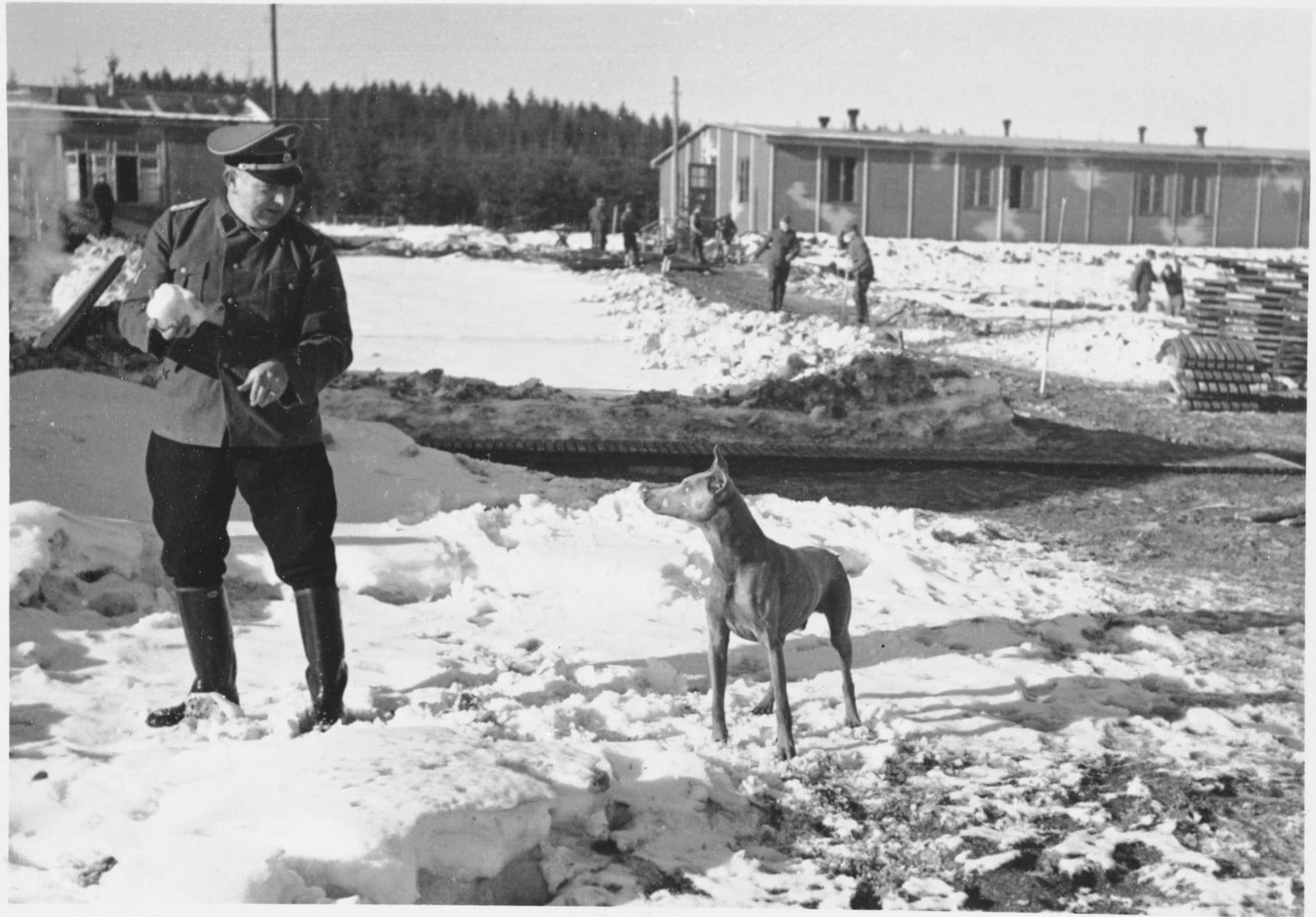
A Nazi official plays with his dog in the snow at Hinzert, a sub-camp of Buchenwald, while prisoners work in the background, 1937–1941. Used with permission. Photo credit: United States Holocaust Memorial Museum, courtesy of Robert A. Schmuhl. Photograph Number 23660.
White slaveholding Americans were neither the first nor the last to exploit dogs for the purposes of persecution. One of the most notorious examples in history of canine weaponry was the Nazi regime and its widespread adoration and use of German Shepherds.
It is impossible to pinpoint the exact moment at which these dogs became so emblematic of the regime. Even before his ascent to power, Adolf Hitler himself developed a fondness for the breed, beginning with a dog he owned whilst living in poverty who ran away from her boarding location to track down her master.
The dictator’s preference for German Shepherds continued throughout his life; his famous pet dog Blondi was frequently photographed with Hitler and even slept on his bed in the Berlin bunker where both of them died in 1945.
Of course, whatever Hitler did was emulated widely throughout the Third Reich, and thus German Shepherds became hugely popular pets among the German populace. The German attachment to the breed was not only borne of Hitler-worship, but also toed the line, conveyed through propaganda, that German Shepherds embodied the very core of Nazi ideology.
This particular breed had its kinship to wolves cited frequently as a badge of honour, and the visible wolf-like characteristics in individual specimens hearkened to the era of Teutonic greatness celebrated in the Third Reich in everything from Wagner’s operas to architecture.
German Shepherds were so popular during the Third Reich that an “animal language school” was founded with the goal of teaching these dogs, perceived to be particularly intelligent and loyal, to “speak” and to make communicative gestures.
The idea was that the German Shepherds could serve as guards during the “Final Solution” and communicate effectively with Nazis at the camps. The experimental programme failed, but it was supported by Hitler himself and reflected common mystical views on German Shepherds of the time.
As is common in racially stratified or colonial societies, the Nazis prioritized their anthropomorphized German Shepherds over their Jewish victims. Indeed, when Jews were rounded up in cities and crowded into ghettos with minimal personal possessions, the German citizenry was far more concerned about the welfare of the dogs left behind when Jews were made homeless than the welfare of the Jewish humans.
The Nazis’ exploitation of dogs, particularly German Shepherds, was not limited to personal affinity and family ownership of pets. Indeed, the most striking association the breed has with Nazism is the use of German Shepherds as weapons throughout the Holocaust.
During the era of the ghettos and their subsequent liquidation through the years of extermination in concentration camps, SS guards utilized dogs to terrorize and even murder Jews. The dichotomy between the domestic German Shepherd and the weaponised German Shepherd has seared itself into collective memory and has even been fictionalised for stage and screen.
One recent portrayal of the German Shepherd’s role in the Holocaust is a film called Shepherd: The Hero Dog. In the film, a Jewish boy is nearly unique in harboring a positive relationship with a German Shepherd, which were, by the 1930s, viewed as dogs upholding “Aryan values” and were anathema to most Jews.
The dog eventually winds up in the ownership of an SS officer, who uses the animal for the purposes of controlling and attacking Jews in a concentration camp. Though this film is fictional, and devoid of graphic violence to play to a younger audience, it reflects the multi-generational trauma endured by Jews, an association between this particular breed of dog and Nazi savagery.
Unfortunately, Nazi exploitation of dogs as agents of oppression was not at all fictitious.
In one notable example, notorious SS officer Amon Göth possessed two dogs at the Plaszow camp in Poland, both of which had been trained to viciously attack Jews on Göth’s command. According to survivors of the camp, the dogs, Rolf and Ralf, were utilized frequently to terrorize victims in sporadic attacks that sometimes occurred for no discernible offense.
The dogs tore the camp’s Jews to pieces, watched by horrified inmates, until Göth called the dogs away. Rolf and Ralf had a Jewish handler who was not spared Göth’s wrath; when Göth began to suspect the dogs liked the handler more than Göth himself, he murdered the man.
Speaking of her experience as a prisoner under Göth, who habitually menaced the prisoners at Plaszow with his dogs, survivor Helen Jonas-Rosensweig said, “We are all traumatized people… Never would I believe that any human would be capable of such horror, such atrocities.”
One survivor of Plaszow, Samuel Offen, was attacked by Göth’s dogs and viciously bitten, but Göth called the dogs off before they could kill Offen. Decades later, he still bore the physical scars of the dogs’ bites, a reminder of the trauma he endured at the hands of those who weaponised dogs during the Holocaust.
Many of Plaszow’s Jewish inmates were killed and maimed by Amon Göth’s dogs, but they were not the only dogs utilized at concentration camps.
Daniela Szelc, a Pole whose family was relocated to a home about a mile from the Auschwitz-Birkenau camp during her youth, recalled the horrific blend of sounds emanating from the site. “When the orchestra played and the people were screaming, the dogs were barking, it was like hell.”
The sound of guards’ dogs barking was often one of the first sensory experiences prisoners had upon arrival at concentration camps. Survivors of Auschwitz-Birkenau describe chaos upon unloading the infamous Holocaust trains, with guards shouting orders in German, an overwhelming stench, and the incessant barking of aggressive dogs.
One female guard at Bergen-Belsen, who was later hanged for her crimes, was Juana Bormann, known as “the woman with the dogs.” Feared and notorious for her cruelty against the camp’s prisoners, Bormann was frequently seen with two German Shepherds on short leads, ready at her command to intimidate or attack.
German Shepherds were also utilized in the extensive medical experimentation carried out by the Nazis upon Jewish victims. One survivor of the abuse described an experiment in which German Shepherds’ teeth were coated with poison. The subjects of the experiment were made to run away from the dogs, who eventually caught and bit them. The skin around the bite was then excised and tested, ostensibly to examine the usefulness of poisoned dog bites.
Quite understandably, it took generations for the trauma Jews experienced from Nazi exploitation of dogs to shift demonstrably. For decades, Jewish memory associated the dog with the words, attitudes, and actions of their oppressors, and the animals were frequently feared, rarely kept as pets in Jewish homes.
It was not until the 1960s, when tales of heroic dogs, including the notorious German Shepherd, filtered through the ranks of the Israeli Defence Forces, becoming folk figures and slowly being welcomed back into Jewish domestic life. Even today, however, many Holocaust survivors express an unease around dogs which is rooted in their trauma.
This history matters because the weaponisation of dogs in the Holocaust was not incidental, ornamental, or merely symbolic. Dogs were made part of the machinery of terror. They were trained, handled, and deployed by human beings who understood the psychological force of sound, teeth, pursuit, and helplessness.
The dog at the camp gate was not simply an animal. It was an extension of the guard, the regime, and the racial order the Nazis sought to impose. In the memories of survivors, the barking dog often remains inseparable from the shouted command, the railway platform, the selection line, and the arbitrary violence of camp life.
To study these dogs is not to blame the animals themselves. It is to examine what human beings are capable of making animals do in service of domination. In the Nazi camp system, the German Shepherd became one more instrument through which terror was made ordinary, daily, and bodily unforgettable.
Bibliography
Associated Press. “Ex-Auschwitz Guard Gives Chilling Details on Death Camp.” New York Post. April 22, 2015.
Claims Conference. “Personal Statements From Victims of Nazi Medical Experiments.” Conference on Jewish Material Claims Against Germany, February 9, 2016.
Ivry, Benjamin. “How Dogs Went From Feared Enemy to Jew’s Best Friend.” The Forward, July 9, 2013.
Leech, Colin Russell. “War Crimes Trials — Vol. II The Belsen Trial. ‘The Trial of Josef Kramer and Forty Four Others.’” 1st Belsen Trial.
The Local. “Nazi Plan to Teach Dogs to Talk Uncovered.” The Local: Germany’s News in English, May 27, 2011.
“Lynn Roth’s Multigenerational Adaptation of The Jewish Dog Is a Compelling, If a Tad Clunky, Addition to Holocaust Fiction.” Mature Times, July 7, 2020.
Perry, BP. “The Horrors of the Kraków-Płaszów Concentration Camp.” Sky History, 2019.
Reuters Staff. “Auschwitz’s Horrors Still Haunt Poles Living in Nearby Town.” Reuters, January 27, 2020.
“Samuel Offen.” Holocaust Memorial Center.
Sax, Boria. Animals in the Third Reich. Pittsburgh, PA: Yogh et Thorn Press, 2000.
Related Topics