
Weapons vs. Welfare: Why Our Defense Budgets Are Sabotaging Our Climate Survival
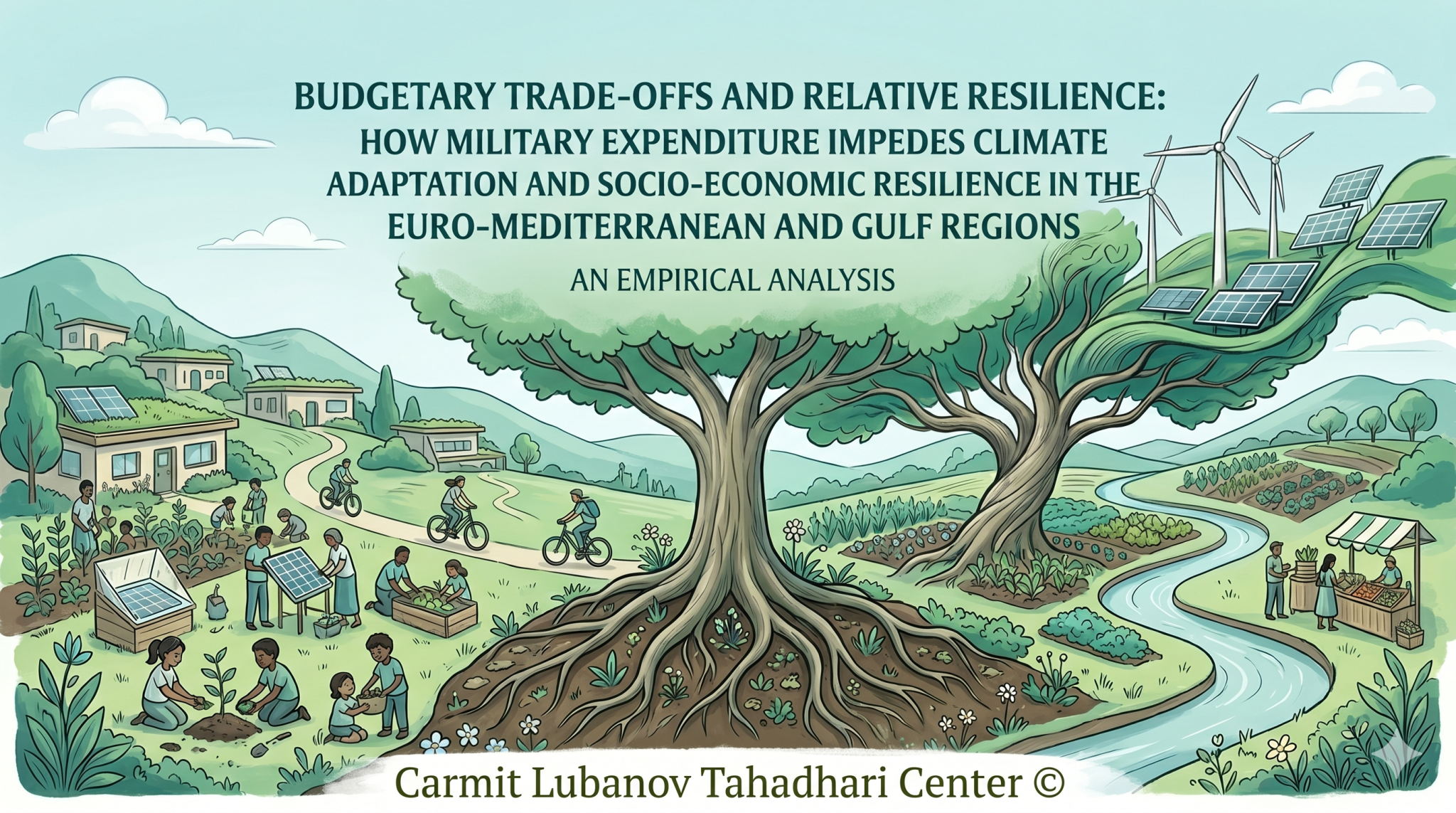
We live in a world obsessed with “hard security.” We measure a nation’s safety by the size of its defense budget, the sophistication of its arsenals, and its capacity to project force. Yet, in the Anthropocene—an era defined by systemic planetary disruption—this narrow 20th-century mindset has created a dangerous national security paradox.
While states over-allocate finite public capital to traditional military systems, they are hollowing out the very pillars required to survive our current century: ecological integrity, resource availability, public health, and social welfare.
This is not a theoretical debate; it is a measurable fiscal trade-off. Last year at the “Democracy Today” conference in Yerevan, I participated at a session exploring a critical question: Can we move the money from war to peace? Research of the Tahadhari Center (Brussels) reveals a stark, empirical reality: there is an explicit inverse correlation between a country’s military expenditure and its environmental and social resilience.
To track this friction, we developed the Policy Trade-off Index (PTI). The PTI quantifies state fragility on a scale of 1.00 (optimal resilience) to 5.00 (extreme systemic fragility) by analyzing the “Fiscal Split Ratio” (defense vs. social/climate budgets) and the institutional power balance between ministries.
The results are an urgent wake-up call for the Euro-Mediterranean and Gulf regions.
In the South and East Mediterranean, states are trapped in the “Severe Friction” zone (PTI > 4.00). Israel (4.25), Egypt (4.45), and Jordan (4.20) have locked their national budgets into permanent securitization. While geopolitical conflicts absorb the cognitive and political bandwidth of our leaders, critical transboundary climate, water, and energy diplomacy remains entirely frozen.
This structural over-allocation to the military apparatus directly starves public healthcare systems and localized welfare networks. This has hollowed out the “social bedrock” of our societies—leaving peripheral and marginalized communities with zero safety nets when climate shocks hit.
Worse, this vulnerability is being multiplied by shifting demographic pressures. As climate-induced agricultural collapse drives migration from Sub-Saharan Africa, and as Europe simultaneously hardens its external borders, South-Med nations are transforming from temporary transit corridors into permanent destinations. This places an immense, unbudgeted strain on local water systems, healthcare, and social protections—the very systems already depleted by defense spending.
Even the hydrocarbon-rich Gulf States are not immune. While Saudi Arabia (3.80) and the UAE (3.50) bypass capital constraints to build glossy, top-down green projects, they maintain a severe Social Resilience Gap by excluding their vast migrant labor forces from basic state protections. A hyper-engineered smart city is completely brittle if the human fabric operating it is structurally disenfranchised.
We must finally confront the hard truth: you cannot bomb a lethal heatwave. You cannot launch a counter-offensive against a severe drought, and you cannot intercept a rising sea level.
To survive the coming decades, global statecraft must transition from a War Economy to a Socio-Ecological Survival Economy—one that roots national security in human welfare and ecological durability than rather only military deterrence. True national security should no longer measured by the size of our arsenals, but by the health of our populations, the security of our water, and the structural justice of our social safety nets. It is time to move the money—before the climate moves us.