Week 5 Teaching Hebrew in Laquia: Challenges
It took me several days to write about the fifth week of teaching Hebrew in Laqiya, since last Monday was not a typical day for me.
Usually, the first group of the day is my best. These are seven smart and quite motivated girls. On Monday, when I was sitting in our room waiting for the group to arrive, two of them were missing. One of the students volunteered to go and get them. When they entered the room, they stood by the door, and one of them said that she didn’t want to study with me because she didn’t like me.
I was caught off guard and didn’t know how to react. Finally, I said that I was sorry to hear that, but encouraged her to join our lesson. While we were talking, the school social worker happened to come in and wanted to know what had happened. The students spoke to her in Arabic, and it turned out that the girl was offended by something I had said to her. According to her, I had reprimanded her. I have no recollection of that. What I do remember is that she, along with some other girls, had asked to go to the restroom, and I had asked them to wait until the end of the lesson, which was only ten minutes away.
Later, I learned that the girls often ask to leave early because they want to go to the canteen and avoid standing in line during recess. I can certainly identify with that, but the lesson is barely 40 minutes long by the time they arrive and we actually get started.
The social worker told the two girls to leave the room. She then spent quite a long time talking to the other students and suggested that my more democratic approach was unfamiliar to the girls and not in keeping with Bedouin culture.
The compassionate social worker could see how shaken I was by the whole incident and tried to cheer me up. I felt that I wanted to talk to the girl and find out what had happened, but the social worker thought it was irrelevant and that the students had no right to be rude.
The rest of the lessons went better. I had brought along a large map of the world, and we tried to locate different countries on it. The students had no idea where Israel was. It is hard to blame them, since we Israelis tend to think that we are the center of the world. But even the letters of the word “Israel” don’t fit into the space occupied by our country on the map.
It is hard not to feel like a failure, but in early December I will be teaching in Laqiya again, and hopefully the lessons will go better.
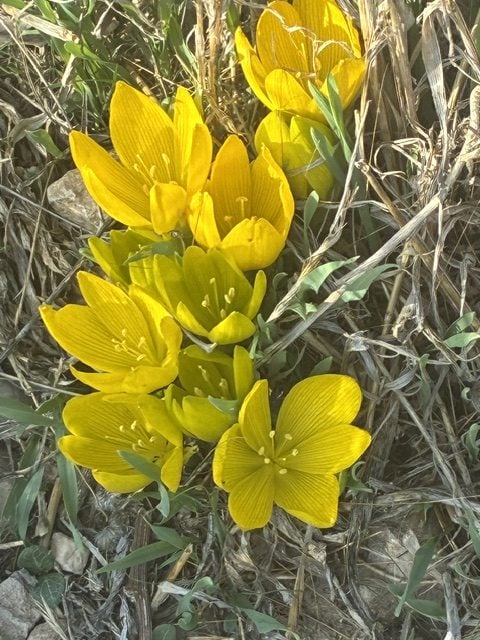
At the end of the day, my fellow volunteer and I went to see the flowers blooming in the Negev. It was truly beautiful. One of the women who was there with her friends admiring the flowers said that these yellow flowers, which appear out of nowhere every November, were teaching her to trust.