
Israel Paralympian Silver Medalist, Adaptive Sport Thought Leader
We’re Israeli, of course we’ll host
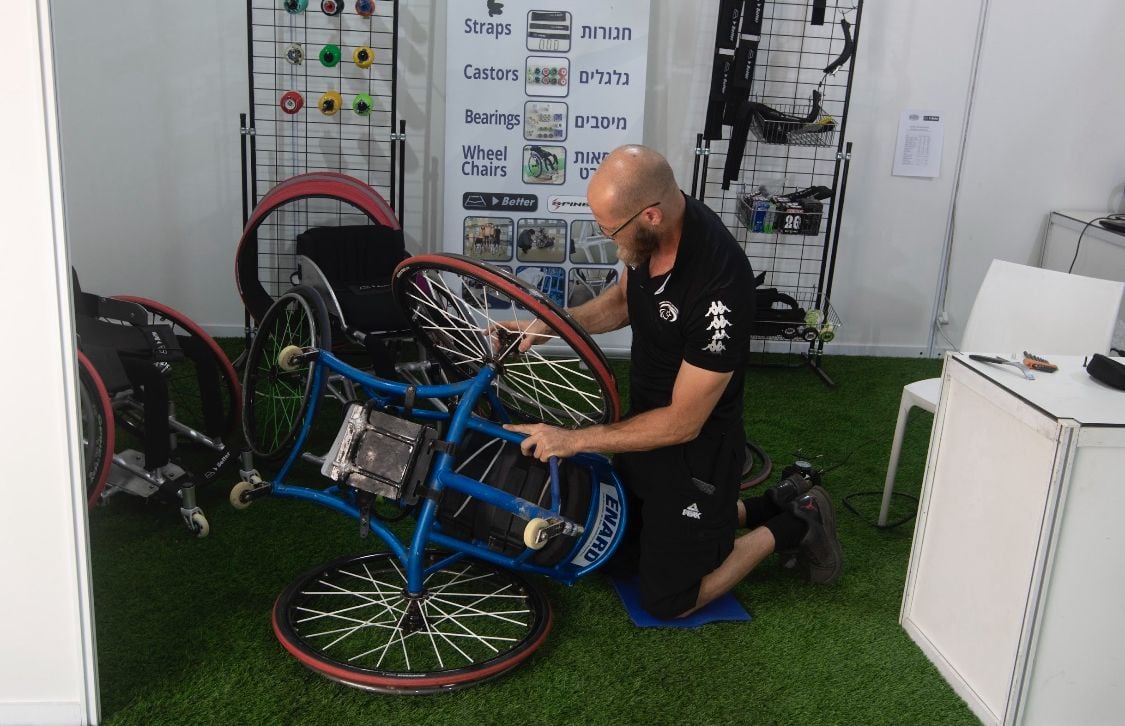
The wheelchair maintenance station at the 2019 Wheelchair Tennis World Cup hosted in Israel (Keren Isaacson)
You watch a game of wheelchair basketball. It’s a close one. Let’s say it’s the Nation’s Cup or some other important international tournament. The host team is leading by four points and you are impressed with the players’ agility and performance as they move around the court in their custom built wheelchairs, some are larger in size than others, who sit lower and closer to the floor, allowing the more severely disabled players stability and speed.
The game is finished.
The players shake hands and roll off the court. Some transfer to their day chairs. Some stand up and walk away on their crutches. Some will shower in the gym, while some will wait until they get to their hotel room where its more accessible and wheelchair friendly. The players of the two teams are headed to lunch, which will be served in a large expo near the gym. While the two teams now have lunch together, two other teams will begin their match.
After lunch, wheelchair accessible shuttles will take the teams back to their hotels. A few days later, when it’s all done, six or eight teams of 10-12 happy and loud guys – and girls – in wheelchairs (pushing both themselves and their wheelchair basketball chairs) will be checking in at the airport to make their way home.
The beautiful event described here happens every week somewhere in the world, and it could be wheelchair basketball, wheelchair rugby, wheelchair tennis or Para badminton. Everything runs smoothly in most cases, and athletes and their professional staff enjoy the competition.
But for us, the organizations hosting international wheelchair sports events, it is a logistical nightmare.
In fact, organizing large scale international Paralympic sports events is such a costly and challenging operation, that many nations do not even dare take it on and it is sometimes difficult to find a nation ready and willing.
Think about it.
Getting a person with two wheelchairs (one for sports and one day chair, sometimes a heavy motorized one) onto an airplane, making sure his shuttle to the hotel is accessible (a van with a lift would do), making sure the hotel room itself suits his needs, then transfer him to the competition site, which of course, has to be fully accessible, feed him lunch in an accessible dining area (don’t forget to make the buffet wheelchair friendly), then, when he goes back to his hotel in your prebooked accessible shuttle, don’t forget to take care of his sports wheelchair and provide a good and safe overnight storage area. In case a wheelchair breaks down, have a wheelchair maintenance guy available 24/7 in a station equipped with everything from tubes to wheel spokes. When your guy is ready to go home, confirm with the airport and airline that they are ready for him, and that ground crews know that he needs help all the way to his airplane seat, in a specialized aisle chair. Do not forget to pack and tag his expensive sports wheelchair so it makes it to the other side of the ocean in one piece.
Now multiply that by 70 athletes. Sometimes a hundred. You get the picture.
No wonder many nations prefer to look busy when a request to host a major event comes up by a wheelchair sports federation.
Well, many nations, except a few Paralympic sports superpowers: Thailand, Turkey, The UK, Germany, The United States, and then there is that little strip of land on the east coast of the Mediterranean – Israel.
While everything is a little different since the pandemic of 2020 and of course, the current situation, Israel is still a major player. Starting with the 1968 Paralympic Games hosted in Ramat Gan (one of the most unlikely pieces of Israel’s history), continuing more recently to the 2019 Wheelchair Tennis World Cup, the Wheelchair Basketball European Championships in 2014 and the EuroLeague in 2019, the world-famous annual wheelchair tennis Israel Open (that’s been going on since the 70s) and numerous various other international events, Israel was, and still is, ready to raise its hand and volunteer to host. We see it as a great honor, a duty and you know what, even a pleasure.
The boldness of Israel’s pioneers came long before it was convenient or popular; people here took risks from the very beginning of the history of Paralympic sports. Volunteers, officials, coaches, and municipal leaders all staked their reputations on Israel’s ability to host at the highest level. With few resources and little precedent, they built ramps where there were stairs, found accessible buses when none were available, learned the language of classification, and wrote playbooks that didn’t yet exist. A small community decided that “we can’t” is not in the Israeli lexicon. The Israel ParaSport Center, The War Veterans’ Beit Halochem clubs, and countless partners have made hosting part of our identity.
The whistle blows. Another game begins. Volunteers swap shifts. A mechanic tightens a spoke. A classifier finishes a review. Somewhere, a young athlete sees the court, the chairs, the noise – and sees his future. That moment is the reason we raise our hand.
Related Topics