CEO of Jewish Federation of British Columbia
What 180 People in a Sukkah Taught Me
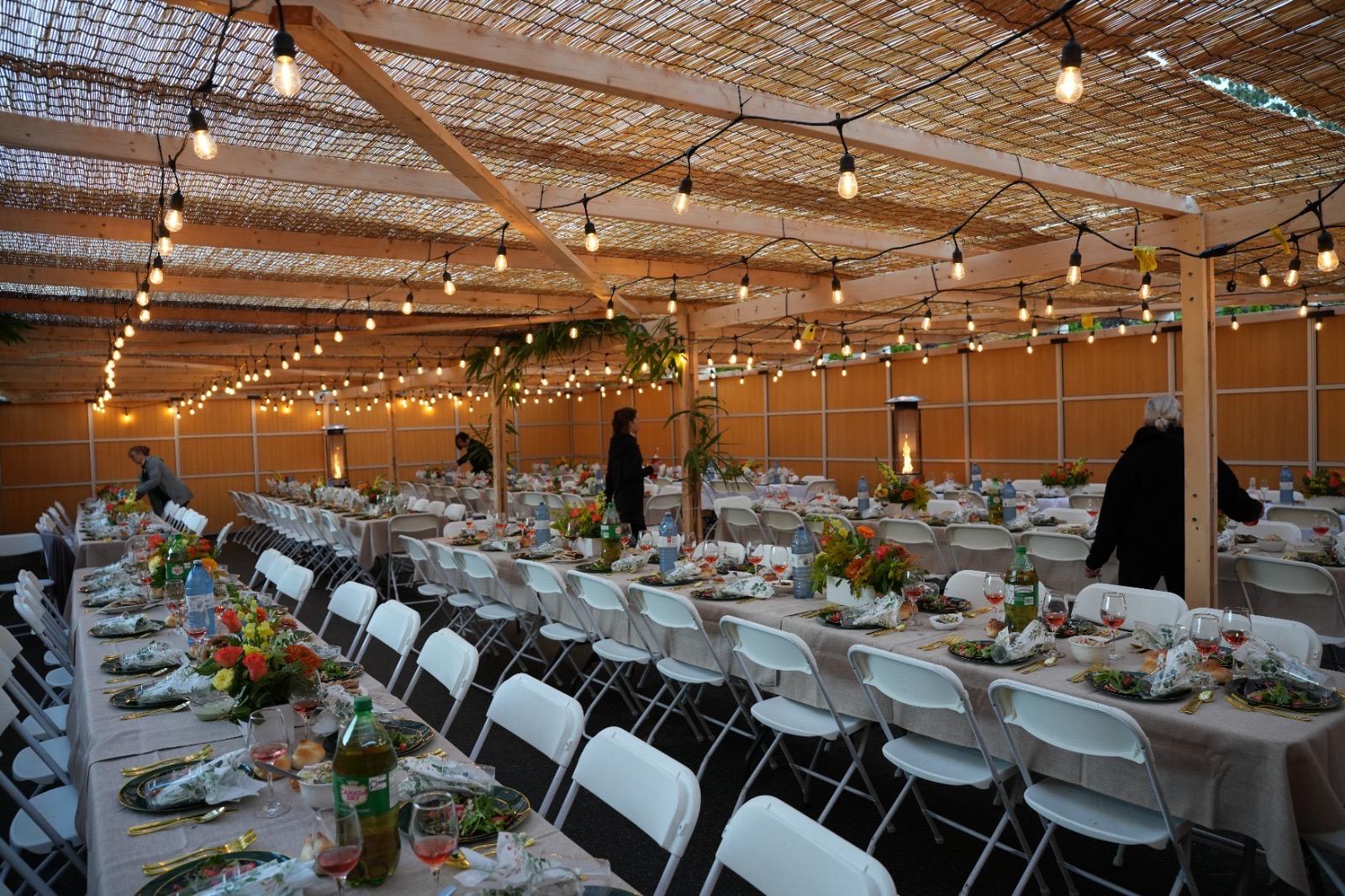
Sukkot in Victoria, BC (Image courtesy of author)
The ferry rocked ever so slightly as it crossed the Georgia Strait, as if to remind us that despite all our planning and preparation, it is nature that is ultimately in control.
It felt like an appropriate beginning to Sukkot.
My family and I were on our way to Victoria, British Columbia, to join Rabbi Meir Kaplan and the community he has spent decades building. Just a week earlier, I had been in Victoria for a very different milestone: the first-ever Jewish Federation of British Columbia campaign launch held in the city.
As a provincial federation still less than a year old, these moments matter. They are opportunities not only to support our collective work, but to deepen relationships and better understand the communities that make up this vast province. A week after launching our first campaign in Victoria, I was returning not for speeches or meetings, but for Shabbat and a sukkah.
What strikes me every time I make the journey is how close Victoria and Vancouver appear on a map, and how far apart they can sometimes feel.
From my Mount Pleasant neighbourhood in Vancouver, Victoria feels close enough to be a neighbour. As the crow flies, it is only about 100 kilometres away. Yet there is no bridge connecting the two cities. To reach British Columbia’s capital requires intention: a drive to the ferry terminal and a crossing of the Georgia Strait, or a flight across the water by seaplane, plane, or helicopter.
The distance is short. The separation feels greater.
For generations, that stretch of ocean has shaped the relationship between our communities. Victoria is close enough to see on a clear day, yet far enough away that every visit feels intentional.
As a provincial federation still finding its footing, I think about that often. Much of our work is about bridging distances measured not only in kilometers, but in relationships.
Rabbi Kaplan had told me about the sukkah that would host the community over the holiday.
It was enormous. More than 1,800 square feet.
More importantly, it would be filled with people.
The crossing itself was wet and windy. As we drove away from the ferry terminal, the rain followed us for a time. But as we approached Victoria, the clouds broke open. Sunlight spilled across the landscape, illuminating the city ahead. The harbor shimmered, the ocean reflected the late afternoon light, and Victoria revealed its beauty.
The uncertainty of the journey had given way to clarity. The storm had made room for light.
After Kabbalat Shabbat, we made our way to the sukkah. We moved from prayer into community, from reflection into celebration. In place of the rain that had accompanied our crossing was a crisp autumn evening and 180 people gathering beneath a roof of branches on the western edge of the Jewish world.
Standing beneath that roof, surrounded by 180 people, I found myself thinking about a much smaller sukkah.
Back home, in our Vancouver neighborhood, my family erects a small but mighty sukkah on the patio behind our townhouse. Every year my parents join us. The walls go up. The schach is carefully laid across the roof. It is not large. When twenty people gather shoulder to shoulder, it feels full to bursting.
Standing in Victoria, the contrast could not have been greater.
One sukkah stood behind a townhouse in the middle of a dense urban neighborhood. The other stood on the edge of the Pacific Ocean and welcomed 180 people.
Yet both taught exactly the same lesson.
A sukkah is never strengthened by its size. It is strengthened by the people inside it.
The Torah commands us to dwell in sukkot for seven days, and the rabbis later described the sukkah as a dirat arai, a temporary dwelling. Its walls are not meant to feel permanent. Its roof is intentionally incomplete. It reminds us that permanence is often an illusion.
It was not lost on me that, sitting in that temporary structure, I was beside a friend and member of our community who, until the launch of the provincial election, had served as British Columbia’s Minister of Public Safety. Here we were, talking about community and the future of Jewish life beneath a roof exposed to the elements.
And yet the evening did not feel vulnerable. It felt strong.
Rabbi Meir Kaplan had a presence that could have filled half the sukkah on his own. His warmth and energy seemed to reach every corner of the space. But what struck me most was not his presence. It was the evidence of decades of work.
Every few steps, someone stopped him.
A parent. A student. A senior. A newcomer.
Watching him move through the crowd, it became clear that the sukkah was simply the visible manifestation of relationships built over decades.
Families. Students. Seniors. Newcomers. Longtime residents. People who had found a place to belong.
Standing in Victoria, I realized that I had been looking at the sukkah the wrong way.
The story was never the 1,800 square feet.
The story was the 180 people.
We often measure communities by the size of their buildings, the scale of their institutions, or the reach of their programs. Yet every thriving Jewish community I have encountered across British Columbia has been built in much the same way: one relationship at a time.
Long before a giant sukkah appears, someone invites a neighbor for coffee. Someone teaches a child. Someone volunteers. Someone welcomes a newcomer. Someone creates a place where another person feels they belong.
Looking around that evening, I began to understand that resilience is not something communities inherit. It is something communities build.
We often speak about Jewish resilience as though it were an inheritance handed from one generation to the next. But standing in that sukkah, I was reminded that resilience is built through countless acts of care, responsibility, generosity, and connection that accumulate over years and decades until one day they become visible.
The sukkah was simply the visible proof.
Some communities are large. Others are small. Some are geographically isolated. Some sit at what can feel like the very edge of the Jewish world.
Yet time and again I encounter the same reality: when people come together around a shared purpose, those spaces become remarkably strong.
Standing in Victoria, I found myself wondering whether that might also be the role of a provincial federation.
Not to replace local communities. Not to overshadow them. But to connect them, strengthen them, and learn from them.
To help ensure that communities separated by mountains, islands, ferries, and hundreds of kilometers never feel as though they stand alone.
As I boarded the ferry home, I realized that the most impressive thing in Victoria was not the 1,800-square-foot sukkah. It was the decades of relationships required to fill it.
Rabbi Meir Kaplan did not simply build a giant sukkah. He helped build a community capable of filling one.
That may be the lesson I carried home from Victoria.
Communities are not strengthened by their size. They are strengthened by the countless acts of welcome, learning, generosity, and connection that take place long before anyone notices the results.
The resilience we celebrate in Jewish communities is not an achievement. It is the result of habits practiced over generations.
One week earlier, I had come to Victoria for Jewish Federation of British Columbia’s first-ever campaign launch in the city. I left Sukkot with a deeper understanding of what a provincial federation might actually be.
Not a campaign, an organizational chart, or a collection of programs.
It is a connection.
A way of helping communities separated by mountains, ferries, islands, and hundreds of kilometers feel a little closer to one another.
The image I carried home was not the size of the sukkah.
It was the sight of 180 people gathered beneath a temporary roof on the edge of the Pacific Ocean.
The walls were temporary.
The community was not.
And for a few hours on Vancouver Island, 180 people gathered beneath that roof and made it feel permanent.
Related Posts