
What a Café Sign Taught Me about Campus Safety
“Lets go grab something to eat on campus!” I say to my friend before heading to one of McGill University’s many libraries to study for our final exams. We decide to go to the Students’ Society (SSMU) café, one of the most popular spaces on campus, to grab a coffee and a quick bite to eat. As we walk in and I place my order with the cashier, my friend whispers to me to look above the coffee machine. Startled, I tap my card, turn to her, and ask her what she is referring to. I glance behind the counter and see a small sign which reads, “Free Palestine,” accompanied by an inverted red triangle. “Why do you have that?” I assertively blurt out to the barista behind the counter, “You serve students of all different backgrounds, so why would you have something that could potentially make a student uncomfortable?” “Because we all believe in a Free Palestine,” she responds back to me. “Do you know the meaning of the inverted red triangle?” I add. “Of course we do,” she retorts, “If you have a problem, you can take it up with the manager.” Our brief interaction gives a small glimpse into the myriad of divisive and combative conversations on college campuses these days, specifically in this case, at my Canadian university, McGill.
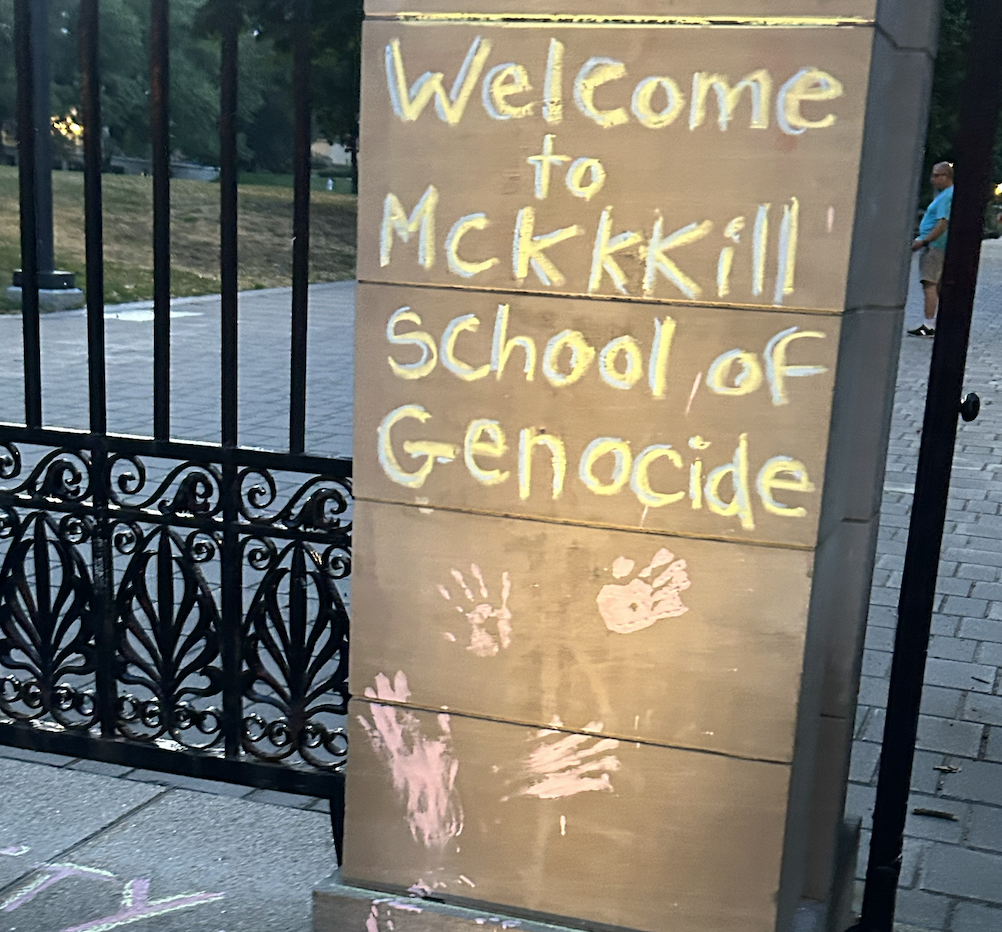
The image of an inverted triangle may have appeared small in size at the café but it carries an immense weight. Hamas uses this symbol to mark Israeli targets, and has become a worldwide symbol that signifies— more often than not—an aggressive Palestinian resistance. It can be seen in graffiti and violent protests around the world. Anti-Israel symbols like this have been ever present on McGill’s campus since October 7, 2023, including as part of sprawling encampments (no longer there), to “IDF Off Campus” graffiti spray painted on the sides of school buildings, to daily chalk defacements on the historical Roddick front gates that read “McKill,” “Stop Israhell,” “Death to the IOF,” or full-sized printed banners stating “McGill University: Leader in Genocide Funding.” These examples barely make a dent into anti-Israel activity and antisemitc rhetoric on campus. Not a day goes by where you don’t see someone without a Keffiyeh—including exam supervisors—or a “Free Palestine” pin. Campus employees and volunteers in the student services building proudly post stickers on their laptops with the outline of the State of Israel and a Palestinian flag inserted within.
From what I can observe, the response from McGill’s administration is either silence, or attempts to maintain a spirit of neutrality due to free speech rights, to some meager efforts to combat the ubiquitous activity. Nightly or early morning, McGill takes a pressure washer to erase the hate-filled graffiti on its gates. And while McGill’s security watches through several cameras near its front gates, it does not station in-person security to deter aggressive anti-Israel/antisemitic activity or graffiti. This reaction, or lack thereof by the administration, lets antisemitism fester on McGill’s campus. Its lack of overt, concrete action only encourages the blossoming of antisemitism and anti-Zionism.
This past October, the Student Union put forward a motion at its general assembly calling for a strike on October 7 against any McGill university investments in Israel. According to the Montreal Gazette, the motion was ratified by 67.5% of eligible voters (over 9,000 of 25,000 eligible voters), and the strike on October 7 became one of the scariest days for Jewish students all across Montreal. The strike began at Montreal’s other English university, Concordia, up the road from McGill, from where thousands of protesters marched to McGill in the pouring rain. When they arrived on McGill’s campus, these protesters proceeded to break windows by throwing rocks, setting off flares, and burning the Israeli flag, right in the center of campus. Mounted and riot Police, on alert by McGill, were very present on this day.
In late November, individual departments across McGill held their own general assemblies calling for students to strike once again. Around twenty departments on both McGill’s downtown and Macdonald campuses passed this motion to strike during the week of November 17. During that week, students were blocked by protesters as they tried to get to class, classes were interrupted, and the police presence on campus was tripled in order to deter any violent behavior.
What began as a small sign above a coffee machine ultimately reflects a much larger failure on the part of McGill’s administration. Students at McGill—and at all universities across the world—deserve a place to feel safe and welcomed, regardless of their background. When these violent symbols become commonplace and once free speech turns into hate speech and aggressive behavior, campuses no longer remain spaces of learning and diversity, they become arenas of fear. If McGill and other universities can’t foster a safe environment for students of all backgrounds, especially Jewish students, then they start teaching this lesson: Some forms of hate are acceptable as long as they are politically trendy.