
Writing on Jewish life, relationships, trauma, and resilience
What a Peace Preparation Process Would Look Like
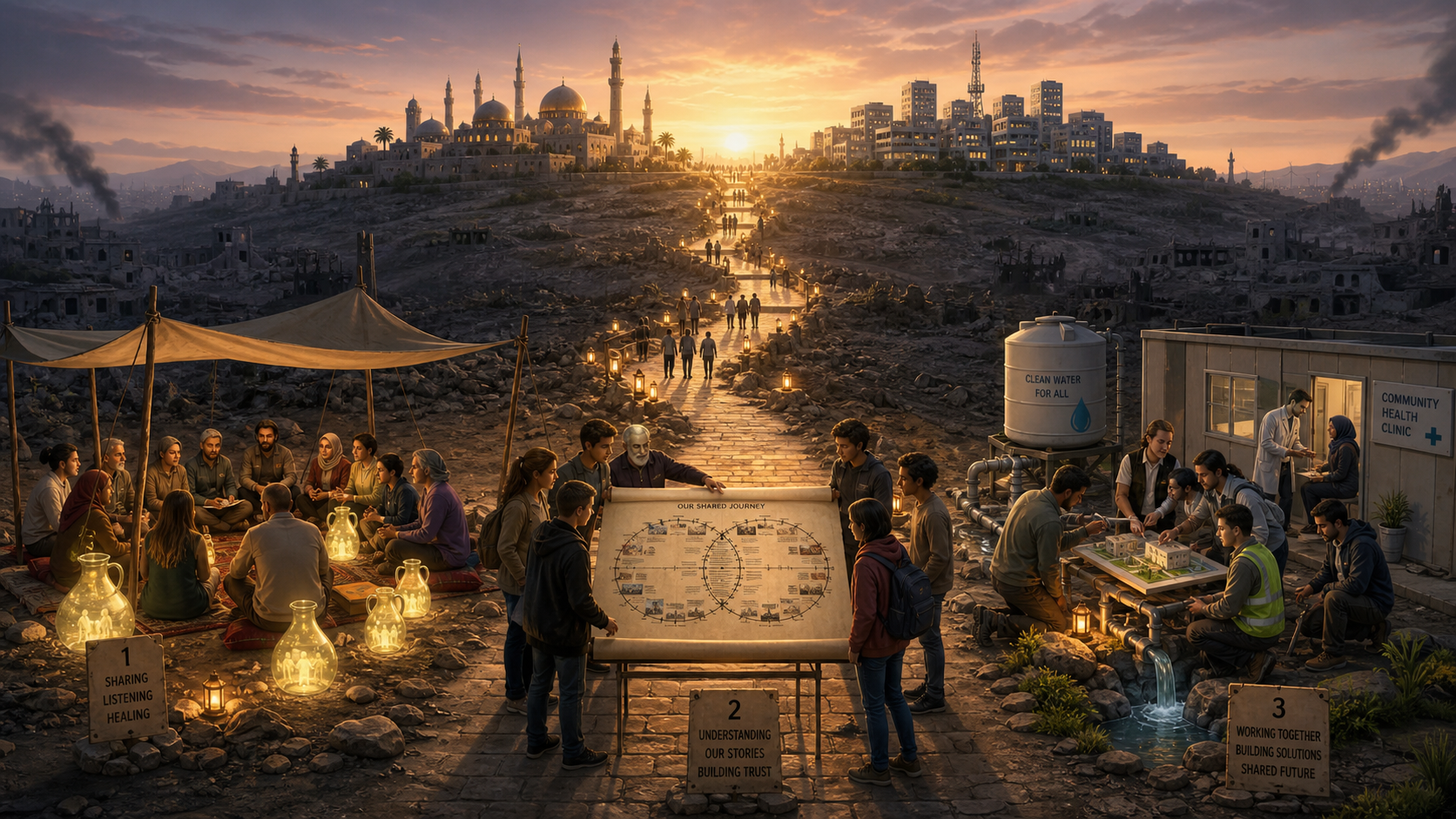
Illustrative. AI image created by the author.
Why agreements fail when societies are not emotionally prepared to live inside them.
Peace agreements describe what leaders sign.
Peace preparation describes what people must be ready to live.
The first is negotiated in conference rooms.
The second is built in homes, schools, mosques, synagogues, refugee camps, WhatsApp groups, and local town halls.
In a recent essay, I argued that peace agreements often fail because we ask them to do emotional work they cannot do. They redraw maps and redesign institutions, but they do not empty the overflowing “emotional jugs” people bring into every round of conflict and every “historic” ceremony.
If agreements cannot do that work, what can?
What would a genuine peace preparation process look like—not as a slogan, but as concrete tasks and responsibilities?
This is an attempt to answer that question.
Negotiation is not preparation
When leaders talk about “preparing the ground for peace,” they usually mean preparing the political ground: lining up coalition partners, managing expectations, weakening spoilers, and building international support.
All of that matters. None of it is enough.
Negotiations focus on borders, security arrangements, refugees, settlements, prisoners, economic corridors, reconstruction funds, verification, and enforcement.
Peace preparation faces different questions:
-
What are people most afraid of losing if peace comes?
-
Which stories about “us” and “them” will feel threatened by compromise?
-
How much unresolved fear, grief, humiliation, and trauma are the societies being asked to carry into this agreement?
Research on post‑conflict societies suggests that political settlements alone rarely create durable reconciliation. Studies of Northern Ireland, Bosnia, Colombia, and South Africa indicate that reductions in intergroup threat perception, trauma transmission, and social dehumanization are often as important to long‑term stability as constitutional or security arrangements. Left to themselves, societies often process trauma through political polarization, collective blame, and hardened narratives. Peace preparation attempts to create healthier pathways before those patterns become entrenched.
Until these questions and these emotional dynamics are treated as seriously as ceasefire lines and demilitarized zones, peace agreements will keep being asked to carry more than they can bear.
Three tracks of peace preparation
Peace preparation is not a single program or conference. It is a set of parallel tracks that can run before, during, and after negotiations.
Think of three of them.
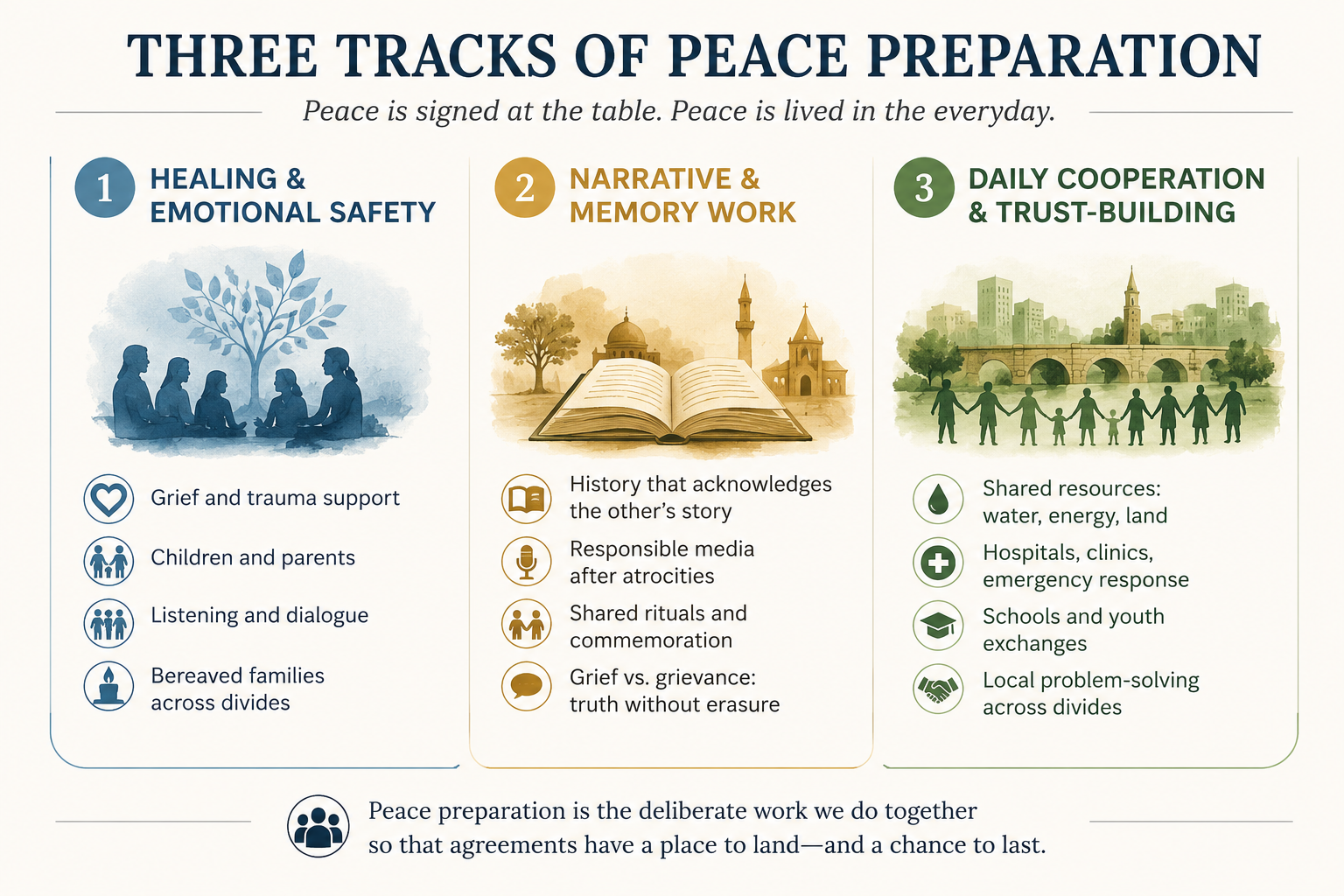
Track 1: Healing and emotional safety
The first track is about grief, trauma, and the human nervous system. It asks:
-
How do we help people who have lived with rockets, raids, sirens, tunnels, and terror feel safe enough to imagine any future at all?
-
Where can rage and sorrow be voiced before they are recruited as political fuel?
In PAIRS, we teach the Emotional Jug: the idea that each person carries an invisible container filled with fear, humiliation, rage, shame, and loss. When the jug is never safely emptied, it eventually overflows, and people respond to present events through the full weight of their history.
Communities do this too.
A peace preparation process would include:
-
Community‑level spaces for grief and listening
Mixed and separate groups where people can talk about what they have lost—children, homes, limbs, years—without being told to “move on” for the sake of the process. -
Trauma‑informed services for children and parents
Counseling in schools; support for parents raising children in constant hyper‑vigilance; training for educators and clinicians to recognize when “misbehavior” is unprocessed terror. -
Protected spaces for bereaved families across divides
Encounters between people who have lost loved ones on both sides, not as public relations but as recognition that those who have paid the highest price often carry a moral authority that cannot be faked.
The goal is not to fix trauma. The goal is to create enough emotional safety that people are no longer living entirely from overflow.
No serious army would walk into a major operation without basic gear and training. Yet we ask entire populations to walk into “historic” agreements with almost no emotional preparation at all.
Track 2: Narrative and memory work
The second track deals with stories: how they are told, who tells them, and what happens when they are challenged.
Societies in conflict often live inside an “ethos of conflict” or “chosen trauma”—a shared narrative that explains past suffering and justifies present fear. These narratives are not lies. They are partial truths told in a particular direction.
Without touching them, almost nothing else will move.
Peace preparation would not ask anyone to forget. It would ask whether people can remember without making the other side’s grief invisible.
This track might include:
-
History curricula that acknowledge the other’s story
Textbooks and classrooms that describe the Holocaust and the Nakba with seriousness and empathy; that name October 7 and the devastation in Gaza; that present the other community’s suffering as real, even when interpretations differ.The point is not to declare that all suffering is identical. It is to loosen the belief that only one people’s grief is legitimate.
-
Media guidelines after atrocities
The immediate aftermath of violence is when dehumanizing language spreads fastest. Peace preparation would include commitments from media leaders, politicians, religious figures, and public intellectuals to avoid language that turns civilians into abstractions, statistics, or collective enemies. A society does not have to deny its own pain in order to recognize another people’s dead. -
Public rituals that widen the circle of mourning
National days of remembrance, religious services, school ceremonies, and civic rituals shape what a society is allowed to grieve. Peace preparation would encourage rituals that begin, even symbolically, to include those beyond one’s borders: joint moments of silence, parallel prayers in mosques and synagogues, public recognition of all children killed.
Grief is not a finite resource. Once that truth becomes even slightly more visible, the difference between grief and grievance is easier to see.
Grief tells the truth about loss.
Grievance turns loss into permanent identity.
Peace preparation asks: which leaders, institutions, media systems, and communities are currently rewarded for keeping grievance at the center—and how can those incentives begin to change?
Track 3: Daily cooperation that changes how people feel
The third track is the least glamorous but often the most durable: practical cooperation that changes everyday experience.
Many people will never attend a reconciliation workshop, read a policy paper, or join a dialogue group. But they will notice if:
-
their water supply improves because of a joint project
-
their hospital has specialists from both communities working together
-
their children share an online classroom with children from “the other side”
-
their village receives rapid assistance after a disaster from a cross‑border emergency team
-
their business survives because cooperation becomes more useful than separation
Each initiative sends a quiet but radical message:
Your wellbeing is tied to mine.
We can solve problems together.
Better comparisons here are not abstract colonial relationships but places where enemies built habits of cooperation over time.
Franco‑German reconciliation after World War II did not happen because memory disappeared. It happened because institutions, exchanges, economic ties, youth programs, and political leadership slowly made another war feel not only immoral but unimaginable.
Northern Ireland remains imperfect and contested, but its peace process shows that agreements require parallel changes in policing, education, public symbolism, community relations, and everyday trust.
South Africa’s transition did not erase trauma or injustice, but it recognized that a political settlement required public truth‑telling and moral confrontation with memory.
None of these examples maps perfectly onto Israel and Palestine. No comparison does. But they underline a simple point: emotional and political relationships can evolve when practical cooperation, institutional change, and narrative work reinforce one another over time.
Peace preparation, at this level, is about designing enough shared interests and shared projects that the default posture shifts from:
Only one of us can survive.
to:
We are bound together. We need to make that less unbearable, and eventually more humane.
Who is responsible?
If peace preparation is this important, who should own it?
Saying “everyone” usually means no one.
In reality, several actors have distinct roles:
-
Political leaders can choose whether to speak only to their base’s anger or also to its grief, and whether to name the other side’s losses at politically costly moments.
-
Educators and religious leaders shape narratives. They can teach history as a weapon or as a warning, preach dignity without erasing pain.
-
Media and cultural figures decide whether to amplify dehumanization or challenge it, whether to reward those who stoke rage or those who risk speaking across the divide.
-
Civil society groups and mental health professionals can create the concrete programs: trauma support, dialogue encounters, youth exchanges, joint projects.
In PAIRS workshops, healing becomes possible when at least one person is willing to stop reacting only from a full jug and begin listening for what lies beneath another’s anger. In conflicts between peoples, the same is true.
Someone has to go first.
Not because they are naïve about danger, but because they are honest about the alternative.
What success would look like
Peace preparation is not magic. It will not eliminate extremists, resolve every territorial dispute, or guarantee that every agreement succeeds.
But it changes what is plausible.
Success might look like:
-
Fewer children certain that the next siren means their house will be destroyed.
-
News segments in which casualties on the other side are recognized as human beings rather than statistics or propaganda.
-
Leaders who can admit their own side’s wrongs without ending their political careers.
-
Negotiations in which publics, though skeptical, are not so terrified or enraged that any compromise feels like existential betrayal.
A world in which grief is still present—how could it not be?—but grievance no longer has a monopoly on identity.
Agreements open doors. Preparation decides what happens next.
Peace agreements answer urgent questions: who controls which borders, what happens to prisoners, where refugees will live, who guarantees security.
They can open doors that have been sealed for generations. They can lower immediate risks and unlock resources, trade, and recognition.
What they cannot do, on their own, is teach people how to live on the other side of fear. They cannot, by themselves, empty emotional jugs that have been filling for generations, soften hardened narratives, or dismantle the machinery of dehumanization.
That is the work of peace preparation.
We now know from Northern Ireland, Bosnia, Colombia, and South Africa that when threat perceptions, inherited trauma, and dehumanization are left untouched, political settlements rest on emotional fault lines that crack under pressure. In those cases, the question “Who was preparing the people?” is not merely rhetorical. It is diagnostic.
We do not face a choice between politics and psychology. We face a choice between agreements built on unreconciled trauma and grievance, and agreements supported by deliberate work on safety, story, and shared life.
If leaders are serious about a different future, peace preparation cannot remain an afterthought, a side project, or a line in a speech. It has to become a central, funded, measurable pillar of any serious peace effort—designed with the same rigor as security arrangements and political timetables.
Left on autopilot, societies process trauma through polarization, collective blame, and hardening narratives.
Peace preparation is the deliberate decision to interrupt that autopilot.
The next time negotiators sit down to draft a framework, one question should be on the table from the first paragraph, not the footnotes:
Who, exactly, is preparing the people who will have to live inside it?
Related Topics
Related Posts