
Featured Post
What Adam Sandler knows about being Jewish
A joke in a teen comedy hides a Shavuot lesson about the meaning of accepting — and choosing — Judaism today
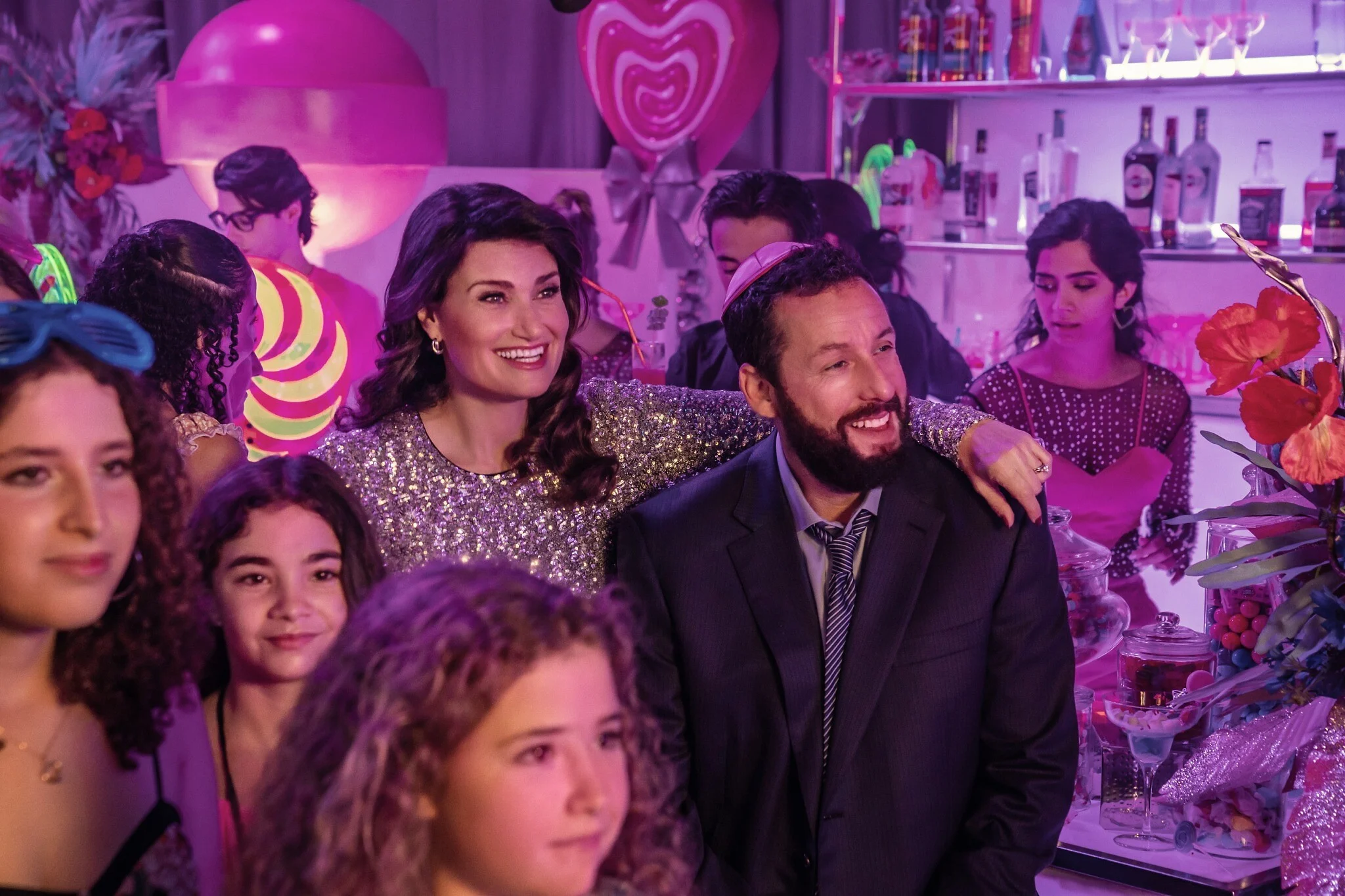
Idina Menzel and Adam Sandler in a scene from the Netflix film 'You Are So Not Invited to My Bat Mitzvah.' (Scott Yamano/Netflix)
In a loud argument near the climax of Netflix’s You Are So Not Invited to My Bat Mitzvah, thirteen-year-old Stacy tells her father she doesn’t want to be Jewish anymore. His answer stops her cold: “God wants you out right now. How’s that?”
It’s a throwaway joke in a teen comedy. It’s also a precise diagnosis of how American Jews understand what being Jewish means.
The father’s perspective is radical: belonging to the Jewish people is not a birthright; rather, it’s a choice you renew constantly, every time you participate in anything recognizably Jewish. Opt out, and the community — and God — will take you at your word. The bat mitzvah party you’ve been dreaming about for years? Gone too. But make the effort, and you’re part of a profound story.
That argument, played for laughs between Adam Sandler and his daughter, contains deeper theology than the average sermon, and it points to something important about Jewishness that the bar and bat mitzvah ceremonies reveal. This Shavuot – a holiday traditionally marking the Jewish people’s acceptance of the Torah – is an opportunity to think about the freedom American and Israeli Jews have in choosing to be Jews, which is on display in their bar and bat mitzvah ceremonies.
Every introductory anthropology course teaches that rites of initiation — the dramatic, on-time enactment of a routine activity in adult life — tell you what a community truly cares about, out of everything we loosely call “culture.” Want to understand what being Jewish means to American Jews today? Look at the bar and bat mitzvah.
But what exactly do these rites mean in an age when “mitzvah” — religious obligation — speaks to so few Jewish teenagers or their families? What are they being initiated into, if this ceremony is in so many cases the last time they’ll set foot in a synagogue? Across the Jewish world, bar and bat mitzvahs have been steadily reshaped by consumer culture into full-blown Keeping Up with the Steins spectacles, with religious initiation feeling increasingly like a residue. The tension between ritual and party is nothing new; historians of bar mitzvah trace it back to the seventeenth century. But today it plays out very differently in the two main centers of Jewish life: North America and Israel.
In North America, the religious component must be there, even in non-Orthodox settings. Rabbis and educators will always complain it isn’t serious enough — but it cannot be cut. Families may feel the whole thing is performative, but plenty of organizations now offer DIY versions. One way or another, something Jewish has to happen. In some Israeli communities, if you’ve attended a bar or bat mitzvah, you might look around and wonder where the Jewish part went. The event can be a pure birthday party: no Torah portion, no rabbi, no mention of anything remotely Jewish, not necessarily even “today I am a “wo/man.” Has Israeli Judaism been colonized by consumer culture more thoroughly than its American counterpart?
Not necessarily. As my new book about The Bar and Bat Mitzvah across Jewish Cultures argues, the difference runs deeper than taste.
In North America, you cannot be Jewish by doing nothing. Jewishness is something you must actively choose and continuously reaffirm, a resource that can be cultivated, shared, or abandoned, but never simply inherited. In Israel, Jewishness is, for most, a fact of birth: either you have it or you don’t, and if you do, no effort is required to maintain it. It is enforced on those who would rather opt out, and denied to others who desperately want in because of the privileges it grants in the Jewish nation state. So why not just throw a party – often a huge one?
In America, the bar mitzvah stages the drama of choosing to belong. In Israel, it marks membership in a collective that was never really in question. This gap explains much of the friction between the two largest Jewish communities of our time.
And yet, like so many things in the Jewish world, October 7, 2023 may have shifted the picture. Numerous studies—from the Jewish Federations of North America to UJA Federation New York—show a measurable increase in the salience of being Jewish in American daily life—with growing shares of Jewish adults reporting that being Jewish shapes their major life decisions more than before 2023. Under threat, American Jews are choosing Jewishness more actively, and more visibly, than before.
There is an old precedent worth recalling. For much of the nineteenth and twentieth centuries, many American Jewish communities preferred group confirmation over the individual bar or bat mitzvah. Some still do. Held usually on Shavuot, it marked a conscious collective choice to be Jewish — transforming the holiday from the traditional giving of the Torah into its voluntary receiving, thus emphasizing the autonomous nature of the choice of being Jewish, rather than a passive, submissive acceptance of God’s will. The individualism of modern life eventually won out, and the personalized bar and bat mitzvah took over confirmation group ceremonies. But the underlying logic survived: you still have to choose.
Some will call that ceremonial choice superficial, illiterate, even hedonistic. Maybe. But look at Israel, where Jewishness requires no performance and no declaration — and that choice is simply unavailable. What American Jews do imperfectly, noisily, and at great catering expense, they do freely. In a world where the freedom to be Jewish is increasingly under attack, that freedom matters more than ever. Proactively choosing to embrace their identity by participating in ritual observance, American Jews choose to be Jews in an increasingly hostile world.
Just ask the great theologian Adam Sandler, still yelling at his daughter.
Related Topics
Related Posts