
Founder & Principal, Line of State
What Akkuyu Really Is
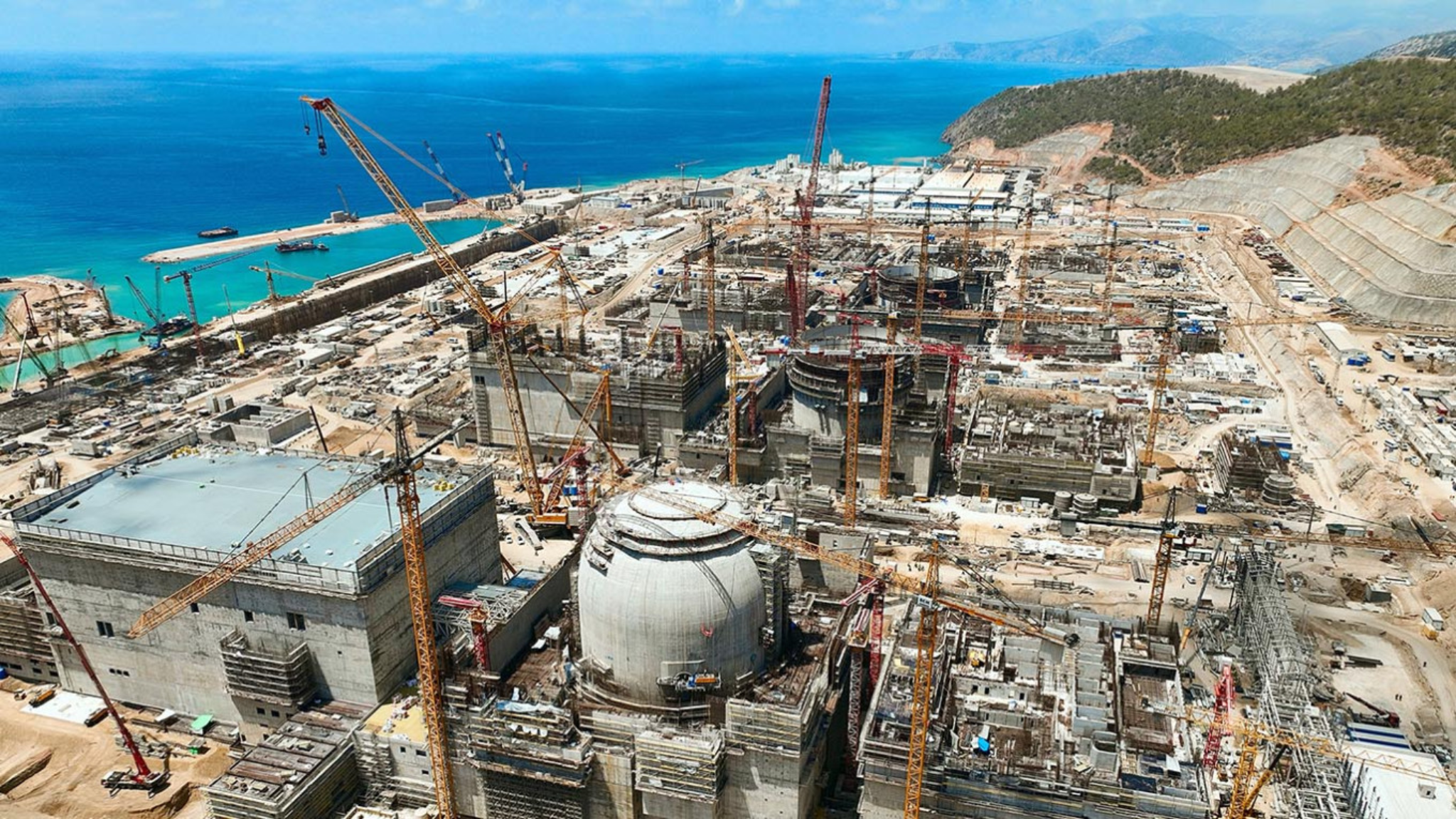
Aerial view of the Akkuyu nuclear site on Turkey’s Mediterranean coast. Designed as long-duration infrastructure rather than a finite project, the facility hard-codes external operational authority into a NATO member’s critical energy backbone, turning electricity into a strategic instrument rather than a commodity. Photo: DHA Image licensed for editorial use with attribution.
Akkuyu is Turkey’s first nuclear power plant only in name. In reality, it is a Russian state owned and state operated nuclear complex planted on Turkey’s Mediterranean coast inside a NATO country. Its reactors, fuel, software, operations, and long term revenue streams are controlled by Moscow, while risk is underwritten by the Turkish state. This places the continuity of Turkey’s baseload electricity, the foundation of industry, governance, and crisis resilience, outside sovereign control for decades. Once operational, this dependency cannot be reversed without systemic shock. What is framed as national autonomy is, in structural terms, outsourced sovereignty, electrical, permanent, and strategically exploitable.
Akkuyu is not Turkey’s “first nuclear power plant”. It is a Russian-owned and Russian-operated energy enclave functioning inside a NATO state. Built, operated, and fueled by Rosatom and financed through Turkish state guarantees rather than exposure to market risk, it operates as offshore infrastructure: physically Turkish, but economically and operationally foreign.
Nothing comparable has been signed by Turkey since Lausanne, which restored full control over territory and strategic infrastructure after decades of foreign concessions. Since 1923, Turkish governments have been acutely sensitive to anything resembling external control over core state functions. Akkuyu crosses that line. It transfers effective control over the most sensitive switch in a modern economy – continuous baseload electricity – to a foreign state actor, structurally and for decades.
Reliable baseload electricity underpins industry, healthcare, and systems of governance. Whoever controls its continuity controls far more than electrons. President Recep Tayyip Erdogan presents Akkuyu as autonomy, as the political equivalent of the S-400s. The comparison is misleading. A weapons system can be reversed. A nuclear power plant once operational cannot. Once fuel supply, software, and operator training are locked into a single owner that also controls the facility, sovereignty becomes contractual fiction. Even if Ankara were to encircle the S-400s and send them back to Moscow tomorrow, the deeper dependency would remain embedded along the Mediterranean coast.
Beyond ownership and control, Akkuyu widens Turkey’s future option space. Erdogan has openly rejected permanent nuclear asymmetry, questioning why enrichment is permitted to some states and denied to others. Combined with fuel-cycle ambitions and parallel investments in long-range delivery systems, this creates a strategic option. What elevates this from a national issue to an alliance problem is NATO cover – a Russian offshore asset operating shielded by collective defense. NATO exists to defend its members, not to guarantee strategic ambiguity embedded in foreign-controlled critical infrastructure.
What makes the Russian move particularly bold is that it mirrors a method Turkey itself has refined abroad. From Mogadishu to Tripoli, Ankara has learned that enduring influence is achieved not through annexation but through operational footprints: training, logistics, long-term contracts, and institutional embedding that make separation costly without redrawing borders. Akkuyu applies the same logic to Turkey itself, except the dependency is electrical, continuous, and politically explosive to unwind. This leverage operates every hour of the day.
Originally published in Greek in ΤΑ ΝΕΑ as “Τι είναι πραγματικά το Ακούγιου”. This essay appears here in English in a version translated by the author.