
What Amnesty got wrong about the Gaza ‘genocide’ – Part 2
In the second part of a multi-part series about Amnesty International’s (AI) report alleging Israel has committed the crime of genocide in Gaza I examine the central claims relating to the element of the crime of deliberately inflicting conditions calculated to bring about the Palestinian’s destruction in whole or in part. For part I of the series, which examines claims related to killing and inflicting serious injury, see here.
Part II: Inhumane conditions
To establish that Israel had deliberately induced inhumane living conditions with the intent of destroying Palestinians in Gaza in whole or in part, the AI report describes three aspects of the conflict:
- The extent of destruction of infrastructure needed to sustain life
- Evacuations or as AI calls it “forced displacement”
- Restrictions on imports and humanitarian aid
I will not address the first two points in any detail. Suffice it to say that military experts and historical precedent – especially the US-led campaigns against ISIS in Raqqa and Mosul – by and large disagree that the extent of destruction is disproportionate given the urban setting and Hamas’s strategy of hiding behind civilians. It also strikes me as especially perverse to cite evacuations meant to protect the civilian population and to which belligerents are obligated by International Humanitarian Law (IHL) as evidence of genocidal intent. Instead, I will focus on the restrictions of humanitarian aid.
On October 9, 2023, Defence Minister Yoav Gallant announced a complete siege of Gaza cutting off “electricity, food, water and fuel”. It is unclear whether this meant allowing no supplies to enter Gaza at all or only from Israeli territory as the IDF did not have control over Rafah Crossing until May 2024. It is also unclear whether this was ever implemented as supplies began entering the Strip almost immediately.
By October 15 water supply had been partially restored to the southern part of the Strip. Within days of the start of the war the relevant Israeli authorities (COGAT) contacted local Palestinians in Gaza to coordinate repairs under heavy IDF security of the pipelines on the Gazan side which had been damaged in the October 7 Hamas invasion und subsequent fighting. By the end of October the second of three Israeli pipelines had been reopened and water supply gradually improved all throughout the war.
By October 21 the first humanitarian aid convoy carrying food and medical supplies entered through Rafah. Electricity and fuel remained restricted although some fuel to power hospitals and desalination plants had been allowed in since November 2023.
Despite quickly abandoning a total siege strategy, a central tenet underlying the report’s accusations is that Israel’s “obligation [as] the occupying power to agree to allow humanitarian assistance to enter and be distributed throughout the occupied territory is unconditional.” (p. 75) Any restrictions, therefore, would be unlawful.
As we will see below, the term “occupying power” is doing all the work here. Whether or not Gaza was occupied prior to the war remains, at best, contentious. Various international organisations and legal scholars did indeed consider Gaza to be the first and only military occupation in human history without military presence. However, this opinion is not based on specific jurisprudence despite the report’s attempt (p. 50) to portray the July 2024 Advisory Opinion by the International Court of Justice (ICJ) as having determined that the Gaza Strip was occupied. The ICJ found:
“Israel’s withdrawal from the Gaza Strip has not entirely released it of its obligations under the law of occupation. Israel’s obligations have remained commensurate with the degree of its effective control over the Gaza Strip.” (§94, emphasis added)
First, we must acknowledge that the ICJ is a politicised institution. Its members are elected by the UN General Assembly which retains an unhealthy obsession with the State of Israel. Its former president, Nawaf Salam, was just appointed Prime Minister of Lebanon and calls Israel “the enemy”. In the relevant passages of the Advisory Opinion regarding Gaza (§§88-94) the ICJ relies on findings by the Independent Commission of Inquiry headed by Navi Pillay who repeatedly declined to condemn her colleagues for antisemitic incidents, such as UN Special Rapporteur Richard Falk for posting an antisemitic cartoon in 2011 when Pillay was UN High Commissioner for Human Rights or fellow member of the Commission of Inquiry Miloon Kothari for expressing dismay over a Jewish lobby controlling social media in 2022.
Still, even this court refrained from calling Gaza occupied. Over a dozen separate declarations by the ICJ’s 15 judges have been issued on its ruling. Most of them do not comment on the question of Gaza’s occupation status or Israel’s obligations. But the ones who do stress that the court took no definitive position (Iwasawa §§2-8, Cleveland §§10-21) or criticise that Gaza was included in its analysis and findings at all (Tomka, Abraham and Aurescu §§13-17). Thus, AI’s claim that the ICJ ruled Gaza was occupied and therefore Israel is bound by the full extent of obligations of occupation law is less a statement of fact – according to every ICJ judge who addressed the matter specifically – and more a declaration of its own anti-Israel bias.
The absurdity of AI’s position that Israel has an unconditional obligation to supply humanitarian aid is betrayed by the very text of Article 59 of the Fourth Geneva Conventions from which it is derived. It states:
“If the whole or part of the population of an occupied territory is inadequately supplied, the Occupying Power shall agree to relief schemes on behalf of the said population, and shall facilitate them by all the means at its disposal.”
However, as the accompanying commentary by the International Committee of the Red Cross makes clear, the article is meant to regulate rights and obligations of opposing sides to an armed conflict. Indeed it continues:
”A Power granting free passage to consignments on their way to territory occupied by an adverse Party to the conflict shall, however, have the right to search the consignments, to regulate their passage according to prescribed times and routes, and to be reasonably satisfied […] that these consignments are to be used for the relief of the needy population and are not to be used for the benefit of the Occupying Power.”
Under AI’s reading Israel is both the “Power granting free passage” and the “adverse Party” occupying territory and thus would have the right to search consignments to make sure they do not benefit the “Occupying Power”, meaning itself. This is nonsensical.
In the absence of occupation, the relevant governing framework is customary IHL prohibiting starvation of civilians as a method of warfare as well as Article 23 of the Fourth Geneva Convention, which states that parties to a conflict must allow consignments of food and medical supplies except where they have reason to fear that such consignments are diverted or would confer definite military or economic advantage to the enemy.
There has been no shortage of evidence of Hamas diverting aid as even the AI report admits: “Humanitarian workers who spoke with Amnesty International also acknowledged aid diversion and looting as two of the multiple obstacles they faced while attempting to deliver supplies and services inside Gaza.” (p. 162)
Consequently, it was within Israel’s rights to put restrictions on supplies, especially dual use goods like fuel and electricity which could be used to directly support the Hamas war effort.
Neither siege nor starvation as a method of warfare are prohibited so long as they are not directed against the civilian population. For example, the US Law of War Manual states:
“It is lawful to besiege enemy forces, i.e., to encircle them with a view towards inducing their surrender by cutting them off from reinforcements, supplies, and communications with the outside world. In particular, it is permissible to seek to starve enemy forces into submission. […] A commander of an encircling force is not required to agree to the passage of medical or religious personnel, supplies, and equipment if he or she has legitimate military reasons denying such requests (e.g., if denying passage may increase the likelihood of surrender of enemy forces in the encircled area).” (§5.19)
Similarly the UK Manual of the Law of Armed Conflict, in effect since 2004, clarifies:
“Siege is a legitimate method of warfare as long as it is directed against enemy armed forces. […] The military authorities of the besieged area might decide not to agree to the evacuation of civilians or the civilians themselves might decide to stay where they are. In the latter circumstances, so long as the besieging commander left open his offer to allow civilians and the wounded and sick to leave the besieged area, he would be justified in preventing any supplies from reaching that area.” (§5.34)
Consequently, it was within Israel’s rights to ban the entrance of all supplies, especially when applied locally in regions where civilians are allowed to evacuate, as was the case in northern Gaza at the beginning of the war and in Jabalia in autumn 2024, at the beginning of the war when temporary evacuation into Egypt was contemplated – though this option was quickly abandoned as Egypt made it clear that it would not accept any significant number of refugees – and as a temporary measure to put pressure on Hamas to release the hostages. We may never know whether a full ground invasion would have been necessary and how many Palestinian lives might have been spared had the Biden administration not immediately pulled the rug from under that lawful strategy.
And yet, despite the legality of these methods of warfare Israel facilitated the entry nearly 800,000 tons of aid in the report’s analysed period between October 2023 and June 2024, according to COGAT data. The debate regarding the entry of food has been particularly contentious, not least since Israeli officials have been charged by the International Criminal Court with using starvation of civilians as a method of warfare.
The AI report’s contribution on this point is essentially to obfuscate. It features a long-winded discussion (p. 166-177) on competing claims of the number of trucks entering Gaza and how many trucks would be required to meet the basic consumption needs given that domestic food production was severely hampered by the conflict. But the truck debate is entirely beside the point as COGAT publishes a much more precise measurement of quantity: the consignment weight.
A recently published scientific study determined the average caloric density of food aid as approximately 315 kcal/100g. With an average daily caloric requirement of 2100 kcal per person and a population in Gaza of 2.3 million it is simple to calculate the food requirement as approximately 1,500 tons per day or roughly 45,000 tons per month, which can easily be compared to the COGAT numbers.
After the first hostage release deal in November 2023, Israel opened Kerem Shalom crossing and almost met this requirement in December. In February there was a slight shortfall after humanitarian organisations scaled back operations due to a breakdown in law and order, although the January oversupply arguably should have provided some cushion. In October and November 2024 food supply again fell short after Israel discontinued commercial imports following reports of Hamas requisitioning revenues from traders, but this too came on the heels of months of considerable oversupply. Otherwise, the requirement was easily met each month since January 2024.
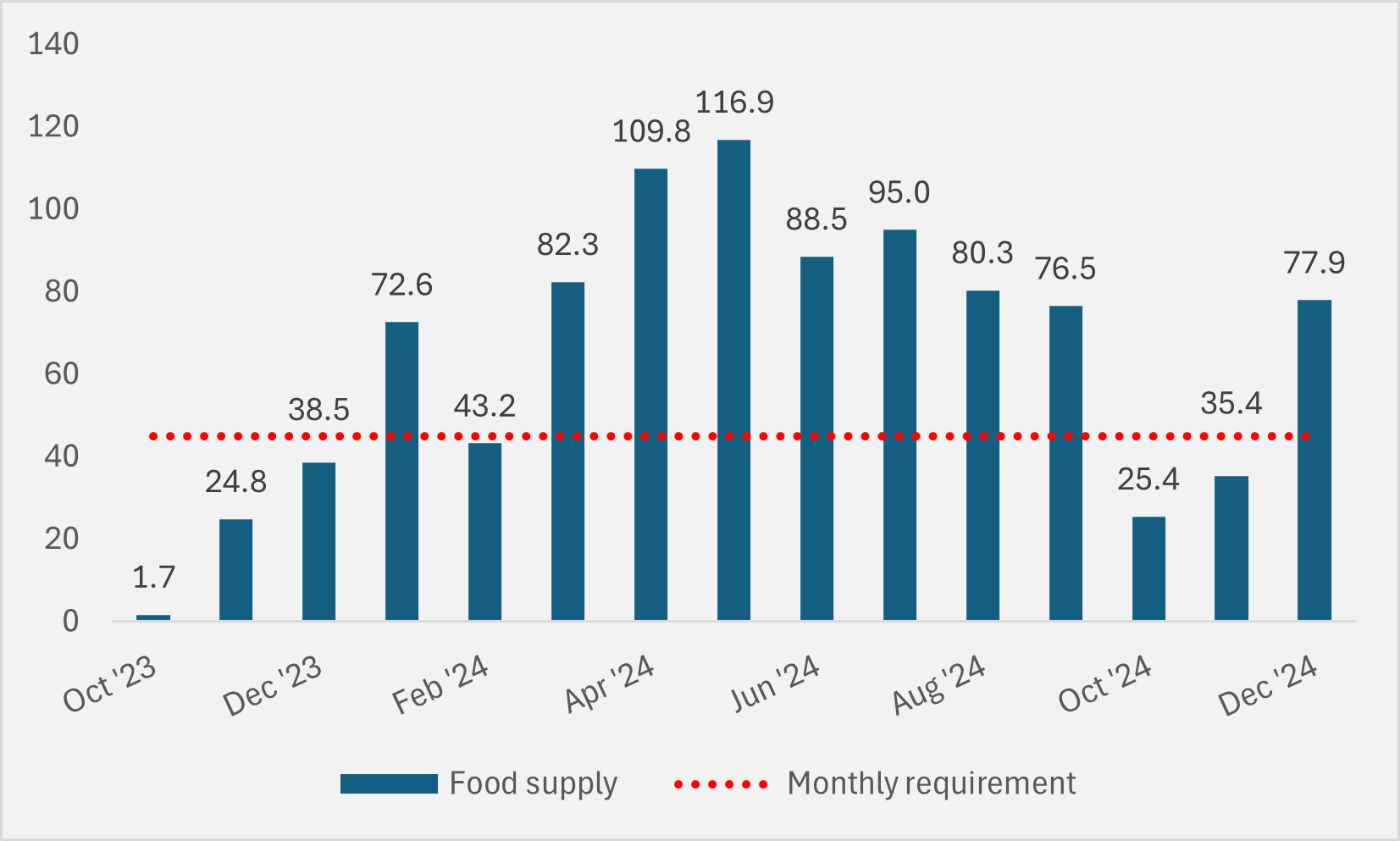
There are good arguments for why 45,000 tons per month may be an underestimate, such as losses in distribution. There are also good arguments for why it may be an overestimate like the younger-than-average Gazan age profile leading to a lower daily caloric requirement – based on demographic data the study estimates it to be closer to 1900 kcal per day. Caloric intake is also not the only measure of sufficient nutrition – the study estimates that the supply of macronutrients (protein and fat) was sufficient but that there may have been an undersupply of micronutrients (iron and other vitamins and minerals).
However, especially from March onwards the supply of food was not borderline. The estimated monthly requirement was overfulfilled by a factor of almost 2 in most months and almost 3 at the zenith. One cannot possibly infer from these numbers genocidal intent or a policy of starvation, they prove the opposite.
It is difficult to explain this omission from the report with ignorance or incompetence. In calculating daily truck requirements the authors demonstrate a sophisticated understanding of numerical data from a variety of sources. Moreover, both the COGAT dataset and a draft version (published in May 2024) of the nutritional assessment study are cited in the report, so the authors must have been aware of its implications. Yet they chose not to share them with their readers.
Instead, the report focuses on food security outcomes on the ground. The situation was undoubtedly serious. Though there has not been robust evidence of malnutrition related mortality, there has been some evidence of an increase in the prevalence of acute malnutrition in children compared to prewar levels. However, the proximate causes for any insufficient availability of food are crucial.
Enough food entering the strip does not mean it necessarily reaches those in need. Hamas stockpiling supplies may have contributed to artificial shortages – an intercepted recording in September, for example, indicated overflowing Hamas warehouses. A failure by NGOs to effectively distribute aid amid the chaos and precarity of an active warzone may likewise have contributed to shortages. Indeed, the report cites security concerns as the “main limiting factor” of the humanitarian response (p. 160) and views Israel as solely culpable:
“The true test of whether enough was being done by Israel as the occupying power and as a party to the conflict to address the humanitarian catastrophe in Gaza is the extent to which Palestinians living in Gaza could access adequate food, water, medicine, health services and other essentials.” (p. 177)
In other words, Hamas is barely a secondary character to the story. Regardless of the difficulties created by military necessity of a war started by Hamas and regardless of the amount of aid stolen by one party to the conflict, Israel must provide.
Yet again, international military practice disagrees firmly. For example, according to the UK Manual (cited above):
“The law [prohibiting starvation of civilians] is not violated if military operations are not intended to cause starvation but have that incidental effect, for example, by cutting off enemy supply routes which are also used for the transportation of food, or if civilians through fear of military operations abandon agricultural land or are not prepared to risk bringing food supplies into areas where fighting is going on.” (§5.27.2, emphasis added)
Underlying this practice is the insight that IHL inherently serves a dual purpose. On the one hand, belligerents must aim to minimise civilian harm, but always subject to being able to achieve their war goals.
This, it seems, is precisely what human rights organisations like Amnesty International refuse to acknowledge. They seem determined to declare civilian well-being as the one and only highest priority, which is inherently incompatible with the right to wage war itself, as war – not only, but especially in the densely populated Gaza Strip – necessarily entails some degree of civilian harm. And this is the impression one is inevitably left with in the face of AI’s downright bewildering misinterpretation of the law of armed conflict: War itself must be outlawed.
In principle, I share some sympathy with this vision for humanity’s future. But as long as barbaric death cults like Hamas have access to firearms and explosives, it remains a rather childish pipe dream and given the fervour with which it is pursued – no lie is too shameful and no libel too egregious – a dangerous one at that.