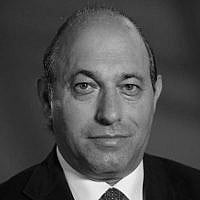
What Amos Oz teaches us about European fanaticism
This week marked the most recent episode of anti-Israeli discrimination in the European art world. Nadav Lapid, an Israeli director who lives in France and is famous for his searing commentary on the current Israeli government, was forced to withdraw from the jury of the FID Festival in Marseille after other directors threatened to pull their films if he participated. An event planned around one of his films was also canceled.
One filmmaker told Le Monde why he threatened to withdraw his film. “I know that Nadav Lapid is critical of his country,” he said. “But that’s no longer enough for me. There’s too much blood today. Too many deaths. And there’s really no room left for nuance, because that nuance has been crushed by the situation itself.”
Another director added, somewhat paradoxically, “We’re not condemning a human being: We are refusing a cultural and political model… It’s not because Nadav Lapid is Israeli. But now, I can no longer listen to the idea that people are ‘fighting from within.’ What does that even mean anymore? Saying you’re against genocide is fine, but for me, it’s not enough.”
Lapid described the frustration of being boycotted not for his views, but for his national origin. “I asked myself: ‘What do they want exactly? That I stop making films? That I leave France? How far will this go?'”
He said, “I prefer to give credit to these people and not say that this is antisemitism, but it is certainly a crazy and superficial fanaticism… accompanied by violence and self-righteousness,” he told Haaretz. According to him, the boycott is a manifestation of a “feeling of frustration and helplessness” over the policies of the Israeli government toward Palestinians. Since there are no significant arms or economic sanctions on the Netanyahu coalition, said Lapid, cultural and educational institutions abroad impose their own sanctions to feel as though they are doing something to help Palestinians by making Israelis feel unwelcome.
This is, of course, deeply unhelpful, and even ironic: the French festival’s boycott caused elation in the government that Lapid vehemently opposes, and which opposes him. Culture Minister Amichai Chikli – who denounced Lapid’s most recent film, “Yes” – wrote that “Nadav Lapid does not understand that the haters of Israel do not differentiate between us, no matter how much he tries to please them.” Lapid’s ouster was condemned by hundreds of French film workers in an open letter called “Cinema is not an embassy.” But the fact remains that he did not participate in the festival, and it is unlikely he will participate in a French festival in the near future.
In 2002, the late Israeli author Amos Oz gave several lectures at Tübingen University in Germany on fanaticism and the Israeli-Palestinian conflict. In 2004, the lectures were transcribed into a short book called How to Cure a Fanatic.
“September 11 was not about the question of whether America is good or bad,” begins Oz in one lecture. “This was about the typical fanatic claim: If I think something is bad, I kill it along with its neighbors.”
“The seed of fanaticism always lies in uncompromising self-righteousness,” said Oz. “Very often the fanatic can only count up to one, two is too big of a figure for him or her. At the same time, you will find that fanatics are often hopelessly sentimental: They prefer feeling to thinking.”
However, though very sentimental, fanatics lack imagination. They lack the fundamental ability, as human beings, “to imagine each other. On every level, on an everyday level, to just imagine each other. Imagine each other precisely at the moment when we feel like we are 100% right.”
“Fanaticism is older than Islam, Christianity, Judaism, older than any state or government, older than any ideology or state in the world,” said Oz. It is resilient perhaps precisely because it is so contagious: “you have only to read a newspaper to see how easily people become anti-fanatic fanatics, anti-fundamentalist zealots, anti-jihad crusaders.”
Lapid’s boycott by the FID is an example of European fanaticism, which in many ways is the mirror image of the fanaticism of the Israeli government: crude, hateful, and messianic. But it is also far less self-aware: while Chikli gleefully remarked on the irony of Lapid’s ban, the many festivals, universities, and other cultural institutions that seek to cleanse their events and curricula of Israelis fail to grasp the incoherence of what they are doing. In that sense, they are even more fanatic.
Ultimately, as Lapid and other French film workers stated, such indiscriminate boycotts – those with “no room for nuance”– don’t serve to mitigate violence or encourage the search for solutions. They work to silence and punish in the name of fanaticism.
Amoz Oz delivered his speeches at a time when the Oslo Accords still seemed like a viable blueprint, believed in by Israel, the Palestinian leadership, and the international community. In the early 2000s, despite the Second Intifada, Israel withdrew from Gaza and seemed like it could be open to more territorial compromises.
The social and political landscape in Israel and Palestine changed dramatically between Oz’s lectures in Tübingen and his death in December 2018. The number of settlements in the West Bank had surged, Hamas had been elected to govern Gaza and turned the Strip into a launching pad for attacks on Israel while outlawing civic freedoms for Palestinians, and peace negotiations had come to an inconclusive halt, with both sides souring on the other’s willingness to come to a just compromise. In other words, fanaticism was flourishing: in Gaza, in the West Bank, in Jerusalem, in other parts of Israel, and, naturally, in the international community.
This landscape changed even more drastically after his death. Oz did not live to see the election of a Netanyahu government in 2022 supported by the most right-wing, messianic coalition in Israel’s history. He did not live to see Hamas’ massacre on October 7, 2023, or the ensuing war, the longest and deadliest in Israel’s history. He did not live to see the reoccupation of southern Lebanon, or the open disdain by the Israeli government and the IDF for the homes, livelihoods and lives of those across the border, be it in Gaza, Lebanon, or the West Bank. Against this backdrop, one could say that his plea – against fanaticism, for a peaceful resolution – is naive and outdated. Some refer to Oz as part of the “old Israel,” the one before Netanyahu’s eternal reign and his government’s racist and messianic interpretations of Zionism.
But though views of the conflict have changed, the conflict itself has not, nor has the solution. As Oz outlined in his speeches and averred throughout his life, there must be two states because both Israeli Jews and Palestinians want to be the majority and the decision-makers in their national home. They want to feel ownership, and they want to feel secure. Neither should have to, in the words of Oz, “commit suicide for the sake of peace.” Both should recognize the other as historic victims who have a real claim to the land.
The fanaticism surrounding the conflict – particularly in Europe – has caused a regression in the discourse around it. Calls to “globalize the intifada” and “from the river to the sea” echo the harsh decades before Oslo when, to quote Oz, “the Palestinians and other Arabs had real difficulty saying ‘Israel’. They used to call it the ‘Zionist entity,’ the ‘artificial creation’, the ‘intrusion’… For a very long time many Arabs and most Palestinians maintained that Israel was some kind of mobile exhibition. If they protested loudly enough the world would take Israel and transplant it elsewhere…” At the time, Israelis also did not recognize the “Palestinian people” or Palestinian nationalism. But, over time, this changed.
It cannot be changed back. Many Israelis now recognize Palestinians as deserving a national home, and vice versa. Former blood enemies of Israel have recognized and made peace with it. Depending on the actions of a future Israeli government, others may follow.
In 2002, Oz told his German audience that “too often I find in the papers of various European countries either terrible things about Israel or terrible things about the Arabs and about Islam. Simpleminded things, narrow-minded things, self-righteous things… Instead of wagging your finger, calling Israelis this name or Palestinians that name, I would do anything I could to help both sides… You no longer have to choose between being pro-Israel and pro-Palestine. You have to be pro-peace.”
He still has a point.
How to Cure a Fanatic is available to borrow for free on the Internet Archive.