
What Ancient Israel Can Teach America’s Fractured Alliances in Northeast Asia
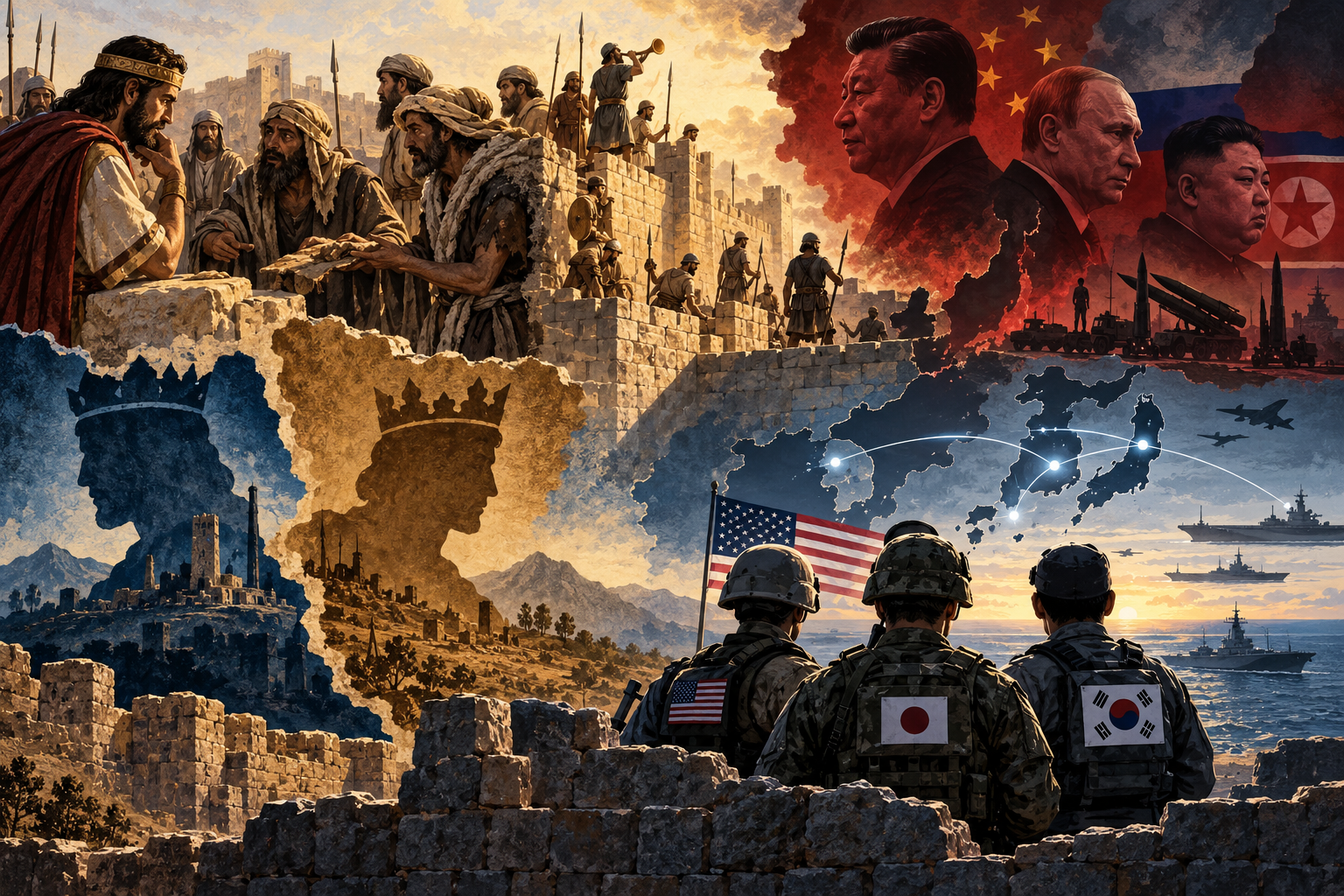
Northeast Asia increasingly resembles pre-World War I Europe, where competing alignments generated strategic polarization without necessarily ensuring collective security. While China, Russia, and North Korea are strengthening their relations, the United States, Japan, and South Korea struggle to overcome political distrust and historical grievances.
Needless to say, the comparison with Europe’s Triple Alliance and Triple Entente does not seamlessly fit. Unlike the rigid alliance structure related to pre-1914 Europe, the China-Russia-North Korea bloc remains an uneven arrangement of overlapping partnerships rather than an integrated military alliance. Nonetheless, the deepening convergence—particularly the mil-to-mil cooperation between Russia and North Korea—is complicating America’s strategic calculations across multiple regions.
Meanwhile, the democratic grouping is faced with a different problem. Although Washington maintains formal bilateral alliances with both Tokyo and Seoul, trilateral cooperation remains fragile against political disputes. A reported exclusion of South Korea’s National Intelligence Service (NIS) from a June 2026 meeting involving US and Japanese intelligence officials has raised additional questions about trust within the alliance network. In addition, the historical dispute originating from Japan’s colonial rule of Korea from 1910 to 1945 continues to constrain further defense cooperation between Tokyo and Seoul.
Joshua and the Gibeonites: Intelligence Before Commitments
The Book of Joshua describes how the Gibeonites approached the Israelites and deceptively presented themselves as travelers from a distant land. They backed up their argument by using ragged clothes and stale bread. Without fully investigating their origins, Joshua and Israel’s leaders accepted their explanation and signed a treaty.
Once the trickery was exposed, the Israelites discovered that they had entered an agreement with a neighboring people whose circumstances differed considerably from what they had understood. Nonetheless, they decided that they were bound by their oath.
The central lesson is that a political commitment made without credible intelligence could create enduring strategic responsibility. In that context, intelligence cooperation for Washington, Tokyo, and Seoul should be treated as the foundation of collective deterrence, rather than a peripheral technical arrangement. The 1983 Soviet shootdown of Korean Air Lines Flight 007, for example, illustrates the strategic value of intelligence sharing. Japan’s intelligence facilities located in Wakkanai eavesdropped on Soviet fighter communications, which were shared with Washington and later publicly presented as evidence of the incident. Although it was a case primarily centered on US-Japan bilateral intelligence sharing, it clearly demonstrated how an ally could help address a security crisis directly affecting another.
In recent years, the three democracies are already sharing North Korea’s missile-warning data and maintaining bilateral intelligence channels. However, these mechanisms should be expanded into a comprehensive intelligence system that could respond to simultaneous contingencies involving China and North Korea.
More specifically, the three countries should establish a standing trilateral intelligence assessment cell that links existing national intelligence agencies with military organizations. Its responsibilities should include evaluating Russia’s military technology transfers to North Korea, identifying preparations for simultaneous regional contingencies, and developing jointly evaluated early-warning indicators.
Such an arrangement does not require unrestricted sharing of all categories of intelligence. While continuously safeguarding sensitive informants and intelligence-gathering methods through compartmentalized access authority, participating governments could exchange operationally relevant assessments.
Israel and Judah: The Strategic Cost of Political Division
The united monarchy’s division into the northern kingdom of Israel and the southern kingdom of Judah, portrayed in 1 Kings 12, provides another lesson on the consequences of political fragmentation. The conflict over the heavy economic burden contributed to the separation of the two kingdoms after Solomon’s death. The subsequent bilateral relations alternated between cooperation and hostility, while powerful neighboring empires increasingly threatened their independence.
The outcome became particularly evident during the Syro-Ephraimite War in the eighth century. Israel allied with Aram-Damascus against Judah, and King Ahaz of Judah requested support from Assyria. Although Assyria’s intervention resolved Judah’s immediate security concerns, it helped an aggrandizing empire that ultimately threatened the independence of the two Hebrew kingdoms.
Such a lesson is highly relevant to Japan-South Korea relations. Political conflict among neighboring countries that are faced with common threats could present a golden opportunity for more powerful adversaries. As aforementioned, Japan’s colonization of Korea remains one of the key sources of South Korean distrust. Undoubtedly, these historical grievances cannot be marginalized simply for the sake of military necessity. Nonetheless, unresolved historical baggage should not paralyze operational cooperation against contemporary security threats.
Washington should thus encourage Tokyo and Seoul to institutionalize their security cooperation without demanding political reconciliation as a prerequisite—this would lessen the impact of political turmoil on determining the overall degree of Japan-South Korea relations. One of the practical arrangements would be a permanent trilateral contingency-planning mechanism that is centered on simultaneous crises involving the Taiwan Strait and the Korean Peninsula.
Such planning should distinguish between South Korea’s primary responsibility for deterring North Korea and Japan’s crucial role in assisting America’s regional operations, which include the use of bases hosting United States Forces Japan (USFJ). This mechanism should also establish procedures for coordinating logistical support, missile defense, maritime surveillance, and the protection of military facilities. Importantly, these systems should respect both South Korea’s sovereignty and Japan’s constitutional and legal constraints on military operations.
Nehemiah: Defense Requires More Than Fortification
Meanwhile, the Book of Nehemiah provides a highly relevant example regarding integrated defense preparedness. When Nehemiah organized the reconstruction of Jerusalem’s walls, the surrounding population was confronted by hostile groups that tried to disrupt the work. Instead of relying solely on physical fortifications, Nehemiah developed a combined system of construction, armed protection, surveillance, and communication.
According to Nehemiah 4:16-18, some workers were armed with weapons and maintained their defensive positions while others continued the reconstruction. This record explains a trumpet-based warning mechanism to assemble defenders wherever attacks occurred.
The United States, Japan, and South Korea possess impressive military capacity that includes advanced missile defense systems, naval forces, and intelligence platforms. Yet these assets are primarily organized around national and bilateral command structures. If China’s military operations surrounding Taiwan and North Korea’s provocations on the Korean Peninsula occur at the same time, as examined in the Atlantic Council report, competing demands on American military forces, logistical assistance, and intelligence assets could surge.
In that sense, the three countries should establish a trilateral defense-sustainment framework that identifies critical shortages before a crisis emerges. The framework should prioritize interceptor missile stockpiles, precision-guided munitions, reserve components, and wartime maintenance capabilities. A common industrial cooperation system should enable Japan and South Korea’s production facilities to replenish weapons and materials without requiring the integration of politically sensitive national command structures. Regular exercises should also test whether existing communication networks can maintain a shared operational picture during missile and drone attacks.
Nehemiah’s experience offers a clear lesson: defense capacity does not depend on possessing formidable fortifications alone, but on organizing manpower and other resources to defend these fortifications.
Avoiding Europe’s Mistakes
The First World War illustrated how alliance commitments, mobilization pressures, and mutual distrust could escalate regional confrontation into a continental war. However, alliances were not the only casus belli, nor would consolidated trilateral cooperation in Northeast Asia automatically bring greater stability. As a matter of fact, a rigid promise could itself create a danger of escalation.
For that reason, Washington, Tokyo, and Seoul should combine deeper operational cooperation with explicit political limitations: their contingency establishment system should clearly outline circumstances requiring consultation, distinguish defensive support from participation in offensive operations, and maintain crisis communication channels with Beijing. The goal should be to prevent opportunistic aggression without creating a knee-jerk military escalation mechanism.
Ancient Lessons for Modern Alliances
To be sure, the Hebrew Bible does not present an immediately applicable blueprint for modern military alliances. Nevertheless, biblical records of political fragmentation, intelligence failure, and collective defense reveal the constant issues regarding strategic organization.
As for the United States, Japan, and South Korea, the implication is practical. They should institutionalize intelligence assessment, construct contingency-planning mechanisms, and coordinate wartime defense industrial sustainment. None of these requires the three countries to relinquish their distinctive national interests and historical perspectives.
The ultimate lesson is that military superiority alone cannot ensure collective defense. More importantly, the paramount question is whether political leaders can transform their respective capabilities into coordinated deterrence before a crisis begins.