
What Are We Making Normal?
Early voting has begun. Once again, we are being called upon to exercise our civic right and responsibility and choose our elected officials, from our local municipalities to the national stage.
We can debate property taxes, homestead exemptions, development, and public services. After all, these decisions matter to our families and our community.
But our elected officials also help shape something more important: the moral character of our society. The people we elevate influence what our institutions defend, what our culture celebrates, and what our society learns to accept as normal.
When dishonesty is excused, people become less embarrassed to lie. When hatred is applauded, it becomes easier to hate. And when terrorists are labeled as freedom fighters, suicide attacks and airplane hijackings that once used to shock any moral human can become normalized and even respectable.
Last week’s Torah reading describes the generation destroyed by the Flood. The world was filled with violence, corruption, and immorality. Yet, surprisingly, when the Torah explains why their verdict was sealed, it specifically mentions robbery.
Why robbery? What made that the final breaking point?
The Midrash describes a popular form of theft carefully designed to evade justice. A merchant would arrive at the market with a basket of peas. Each person who passed by would take just a small amount, until nothing was left.
Each person took so little that, under their legal system, the merchant could not recover his stolen goods in court. But by the time everyone had finished, his basket was completely empty.
The merchant had lost everything. Yet as he stood there empty-handed, he had no legal case to pursue. The rules that should have protected the victim had instead become the thief’s protection. People could destroy another person’s livelihood and still congratulate themselves on staying within the law.
This week’s Torah reading introduces us to the infamous city of Sodom. Abraham’s nephew, Lot, looks at its lush, well-watered surroundings and chooses to settle there. The land was as beautiful as the Garden of Eden, but the Torah warns that its people were deeply corrupt.
From a real estate perspective, Lot had found a wonderful opportunity. But he paid far less attention to the neighbors and the fact that he was moving to a society whose values would endanger his family.
Sodom was determined to keep outsiders from sharing its prosperity. It created such an effective culture of selfishness that helping the poor and welcoming strangers became punishable offenses.
The Talmud tells of a young woman who secretly brought bread to a homeless person, hiding it in a pitcher. When her kindness was discovered, the people covered her with honey and left her on a rooftop, where bees stung her to death.
In a city where cruelty had become public policy, compassion had become a criminal offense. The institutions that should have restrained evil were instead enforcing it.
And that’s when G-d saw no choice but to decree Sodom’s destruction. Because once a society had lost any sense of right and wrong, once its lawmakers could turn kindness into a punishable act, this was a society that could no longer be saved.
So as we go to vote, we need to remember these stories and consider what our own choices are helping to normalize.
Which is why I believe that a candidate’s response to Israel and antisemitism has become more important than ever. Not because I am afraid of being shouted at by a passing car (which has already happened to my kids twice), or having vandals attack our Chabad.
My greatest fear now is for the naïve and morally confused society we have become that mistakes cruelty for righteousness.
My mother has told me a story from my childhood many times, although I don’t personally remember it. I was listening to a discussion about the newly elected American president and whether he would be good or bad for Israel.
Apparently, I had a simple response: “Don’t worry. G-d will watch over the Jewish people. We don’t need the president of America to protect us.”
That pure faith of my childhood remains with me today. I am still confident that the Guardian of Israel will watch over His people regardless of who occupies the White House or which party controls Congress.
But today, I understand something I didn’t appreciate as a child. Choosing a leader who supports Israel also matters for America itself. It helps shape the values we uphold, the behavior we accept, and the kind of nation we are becoming.
When a society excuses terrorism as a “right to resistance”, and completely ignores the slaughter of 1200 innocent Jews, something happens to its moral judgment. When hatred of Jews is presented as a commitment to justice, that society begins losing its ability to recognize the evil it claims to oppose.
The consequences of institutions and leaders normalizing evil reach far beyond Israel. Our leaders teach our local community what deserves admiration, what should be excused, and whose suffering can be ignored.
As we choose our next leaders, their ability to distinguish truth from propaganda has never been more important. Will they challenge hatred when it comes from their own supporters? Does their commitment to human dignity include the Jews?
The truth is we also choose leaders who never appear on a ballot. The actors we admire, the media voices we follow, and the cultural figures we respect gain influence through our attention, our clicks, and our shares. We need to ask these same questions of every singer and influencer we follow.
Here is the good news. We also have the power to make goodness normal.
The hero of this week’s Torah reading is Abraham, the first Jew. Living in physical proximity to the wicked city of Sodom, his actions of kindness and responsibility offer us a profoundly different example.
The Torah describes the many “souls” Abraham and Sarah brought close to G-d. They invested themselves in helping their neighbors discover a deeper truth, and a better, more meaningful way to live.
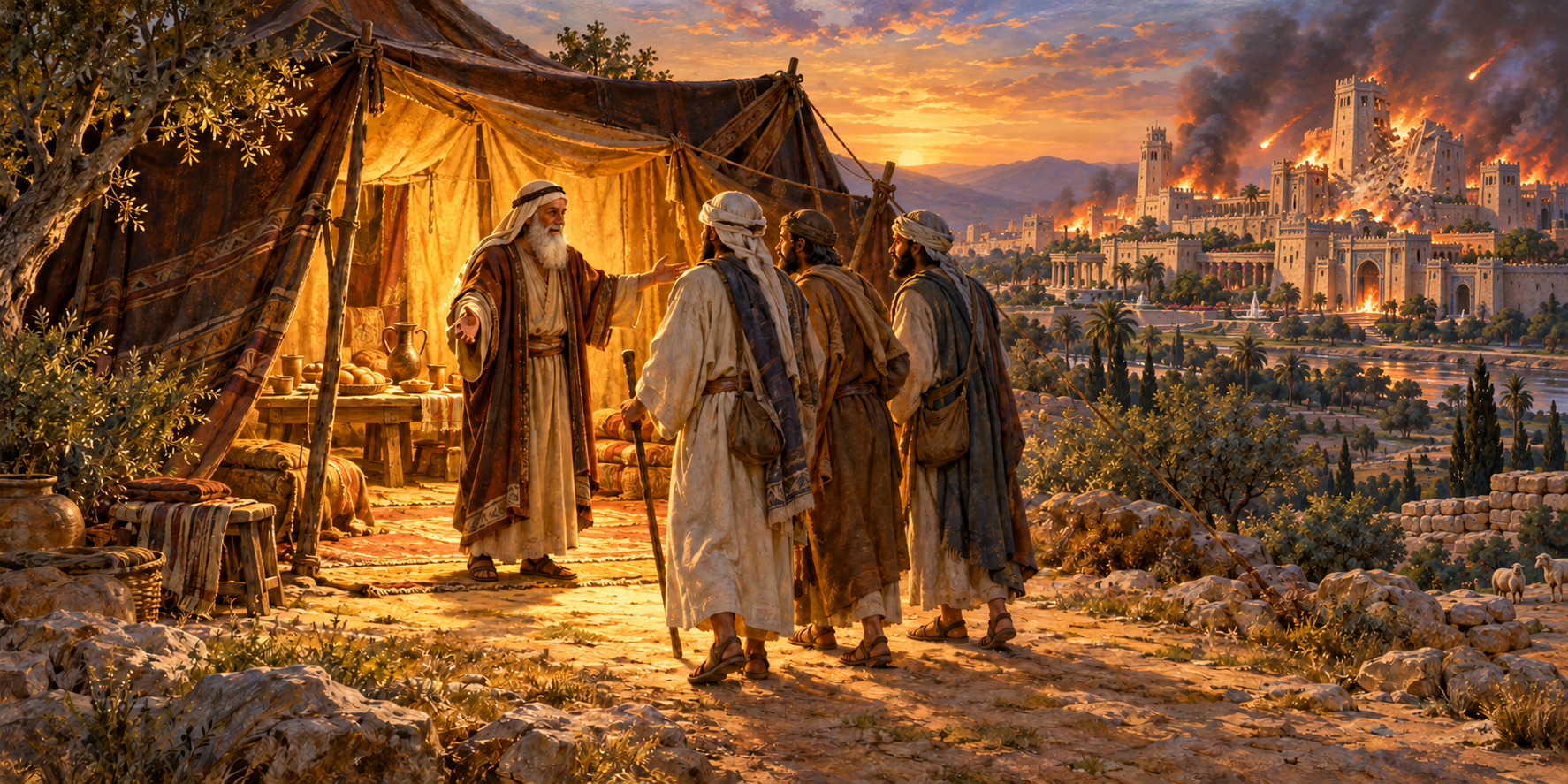
When three strangers appear near Abraham’s tent, he runs to welcome them and prepares a generous meal. Abraham believed these travelers were idol worshippers, and their beliefs stood in direct opposition to the truth he had devoted his life to teaching.
Yet he opened his home to them. He gave them his attention, his food, and his time.
Abraham had spent his life challenging the corrupt and foolish ideas of the society in which he lived. But his convictions didn’t make him isolated from those who didn’t think like him.
On the contrary, his faith gave him a deep sense of responsibility for his neighbors and a reason to engage with them. It made him willing to invest his time and energy in helping them discover the truth and grow in their own relationship with G-d.
He challenged their beliefs without reducing them to labels or treating them with contempt. Even those with whom he deeply disagreed experienced his warmth and genuine care. Because even their lives and their worldview mattered to him.
His example carries an obligation for us. We share streets, stores, neighborhoods, and a country with people whose beliefs and backgrounds may be very different from ours. Yet we have a stake in one another’s spiritual well-being, and in the moral character of the society we are building together.
It is easy to become upset about what our culture is becoming. Abraham’s example asks something more demanding: How much are we willing to invest in making it better?
Are we willing to have thoughtful conversations and build relationships outside our usual circle? Are we willing to show enough care and patience to educate those with a simplistic worldview to recognize the danger of dismissing evil and terror as normal human behavior?
We need leaders who accept that responsibility. And as Abraham’s descendants, we must accept it ourselves.
The moral character of our country must concern every one of us. Our vote helps shape its institutions. And each conversation conducted with respect, each relationship built with sincere care, gives us another opportunity to help shape its heart.
Good Shabbos,
Rabbi Yankie & Chana Denburg