
The Jewish World of the New Testament
Messiah, kingdom, resurrection, covenant: the central ideas of the New Testament come from Israel’s Scriptures. Without them, many Christians miss what their own Bible is saying. Antisemitism is rising outside the church and inside it, and it grows best where Christians have forgotten that we are the branches, not the root.
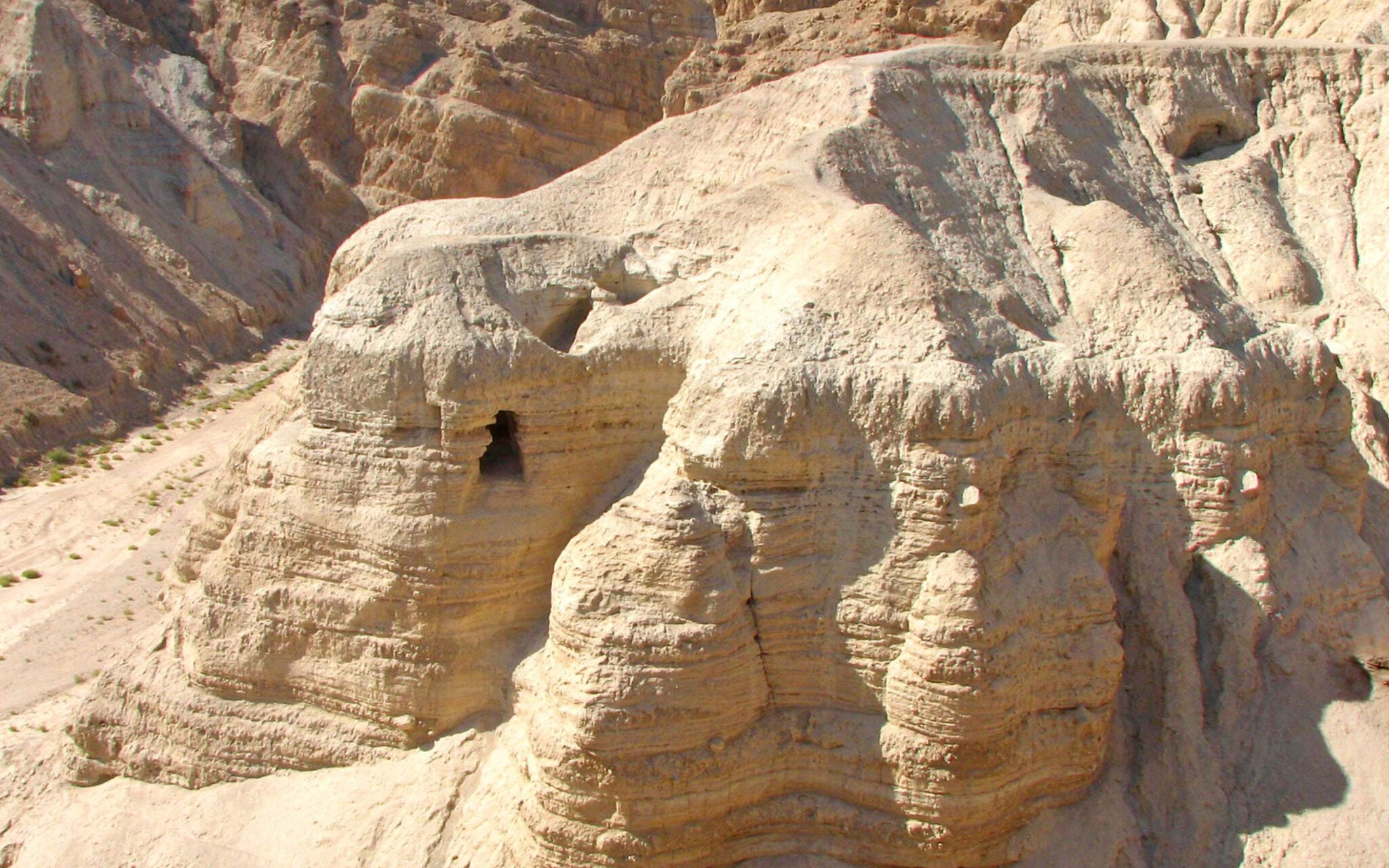
In the winter of 1946-47, three Bedouin shepherds grazed their goats on the cliffs above the Dead Sea. They belonged to the Ta’amireh tribe, and their days ran on what the animals needed. They walked the flock toward whatever the winter rains had turned green, kept them off ledges they couldn’t come down from, and brought them to water at the spring at Ain Feshkha. At dusk they counted the animals and went after whichever one was missing. At night they slept on the ground near the flock. The rock there is pale and crumbling, baked by the sun and pocked with dark openings. One day, one of the shepherds, Jum’a Muhammad, noticed two holes in the cliff. He picked up a stone and threw it through the smaller opening.
He didn’t hear the dull knock of rock against rock. He heard the hollow crack of a clay pot breaking.
According to an account scholar John Trever pieced together from interviews with the shepherds, the three agreed to come back and look inside. On the third morning, shortly after sunrise, while the other two still slept, the youngest, Muhammad edh-Dhib, climbed back to the cliff alone. He squeezed through the larger opening into the dark. Tall clay jars stood along the walls. Broken pottery lay on the floor, and some of the jars still had lids. Most were empty. In one, he found three leather scrolls, two of them wrapped in cloth. He carried them out to show the others.
Muhammad had found the first of the Dead Sea Scrolls. Over the next decade, shepherds and archaeologists found eleven caves near the ruins of Qumran and some 25,000 scroll fragments. The scrolls themselves are far older. Jewish scribes copied them between about the third century BC and the first century AD. They are a Jewish library from the generations just before Jesus and during his lifetime.
One small fragment, found in Cave 4, published in 1992, and known as 4Q521, describes what God will do in the days of his Messiah. The scroll calls God Adonai, the Lord, and says he will heal the wounded, give life to the dead, and bring good news to the poor.
The scribe who copied that fragment worked roughly a century before Jesus was born. Generations later, on the other side of that same sea, another Jew was waiting for the Messiah. According to the historian Josephus, Herod Antipas held John the Baptist in Machaerus, a hilltop fortress east of the Dead Sea. John had staked his life on the message that the one God promised was coming. Now he sat in a cell, and he sent his disciples to ask Jesus one question: “Are you the one who is to come, or shall we look for another?” Jesus answered: “the blind receive their sight and the lame walk, lepers are cleansed and the deaf hear, and the dead are raised up, and the poor have good news preached to them” (Matthew 11:3–5).
Both lists draw on Isaiah (Isaiah 35:5–6; 61:1). Those passages speak of healing and good news to the poor, not of raising the dead. The scroll adds raising the dead to the list. So does Jesus.
Jesus didn’t invent a new set of signs. He answered in words his people were already using for the days of the Messiah.
The New Testament presents Jesus as the Messiah, the Son of David, the Son of Man, the mediator of a new covenant, and the one who brings God’s kingdom. The writers almost never stop to explain these titles. Matthew doesn’t pause to tell readers why they should care about the Son of David. Jesus doesn’t define the kingdom of God every time he mentions it. Paul assumes his readers already understand covenant, resurrection, temple, sacrifice, and redemption. The New Testament writers write as though they are joining a conversation that has been going on for centuries.
They are.
That conversation began in Israel’s Scriptures, centuries before Jesus. By his lifetime, Jews carried it on in synagogues every Sabbath, in the Temple courts, and in the scrolls they copied by the Dead Sea. Historians call that era the Second Temple period. Many Christians have never heard the phrase. Without it, they read the New Testament as if it dropped from the sky, a new religion full of new ideas. The men who wrote it would not recognize that book.
What Was the Second Temple Period?
In 538 BC, the Persian king Cyrus let the Jews exiled in Babylon return to Jerusalem and the land of Judah (Ezra 1:1–4). They came back to a burned city. When the builders laid the foundation of a new Temple, many in the crowd shouted for joy. The old men who remembered Solomon’s Temple wept out loud. The weeping and the shouting rose together, and no one could tell one sound from the other (Ezra 3:12–13).
That second Temple, finished around 516 BC and later rebuilt on a grand scale by King Herod, gives the period its name. The period ended nearly six centuries later, in AD 70, when Roman soldiers burned the Temple and leveled Jerusalem. Jesus taught in the courts of that Temple. Paul wrote his letters in that world. The earliest followers of Jesus were Jews of that world.
The Question That Shaped an Era
To understand what Jews were waiting for, go back about fifty years before Cyrus, to the summer Jerusalem fell. In 586 BC, Babylonian soldiers broke through the walls of Jerusalem. They burned the Temple, the king’s palace, and every great house in the city (2 Kings 25:8–10). They blinded Zedekiah, the last king from David’s line to rule in Jerusalem, and carried him to Babylon in chains (2 Kings 25:7).
Israel’s prophets had warned that this would happen. For generations they told the people that if they kept turning to other gods, they would lose the land, just as Moses had warned. Jews still say it in their festival prayers: “because of our sins we were exiled from our land.” The same prophets also promised that God would not abandon his people. He would bring them back.
Those promises went far beyond a trip home. Isaiah, who prophesied more than a century before Jerusalem fell, saw the nations streaming to Jerusalem to learn God’s ways, and a new shoot growing from the stump of Jesse, David’s father (Isaiah 2:1–4; 11:1–10). Jeremiah, who watched the city fall, promised a new covenant: “I will put my law within them, and I will write it on their hearts. And I will be their God, and they shall be my people” (Jeremiah 31:33). Ezekiel, living among the exiles in Babylon, saw a valley full of dry bones rattle together, grow flesh, and stand up as a living army (Ezekiel 37:1–14).
When the exiles came home and rebuilt the Temple, some of those promises seemed to be coming true. Still, the prophets had promised far more than a return from Babylon. Look at what a Jew in Jerusalem saw in the centuries that followed. Persian governors gave way to Greek kings. In 63 BC, the Roman general Pompey took Jerusalem and walked into the Holy of Holies, the room only the high priest could enter, once a year. When Jesus was born, no son of David sat on the throne. Herod, a king installed by Rome, did. By the time Jesus taught in the Temple, Roman soldiers watched its courts from a fortress built against its walls, and the coins in people’s hands carried Caesar’s face (Mark 12:16). The nations had not streamed to Zion, and the peace the prophets promised had not come.
So one question shaped those centuries: When would God finish the restoration he had promised?
Jews believed the answer was in the Scriptures. Every Sabbath, in synagogues from Galilee to Egypt, someone unrolled a scroll and read the Law and the Prophets aloud (Acts 13:15). Among the scrolls found near Qumran was the Great Isaiah Scroll, nearly 24 feet long and containing all 66 chapters. Messiah, kingdom, resurrection, judgment, and covenant renewal moved to the center of Jewish thought. None of these ideas were invented in this period. They were already woven through Israel’s Scriptures. Centuries of reading, praying, and waiting brought them into focus.
Messiah
Picture the prophet Samuel pouring a horn of oil over the head of a shepherd boy named David while his older brothers watch (1 Samuel 16:13). The Hebrew word for someone set apart that way is mashiach, “anointed one.” In the Tanakh, the Hebrew Scriptures Christians call the Old Testament, God anointed kings, priests, and sometimes prophets for their roles. Over time, the word became tied to Israel’s royal hope because of God’s covenant with David. In 2 Samuel 7, God promised David that his royal line would continue. The prophets described a future ruler from that line who would bring justice, gather God’s people, and extend God’s reign to the nations.
After Pompey’s soldiers stood in the Temple, a Jewish poet wrote a prayer preserved in the Psalms of Solomon, a collection outside the Bible: “raise up for them their king, the son of David” (Psalms of Solomon 17:21). By the first century, the hope of restoration and the hope of a king from David’s line had become one hope. When a blind beggar named Bartimaeus sat by the road outside Jericho and heard that Jesus was passing, he shouted, “Jesus, Son of David, have mercy on me!” (Mark 10:47). No one had to explain the title to him.
Resurrection
In the village of Bethany, about two miles from Jerusalem, Lazarus had been in the tomb four days (John 11:17–18). When his sister Martha heard that Jesus was coming, she didn’t wait at the house. She went out to meet him on the road. Jesus told her, “Your brother will rise again.” She answered, “I know that he will rise again in the resurrection on the last day” (John 11:23–24).
Martha isn’t reaching for a new idea. She is speaking the hope of her people. Daniel had written that those who sleep in the dust of the earth will awake, “some to everlasting life, and some to shame and everlasting contempt” (Daniel 12:2). For many Jews in the Second Temple period, resurrection meant confidence that God’s promises would outlast suffering, injustice, and death itself. When the apostles proclaimed that Jesus had been raised, they drew on a hope that was already deeply rooted in Jewish Scripture and embraced by many Jews.
Son of Man
In Ezekiel, “son of man” simply means a human being, and God addresses the prophet that way again and again (Ezekiel 2:1). In Daniel 7, the phrase takes on new weight. In a night vision, Daniel watches four great beasts rise out of a churning sea. Thrones are set in place, and the Ancient of Days takes his seat, his clothing white as snow. Then Daniel sees “one like a son of man” coming with the clouds of heaven, and he receives dominion and a kingdom “that shall not be destroyed” (Daniel 7:2–3, 9, 13–14). That vision of God’s rule over the empires of the earth shaped Jewish hope in the Second Temple period. It also became Jesus’ favorite way to refer to himself (Matthew 8:20; Mark 2:10; Luke 19:10; John 5:27). A reader who knows only the first sense hears Jesus calling himself a man. A reader who knows Daniel 7 hears him take the title of the one who comes with the clouds and receives a kingdom that will never be destroyed.
Kingdom
Picture John the Baptist standing in the Jordan River in a garment of camel’s hair, while crowds come down from Jerusalem and all of Judea to hear him. His message is short: “Repent, for the kingdom of heaven is at hand” (Matthew 3:1–6). No one in that crowd asked him what a kingdom of heaven was. Isaiah had seen all the nations flowing to the mountain of the Lord (Isaiah 2:2–3). Daniel had described a kingdom from the God of heaven “that shall never be destroyed” (Daniel 2:44). Zechariah had declared, “the LORD will be king over all the earth” (Zechariah 14:9). When John and Jesus announced the kingdom, they were speaking into a conversation that began long before either man stood on the banks of the Jordan.
How the New Testament Writers Read Their Bible
On the feast of Shavuot, Jerusalem was packed with Jewish pilgrims from across the known world. Peter stood up before them and explained what was happening by quoting the prophet Joel (Acts 2:5–21). That is how the New Testament writers worked. They didn’t treat Israel’s Scriptures as background. They treated them as the authority through which God’s purposes were being revealed. Matthew presents Jesus again and again as the fulfillment of Israel’s story. Paul builds his arguments from Genesis, Exodus, Deuteronomy, Isaiah, Habakkuk, and the Psalms. The writer of Hebrews assumes its readers know temple worship, sacrifice, priesthood, and covenant. John, in Revelation, draws heavily on Daniel, Ezekiel, Isaiah, Zechariah, and Exodus. These writers don’t just quote the Tanakh. They think through it, argue from it, and read the life of Jesus through it.
This is where Christians and Jews part ways. As a Christian, I believe Jesus is the Messiah those Scriptures promised, and that much of what the prophets foresaw will be fulfilled when he returns. Most Jewish readers do not believe that, and they read the same Scriptures with deep devotion in a different light. The disagreement is real. It is also a disagreement inside one story, about one set of Scriptures, first given to one people.
What Christians Lose When They Forget
Open the New Testament to its first page. Before Matthew tells a single story, he lists the family of Jesus, beginning with “the son of David, the son of Abraham” (Matthew 1:1). Many Christians skip that list. They read the New Testament as though it opened a brand-new world. The first followers of Jesus saw themselves differently. They believed they were living in the days the prophets had promised. The words they used to understand Jesus came from Israel’s Scriptures: Messiah, Son of Man, kingdom, resurrection, covenant, temple, and restoration.
When Christians forget that, they lose more than history. They lose the meaning of their own words. “Messiah” becomes a last name. “Kingdom” becomes a feeling. They also lose sight of where their faith came from, and with it, the gratitude they owe the Jewish people.
Muhammad edh-Dhib squeezed through a hole in a cliff above the Dead Sea and reached into a clay jar. He came out holding part of a library from the world the New Testament was born in: a world of Jews reading their Scriptures, waiting for God to finish what he had promised.
The New Testament came out of a Jewish world, tells the story of a Jewish Messiah, and speaks the language of Jewish Scripture. The story that begins in Genesis runs through the Gospels and the letters of Paul. Christians who want to understand their own Bible have to start where its writers started: with the Scriptures of Israel. We are the branches, not the root. Christians who keep that in view have no reason left to turn against the people the root belongs to.
Scripture quotations are from the ESV® Bible (The Holy Bible, English Standard Version®), © 2001 by Crossway, a publishing ministry of Good News Publishers. ESV Text Edition: 2025. The ESV text may not be quoted in any publication made available to the public by a Creative Commons license. The ESV may not be translated in whole or in part into any other language. Used by permission. All rights reserved. Biblical references appear in the text.