
Writing on Jewish life, relationships, trauma, and resilience
What Cannot Be Mourned Cannot Be Forgiven
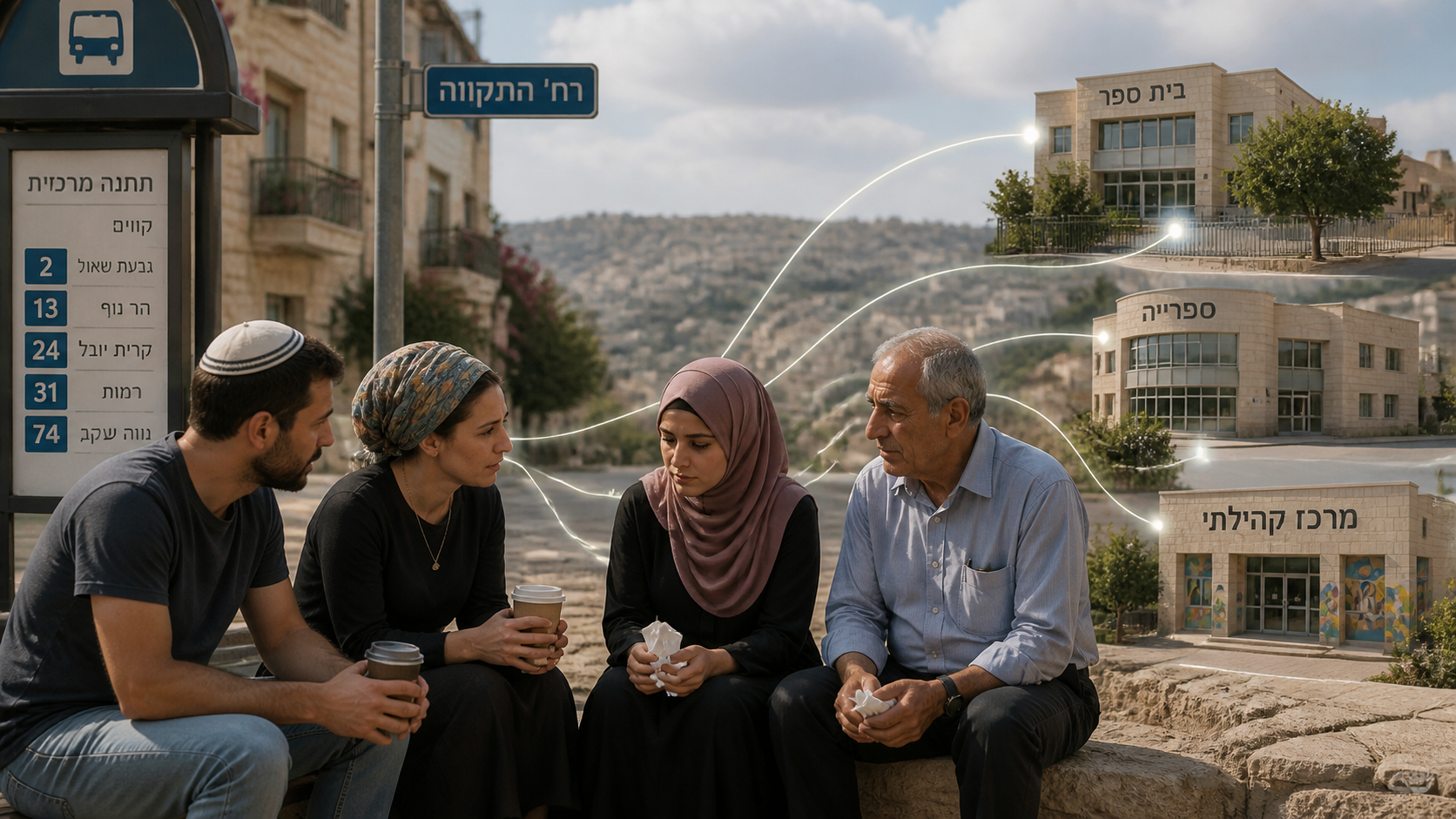
Illustrative. AI image created by the author.
How grief becomes grievance—and what communities can do about it.
The title of this essay is not a metaphor. It is a description of something that happens — in families, in communities, in nations — when loss has no legitimate public form. What cannot be mourned does not dissolve. It migrates. It finds other expressions: chronic resentment, moral absolutism, the kind of rage that feels like justice because it borrows justice’s language. The grievance economy does not manufacture this pain. It harvests pain that was already there, already waiting, because no one built a place for it to go.
Every society teaches people what to do with grief. Some teach silence. Some teach endurance. Some teach revenge. Some privatize sorrow until it hardens into loneliness or shame. Others teach remembrance, accompaniment, ritual, and shared mourning.
That difference matters more than we tend to acknowledge — and we barely acknowledge it at all.
Grief does not vanish when a society has no language, ritual, or container for it. It migrates. It hardens into silence and isolation, into the chronic low-grade resentment that makes ordinary life feel like a wound, and sometimes into something that can be weaponized. Grief literacy is an answer to that dynamic — though not a simple or sentimental one.
What Grief Literacy Means
Grief literacy is the shared knowledge and capacity that allow people to support themselves and one another through loss with greater compassion and competence. The word literacy is doing real work here. A literate person can recognize, interpret, communicate, and respond. A grief-literate community can do the same with loss.
It can recognize grief when it appears not as tears but as anger, withdrawal, numbness, irritability, or fear — the disguises loss most commonly wears. It understands that grief is carried not only in stories but in bodies: in tightened shoulders, shortened breath, sleeplessness, and vigilance. A grief-literate community learns to read these as ordinary expressions of loss rather than signs of weakness or failure. It gives people language for what they are carrying, so that what is unnamed does not remain unexamined. It creates rituals that mark absence rather than pretending nothing has changed. It offers witness without rushing people toward closure. And it accompanies pain over time without turning it into spectacle.
In practice, grief literacy means more than clinical counseling. It means ordinary people — in schools, libraries, congregations, workplaces, families, and civic institutions — learning how to acknowledge loss, make room for mourning, and walk alongside one another through the emotional aftermath of suffering. A grief-literate community does not ask grieving people to move on quickly. It does not romanticize pain. It creates the social conditions in which sorrow can be named before it is weaponized.
Grief as Infrastructure
This is why grief literacy is best understood not as a psychological service but as emotional infrastructure. Infrastructure is what makes other things possible. Roads determine where commerce can flow. Schools determine what knowledge gets transmitted. Libraries determine whose stories get kept. In the same way, emotional infrastructure shapes what becomes possible when human beings encounter loss — where people take pain, who helps hold it, what language is available, and what rituals keep hurt from congealing into identity.
A society that lacks healthy structures for mourning should not be surprised when grief reappears as accusation, moral absolutism, or the kind of emotional mobilization that resists resolution almost by design. What cannot be mourned becomes what cannot be forgiven. That is not metaphor. It is a pattern with a long and legible history.
Germany after World War I is the starkest illustration. The Versailles Treaty imposed punishment but offered no structure for national mourning — no acknowledgment of the genuine losses ordinary Germans had suffered, no public language for grief that was not immediately converted into humiliation. Into that vacuum came political entrepreneurs who were skilled at one thing: naming an enemy. They did not manufacture the pain. They harvested it. The grief of a generation — for sons, for certainty, for national dignity — had no legitimate public form, so it found an illegitimate one. The names change across history. Bosnia in the 1990s. Communities gutted by industrial collapse and told their anguish was someone else’s political problem. In each case the emotional logic is the same: grief without a container becomes fuel.
Five Capacities a Grief-Literate Community Needs
A community capable of holding loss well needs at least five things.
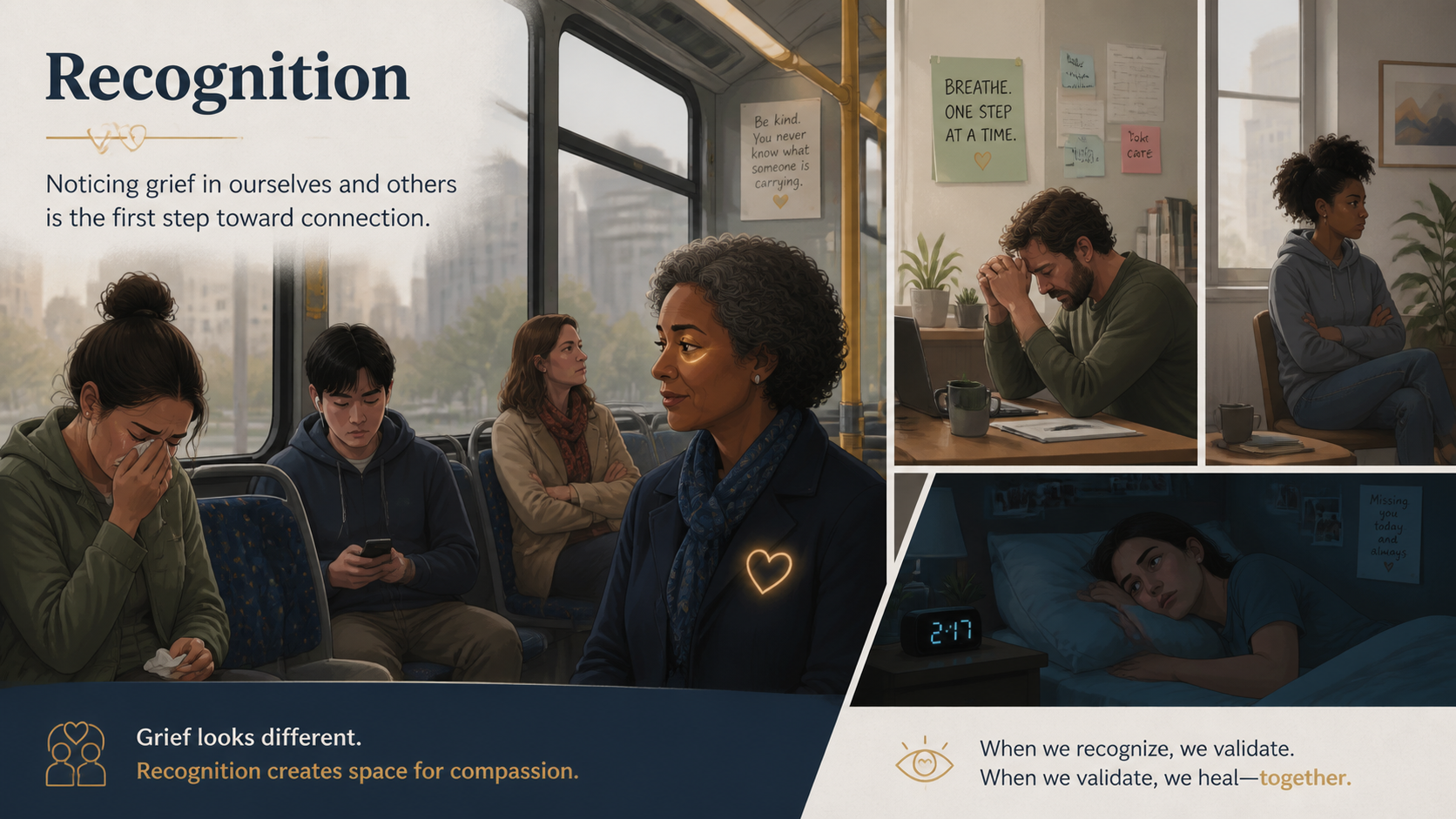
Recognition. The ability to notice grief even when it does not look like tears. A school counselor who sees a student’s grades slip after a parent’s illness and names what she sees — not as a discipline problem, not as laziness, but as loss — is exercising this capacity. She is doing something the student cannot yet do for himself: making the invisible visible. A community that can only recognize the obvious forms of grief misses most of what needs tending.
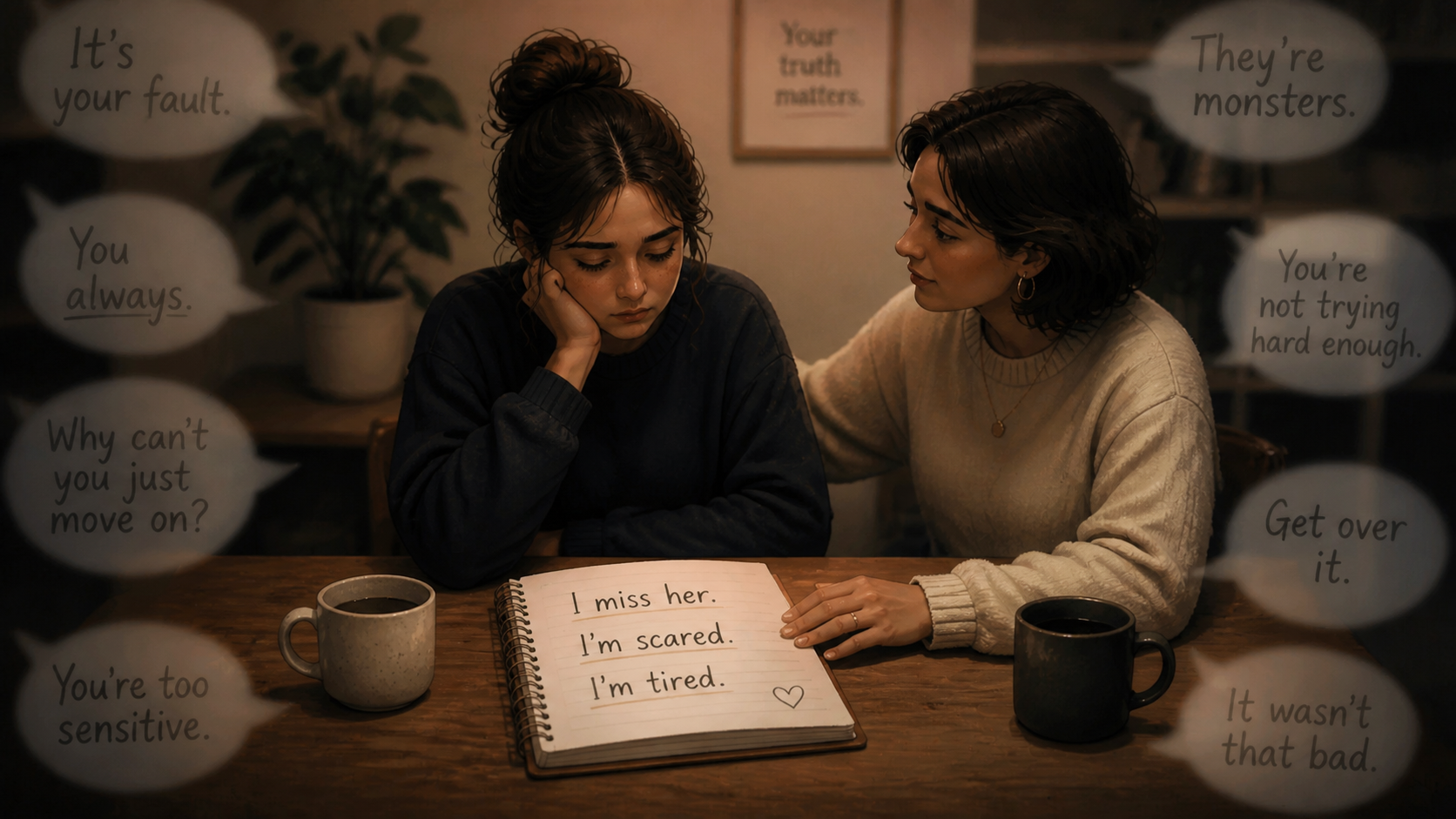
Language. Words that help people name loss without shame or performance. A congregation that builds the Hebrew word avelut — a sustained period of mourning — into its communal life is giving people permission to grieve past the first week, past the polite inquiries, into the slower seasons of loss that most communities pretend have ended. The absence of adequate language is not neutral: when sorrow has no name, it tends to borrow the vocabulary of blame.
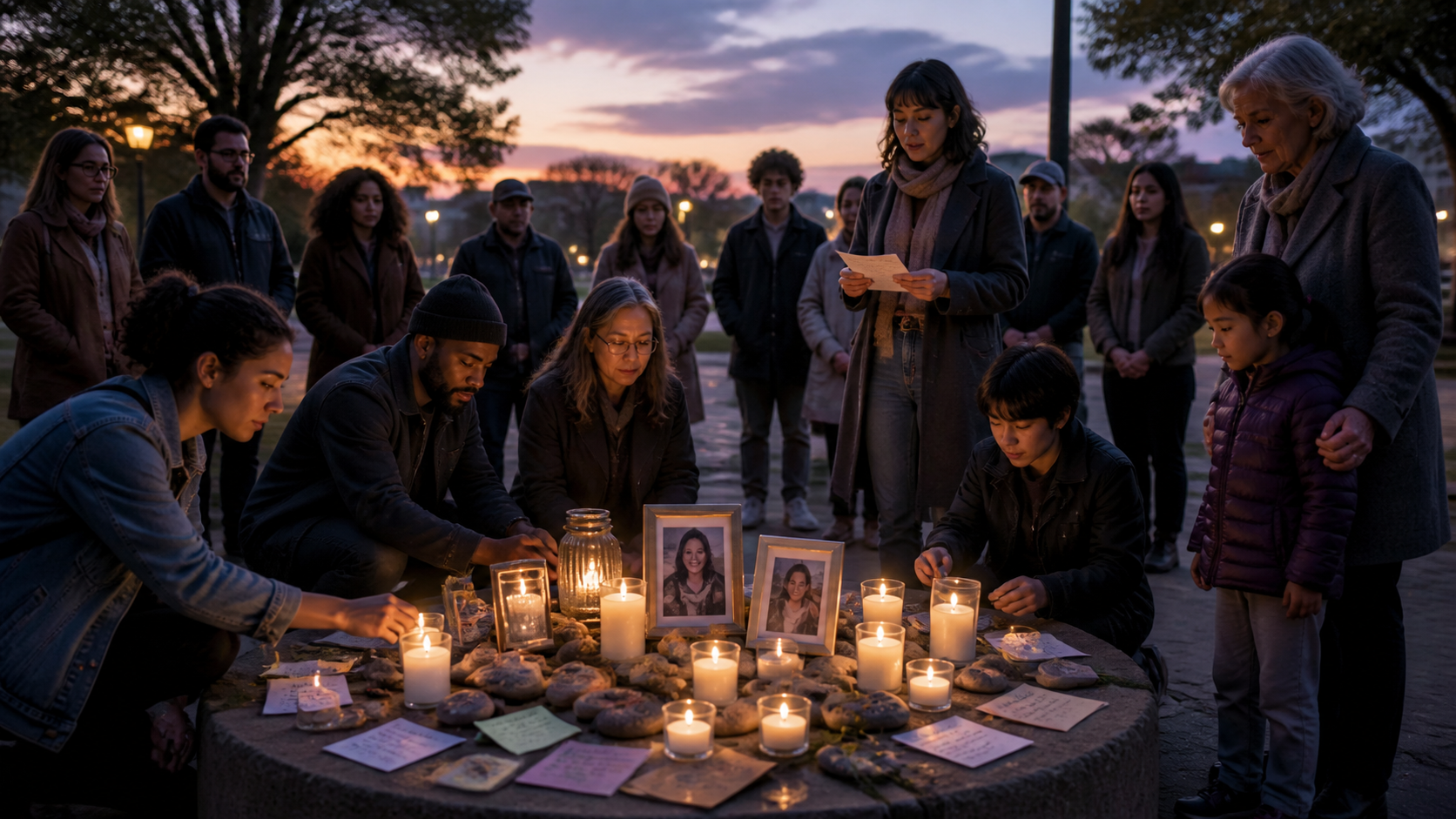
Ritual. Shared practices that mark death, absence, rupture, displacement, and inherited trauma. Ritual does not require religion. It requires collective acknowledgment that something real has ended or changed, and that this matters. A town that holds an annual gathering to name those who died by suicide — reading the names aloud, lighting candles, sitting in the silence — is doing something pharmacology and policy cannot: it is saying that these losses belong to all of us.

Witness. The willingness to stay present to another person’s pain without trying to fix it too quickly. This is harder than it sounds in a culture that equates helpfulness with problem-solving. A friend who sits with someone in grief and resists the urge to offer silver linings, timelines, or distractions is offering something rarer and more sustaining than advice. Sometimes the most powerful thing a community can offer is sustained, non-anxious presence.

Accompaniment. The patient work of walking with people through grief over time, not only in the acute phase but through the slower, less visible seasons of mourning that follow. The Utah volunteers described below understood this instinctively: their value was not expertise but persistence — showing up in month six, when everyone else had moved on.
Without these capacities, grief becomes privatized. People are left to metabolize pain alone, which is both a cruelty and a risk. In that vacuum, unresolved hurt seeks other outlets. It attaches itself to humiliation, hardens into grievance, and becomes available to political entrepreneurs who know how to convert pain into attention and attention into power. Communities do not merely need places where grief can be expressed — they need experiences that restore people’s sense of dignity and personal worth. When people rediscover that they matter independent of their suffering, grief becomes easier to carry without turning into grievance.
Where Grief Literacy Already Lives
Some of the clearest examples of grief literacy in practice come from community-based initiatives that make grief visible in ordinary settings — which is precisely where it needs to be visible.
Consider what happened in Utah. Over the course of a year, the Utah Division of Aging and Adult Services partnered with local hospices and community organizations to train volunteers as grief companions across diverse populations — older adults, veterans, Indigenous communities, and rural residents who rarely appear in clinical conversations about bereavement. One of those volunteers, a retired schoolteacher in her late sixties, described the work this way: she was not there to fix anything. She was there to make sure people knew they were not alone with it. That distinction — between fixing and accompanying — is the whole of what grief literacy asks of ordinary people. And ordinary people, it turns out, are capable of it.
Libraries are a revealing model for this work. They are familiar, accessible, and non-stigmatizing — which means they can hold conversations that clinics and courts cannot. In several communities, grief-sensitive library programs have brought conversations about death, bereavement, and emotional support into ordinary civic life through book displays, facilitated discussions, children’s resources, and partnerships with local organizations. The symbolic meaning matters as much as the practical: it says grief belongs in civic life, not only in therapists’ offices.
Schools may matter most of all. Children and adolescents are often surrounded by loss without adults having the vocabulary or confidence to help them make sense of it. A grief-literate school trains staff to recognize bereavement, builds routines that acknowledge absence, and normalizes age-appropriate conversations about death, rupture, and change. Such practices do more than comfort individual students. They interrupt the lesson — learned so easily and so early — that pain must be either hidden or acted out.
Every library program, every school ritual, every grief circle, every conversation between neighbors is not merely providing a service. It is teaching a new pattern of relationship. Peace is learned one relationship at a time before it is ever negotiated between nations.
Why This Belongs in Conversations About Democracy and Peace
Pain alone does not create grievance. Pain joined to isolation, shame, and the loss of human connection does. Conversely, when people experience themselves as seen, valued, and accompanied, grief can remain grief rather than becoming an identity organized around blame.
This is what grief literacy makes possible at the level of language itself: congruence — the alignment between inner experience and outward expression. When people lack the words or the social permission to say “I am frightened,” they reach for a substitute that feels equally powerful: “You are evil.” When they cannot say “I miss my son,” they say “Your children must suffer.” The emotional energy is real in both cases. What changes is where it goes. A grief-literate society does not eliminate that energy. It gives it a more accurate address — and in doing so, it keeps sorrow from becoming a political instrument.
This is why grief literacy belongs in conversations about democracy, coexistence, and peacebuilding. Peace agreements and institutional reforms can restrain violence. They can restructure incentives, redistribute resources, and establish legal protections. But they cannot by themselves metabolize humiliation, inherited fear, displacement, or grief that has never been publicly held. Communities need practices that operate below the level of policy and above the level of solitary suffering.
Contemporary thinking about social stability focuses heavily on laws, incentives, deterrence, and strategic communication. Those things matter. But South Africa after apartheid offers a counterexample worth sitting with. The Truth and Reconciliation Commission (TRC) was not primarily a legal instrument — it was a grief structure. It gave people a public forum to name what had been done, to speak loss into the record, to be witnessed by the nation. It was imperfect, contested, and incomplete. It did not deliver justice in any clean sense. But it did something that law alone cannot: it created a space in which grief could be expressed before it fully hardened into permanent accusation. The lesson is not that TRCs solve everything. It is that democracies ignore this dimension of civic life at their peril. Unprocessed sorrow is a civic force. It accumulates pressure. It waits for a language, a leader, or an algorithm to convert it into movement. The question is whether communities build the infrastructure to process grief before that conversion happens — or leave the field to those who profit from it.
Practices That Help — and Their Limits
A grief-literate culture is built through repeatable practices, not only institutions. Communities can create remembrance rituals for losses that are typically ignored — not only deaths, but divorces, estrangements, displacements, betrayals, lost homes, broken neighborhoods, and inherited trauma that was never fully named by the generation that first carried it. Schools can mark absence in ways that acknowledge grieving students without exposing them. Libraries can host grief circles and reading groups that make mourning discussable. Congregations can create space for lament without treating it as a failure of faith. Workplaces can train managers to recognize grief instead of confusing it with disengagement. Families can learn to speak about loss across generations before silence becomes the only inheritance they pass on.
Public infrastructure is only half the picture, though. Communal structures for grief depend on individuals willing to do their own interior work. One useful practice invites people to revisit old wounds as if walking through a museum — observing them, naming them, recognizing their continuing influence, without being required to live permanently inside them. Many people carry inner galleries of humiliation, betrayal, abandonment, and loss. When those galleries go unvisited, they quietly curate present reactions: the disproportionate anger, the sudden withdrawal, the loyalty to a grievance that no longer serves. The purpose of revisiting is not to erase pain but to turn unconscious inheritance into conscious reflection.
Another practice asks people to write honestly about an injury: what happened, what was lost, what remains unfinished, and what release might someday require. Here it is essential to be clear about what grief literacy is not: it is not cheap reconciliation. Some injuries require justice, protection, memory, and structural repair — and no amount of inner work substitutes for that. The harder question, and the more important one, is how communities help people distinguish between honoring pain and being organized by it. Between grief as witness and grievance as identity. Between carrying sorrow and passing it on.
What Taking This Seriously Would Require
A society that took grief literacy seriously would train teachers, clergy, librarians, health workers, community leaders, and civic volunteers to recognize grief as a normal and consequential feature of shared life — not a private failure to be managed discreetly. It would design rituals for losses that are too easily ignored and invest in peer support networks, public spaces for mourning, and accessible tools that help people name old hurts before those emotions become raw material for manipulation.
It would understand that grief is not only something individuals carry. It is something communities organize — or fail to organize. And it would understand that failure has consequences that eventually express themselves in political life, whether or not we choose to name them.
A community does not become grief-literate by eliminating conflict or achieving emotional purity. It becomes grief-literate when it grows more capable of holding pain without either denying it or converting it into permanent accusation. That is a modest ambition. It is also a radical one.
In a culture that rewards emotional spectacle, grief literacy asks for something quieter and harder: the patient work of accompaniment, language, ritual, and restraint — the willingness to stay with sorrow long enough for it to become something other than a weapon.
If the grievance economy profits by teaching people to stay hurt in public, grief literacy teaches something else: how to mourn without disappearing, how to remember without turning memory into ammunition, how to carry sorrow without passing it on as grievance. These are not small things. They are the difference between a society organized around its wounds and one that has learned, slowly and imperfectly, to heal them.
Peaceful societies are not societies without grief. They are societies that know what to do with grief before it becomes something else entirely.
A companion essay, “The Grievance Economy,” examines how today’s media and political systems monetize pain and reward grievance. This essay sketches the other half of the work: the grief-literate communities and practices that can hold loss before it hardens into something those systems can harvest.
Related Topics
Related Posts