
What Germany and Israel Can Teach Japan and South Korea on Security Cooperation
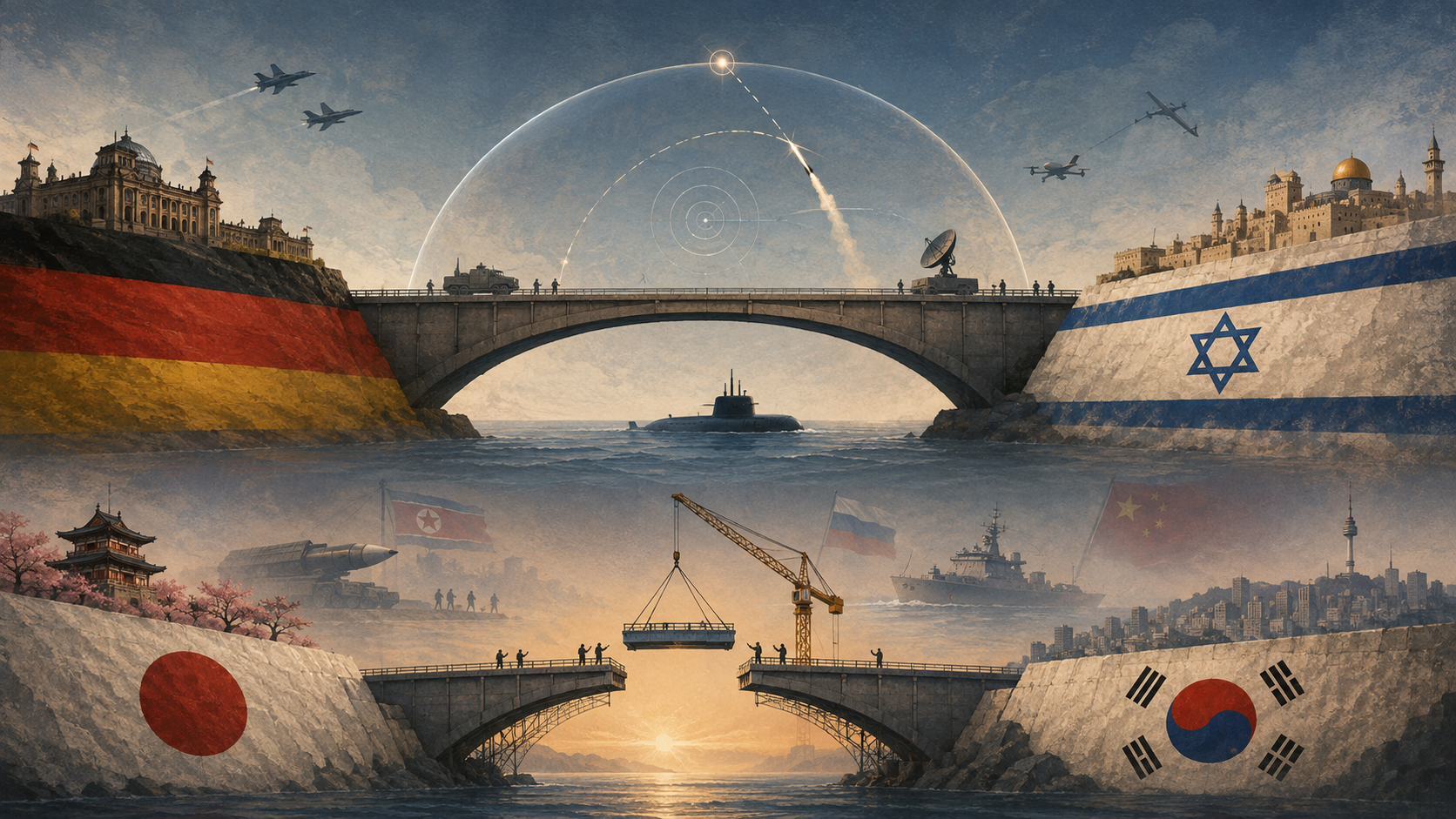
More than 80 years after World War II, Germany and Israel have developed a remarkable security relationship. German-built submarines constitute an important part of Israel’s naval power, Israeli defense technologies have been incorporated into the German Bundeswehr, and both countries cooperate in areas including missile defense, intelligence, cyber security, military technology, and training.
Such a relationship might have seemed extraordinary in the immediate aftermath of the Holocaust.
Therefore, the German-Israeli experience offers useful lessons for another historically difficult relationship: Japan and South Korea.
To be sure, the historical experiences are fundamentally different, and thus they should not be equated. Nonetheless, Germany and Israel demonstrate a crucial strategic principle: complete historical reconciliation is not necessarily a precondition for meaningful security cooperation to begin. Practical cooperation can first develop around concrete security needs, and it could be institutionalized with the passage of time.
The lesson is increasingly becoming relevant as Japan and South Korea face growing North Korean military capabilities, deepening Russia-North Korea cooperation, China’s military expansion, and a strategic environment in which the United States is encountering an increasingly heavy burden.
From Secret Contact to Strategic Cooperation
German-Israeli defense cooperation started much earlier than is sometimes remembered.
In 1957, Shimon Peres, then director-general of Israel’s Ministry of Defense, secretly met with West German Defense Minister Franz Strauss, initiating close covert cooperation between the two defense ministries. West Germany subsequently supplied Israel with military equipment, and from 1962, the relationship expanded to include major weapons systems such as transport aircraft, helicopters, tanks, and other weapons systems to Israel.
This relationship was politically sensitive, and much of the early stages of the cooperation remained discreet. Nevertheless, it was not merely about Germany assisting Israel.
Since the Arab countries were operating massive quantities of Soviet equipment, Israel possessed valuable expertise on Soviet weapons and military practices. For West Germany, which was confronted with the Warsaw Pact across the divided European continent, such intelligence had strategic value.
Such reciprocity mattered. What began partly as assistance gradually evolved into a relationship based on mutual security interests.
The partnership further deepened in the post-Cold War era. After the 1991 Gulf War, Germany financially helped Israel with the Dolphin-class submarines and later continuously offered subsidies for additional submarine acquisitions. In 2017, Berlin agreed to contribute 540 million euros toward three additional submarines.
Meanwhile, the flow of military technologies increasingly moved in both directions. Germany started to introduce Israel’s defense systems while expanding cooperation in missile defense, cyber security, and military training. In 2026, the German and Israeli armies signed an official agreement for cooperation that covers doctrine, training, personnel, and capabilities.
America’s Allies Need Each Other More
Japan and South Korea remain America’s treaty allies, and bilateral cooperation should complement—and not replace—the existing alliance framework. But America’s military resources are finite.
The United States should prepare for simultaneous contingencies across Europe, the Middle East, and the Indo-Pacific. Ships, aircraft, missile defense interceptors, precision-guided munitions, and other logistical assets committed in one theater cannot always be available for other theaters.
At the same time, boundaries between theaters are becoming blurred.
The deepening military relationship between Russia and North Korea demonstrates how Asia’s security problems can directly impact Europe’s war. Through exchanging military equipment, technology, and operational support, Moscow and Pyongyang have shown that the balance in diverse theaters that are several thousand kilometers apart can be altered.
China, Russia, and North Korea do not constitute an alliance arrangement akin to NATO, and their interests often clash. Nonetheless, their expanding cooperation is creating strategic problems for Washington and its allies in Northeast Asia. Simply put, pressure in one area could increasingly influence the need for deterrence in other areas. Thus, America’s allies should become more capable of supporting one another.
Begin With Concrete Operational Problems
The first lesson from German-Israeli cooperation is that Tokyo and Seoul should not begin with an overly ambitious political objective. A formal Japan-ROK military alliance is neither necessary nor politically realistic. Instead, both governments should discern specific operational problems for which cooperation produces measurable benefits.
Missile alert already provides an example. Other possibilities may include anti-submarine warfare (ASW), maritime surveillance, cyber defense, C-UAS, and the protection of critical infrastructure.
Freedom Edge, a trilateral exercise, provides an important institutional framework. Yet Japan and South Korea should gradually develop a bilateral mechanism.
The ultimate goal should not be independence from Washington. It should rather be reducing the amount of American capacity that is required to make the regional security structure function. If Japan and South Korea could rapidly share intelligence, effectively coordinate responses, and bridge some operational gaps themselves, US troops could be used more flexibly across the broader Indo-Pacific.
Combine Complementary Defense Technologies
The second lesson is that cooperation becomes sustainable once both sides gain something tangible.
Germany and Israel gradually developed a reciprocal security relationship because each possessed capabilities valuable to the other. Japan and South Korea have similar opportunities.
South Korea has developed substantial capacity to produce tanks, artillery systems, missiles, aircraft, warships, and ammunition. Japan possesses strengths in sensors, electronics, materials, naval systems, robotics, and space technologies. C-UAS can offer a politically manageable starting point.
Recent conflicts in Ukraine and the Middle East have demonstrated the increasing threat posed by drones and the economic problems that are created when militaries use expensive interceptors against comparatively cheaper targets.
Both Japan and South Korea face the growing possibility of a saturation attack that includes missiles and unmanned systems. If Japan’s strengths in sensing, electronics, and precision components are coupled with South Korea’s advantages in missile production and defense industrial manufacturing, this could produce useful systems for both countries.
Cooperation could later expand to autonomous maritime systems, electronic warfare, missile detection, artificial intelligence, and space-based surveillance.
Build a Defense Industrial Backup System
The third lesson is even more important in a protracted conflict. Japan and South Korea should see each other’s industrial capacity as a strategic reserve.
A large-scale contingency in the Indo-Pacific could deplete missiles, ammunition, drones, spare parts, and missile defense interceptors at rates far above normal peacetime production. American defense- industrial capacity alone may struggle to meet simultaneous munitions requirements across Asia, Europe, and the Middle East.
Tokyo and Seoul should therefore review how their defense industries would assist each other in a prolonged crisis. Both countries could begin with common standards for selected components, reciprocal maintenance arrangements, shared supply-chain information, coordinated stockpiling, and a mechanism that allows factories in one country to produce specific components required by the other.
If a missile attack, cyber operation, or naval blockade impedes one country’s production, the industrial capacity of the other could help sustain military operations. Such measures could transform Japan-South Korea cooperation from diplomatic symbolism to practical military resilience.
Institutionalize Cooperation Without Overpoliticizing It
The German-Israeli case offers a subtle lesson.
Some sensitive security relationships could first develop through cooperation at the working level rather than through grandiose political declarations.
The secrecy surrounding the early German-Israeli contacts would not be applicable in the contemporary era and would not necessarily be desirable. However, Tokyo and Seoul do not need to turn every technical defense initiative into a highly publicized political project.
Military officers, engineers, intelligence experts, and defense officials should be allowed to structure habits of cooperation beneath the level of summit diplomacy. In that sense, a permanent bilateral defense technology dialogue would be able to annually identify a limited set of projects that would be mutually beneficial.
Security Cooperation Does Not Erase History
There is an important caution in the German-Israeli comparison. Security cooperation cannot replace efforts to deal with history.
The relationship between Germany and Israel developed alongside Germany’s explicit acknowledgement of its responsibility for the Holocaust. Japan and South Korea should pursue their own political framework in order to deal with historical disputes.
Security cooperation should therefore not demand that South Koreans simply forget about Japan’s colonial rule. Moreover, every defense initiative should not wait until historical disagreements disappear. A more realistic approach would be compartmentalization.
Tokyo and Seoul could continue to manage historical issues while acknowledging that North Korea’s nuclear weapons, Russian-North Korean military cooperation, and China’s expanding military capacity would not wait until such issues are fully addressed.
From Dependence to Allied Resilience
Hence, the most profound lesson from German-Israeli security cooperation is not that history would become irrelevant. It is that countries with painful histories can still recognize newly emerging common interests and establish institutions centered around them.
Washington will continue to remain essential for Northeast Asia’s security. Nonetheless, an alliance structure in which every major contingency requires additional US naval vessels, interceptors, intelligence assets, and logistical support would become unsustainable if crises occur across several regions.
The next stage of the US alliance system should therefore link America’s alliances more directly with one another. A couple of decades ago, Germany and Israel started to develop such cooperation under extremely unfavorable historical conditions.
Japan and South Korea should raise a similarly practical question today: If a large-scale regional contingency breaks out within five or ten years, which capabilities will they wish they had started developing together now?