Political science graduate and Israel advocate
What “Globalize the Intifada” Really Means
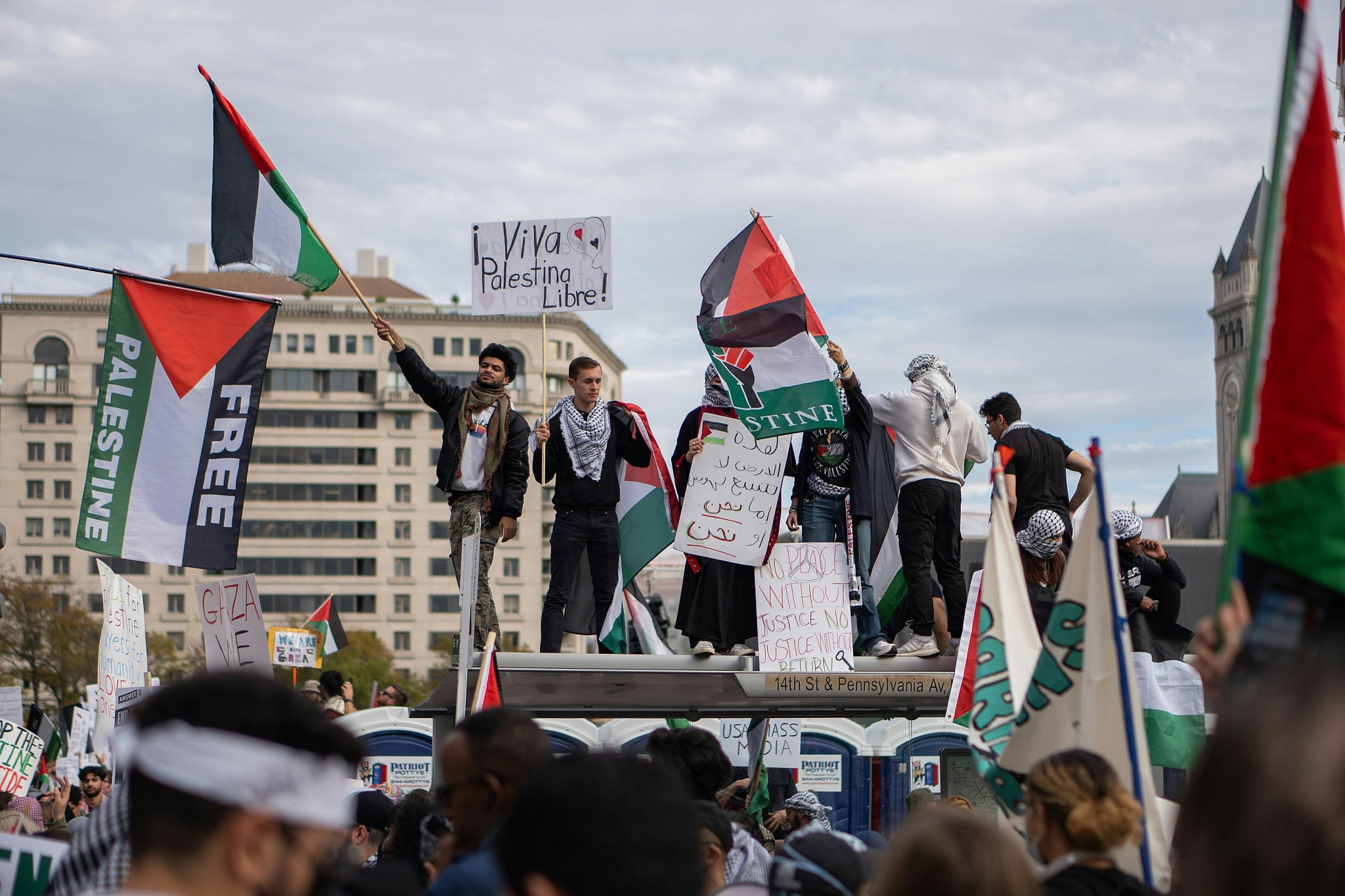
Protesters wave Palestinian flags during a pro-Palestinian rally at Freedom Plaza in Washington, D.C., November 4, 2023. (Photo by Ian Hutchinson / Unsplash)
In the recent Eurovision Song Contest held on May 17th, 2025, in Basel, Switzerland, Yuval Raphael, a Nova massacre survivor, represented Israel with her song of hope, “New Day Will Rise.”
Starting from day one of the competition, the young singer became a target of threats, hate speech, and discrimination beginning with the Turquoise Carpet event, where she was met by Palestinian flags and anti-Israel protest chants. Among the crowd, a man made a menacing gesture, drawing his hand across his throat as the Israeli delegation entered.
Just four days later, the hostility took a deadly turn far from the stage. On May 21st, 2025, at 21:08 in Washington, D.C., a man armed with a handgun opened fire outside the Lillian & Albert Small Capital Jewish Museum. The attack brutally ended the lives of two Israeli Embassy staff members, shot down in cold blood on American soil, adding yet another chapter to the wave of rising anti-Israel violence.
What happened a few days ago is part of a bigger chain of events. It is, in fact, part of a disturbing trend with a name. Across protests, university campuses, and social media feeds, a rallying cry has resurfaced: “Globalize the Intifada.”
The Arabic word Intifada, meaning “uprising” or “shaking off,” historically refers to waves of violent Palestinian resistance against Israel, marked by terrorism and civilian casualties. Today, that term is being revived and rebranded by Western activists and influencers who, under the banner of “resistance” and “liberation,” are giving cover to violence, antisemitism, and calls for terror.
This shift of perception towards the events and Israel is actually dangerous and layered. From the threats hurled at an Israeli singer on a European stage to the cold-blooded murder of diplomats in Washington, the signs are everywhere.
So what brought us to this point?
It all started as global support for Palestinian civilians. People marched, posted online, raised their voices. But slowly, something changed. That solidarity shifted into a movement that now excuses terrorism, and spreads hate against Jews coated as “resistance.”
There’s no differentiation anymore between standing for human rights and supporting terror. That line has been crossed. In universities, in protests, and all over social media, chants like “From the river to the sea” are not rare. They are everywhere. So the question is simple: how did we go from caring about innocent lives to cheering for bloodshed?
Let’s take the outrageous case of Guy Christensen, a well-known pro-Palestinian influencer in the United States. Just days after the brutal shooting in Washington, D.C., that left two Israeli embassy officials dead, Christensen went online to defend the attack. He didn’t express grief; he, in fact, justified it. His exact words were: “The shooter was not a terrorist. He was resisting an occupying regime.”
These weren’t anonymous internet comments. They came from a person with hundreds of thousands of followers, including university students, protest organizers, and self-styled human rights activists. This person’s words didn’t exist in a vacuum; they were an echo of the ideological script of the radical activism.
The shooter, Elias Rodriguez, shouted “Free Palestine!” as he opened fire. He wore a keffiyeh, a symbol once associated with national identity but now often deployed in radical leftist circles as a badge of ideological militancy. Rodriguez was reportedly affiliated with the Party for Socialism and Liberation, a political group that has publicly called to “globalize the Intifada.” For years, he had been consuming antisemitic propaganda and conspiratorial content, all part of a slow, deliberate radicalization process disguised as activism.
There is a deep and unresolved contradiction in this new wave of pro-Palestinian activism. First it claims that Hamas does not speak for the Palestinian people. Then, just moments later, it praises Hamas’s attacks as acts of legitimate resistance. But don’t be fooled. This has never been a confusion. It is a calculated strategy. It lets activists hold on to the moral high ground by showing sympathy for Palestinian suffering while at the same time defending or even celebrating the murder of civilians, both Jewish and Palestinian.
What we are seeing is not a call for peace. It is the glorification of martyrdom. It is the normalization of hatred against Jews. It is the repackaging of terror as justice and of antisemitism as resistance. Influencers like Christensen, parties like the PSL, and university circles that host speakers who justify violence are not neutral voices. They are the ones shaping a narrative that has turned the word resistance into a polite way of saying extremism.
The resurgence of antisemitism in recent years has taken on new forms, often disguised in the language of social justice and political activism. This modern iteration doesn’t always resemble the overt hatred of the past. Instead, it manifests subtly, under the guise of progressive ideals.
Social media platforms have become fertile ground for spreading antisemitic rhetoric. Under the pretense of advocating for Palestinian rights, some users disseminate content that crosses the line into hate speech.
These platforms allow for the rapid spread of misinformation and extremist ideologies, often without adequate moderation. It only takes one post. One lie. And suddenly, millions believe it, and hate spreads like wildfire.
And it’s not just Instagram or X. Some governments like Turkiye and Qatar are fueling this hate in the name of ‘solidarity.’ Turkiye, for instance, has long positioned itself as a staunch supporter of the Palestinian cause. However, this support often blurs the line between legitimate advocacy and the endorsement of extremist elements. In an article for The Times of Israel, Turku Avci discusses how Turkey utilizes the Palestinian issue as a tool for radicalization, leveraging it to bolster its geopolitical standing and influence in the Muslim world. Similarly, Qatar’s financial backing of Hamas raises concerns about the state’s role in enabling organizations that have been designated as terrorist groups by multiple countries.
While Qatar frames its support as humanitarian aid, critics argue that it indirectly fuels the ongoing conflict and perpetuates antisemitic ideologies. Israel’s Minister for Diaspora Affairs, Amichai Chikli, has pointed to Ireland and Spain as examples of countries where political actions have veered into antisemitic territory. In an interview with Euronews, Chikli criticized these nations for their increasing hostility towards Israel and the Jewish community, citing their recognition of a Palestinian state and support for legal actions against Israel as indicative of a broader trend of institutionalized antisemitism.
One of the scariest parts? Antisemitism now hides behind what looks like political critique. While it’s entirely valid to scrutinize any government’s actions, there’s a fine line between policy critique and the propagation of age-old antisemitic tropes.
This phenomenon is evident in the way some activists and influencers conflate the Israeli government with Jewish people worldwide, leading to a rise in antisemitic incidents globally. The rebranding of antisemitism as progressive criticism not only endangers Jewish communities but also undermines genuine efforts to address human rights concerns in the region.
This redefinition of antisemitism has also impacted humanitarian efforts as a moral disguise while funneling money into war and terror. How has humanitarian aid been weaponized in this conflict? Who truly benefits from the billions in international assistance?
When aid enters Gaza, it isn’t intercepted. It’s handed directly to Hamas, the ruling government in Gaza. They take that aid — constituted of food, medicine, and other essentials donated for free by the United Nations and international organizations, funded by taxpayers from mostly Western countries — and they sell it back to their own people for profit. This money helps them keep paying their fighters and rebuilding their underground network, including the 400 miles of tunnels discovered beneath Gaza.
Here’s what people need to understand. During the ceasefire, when hostages were being released, 25,200 trucks entered Gaza. That’s around 400,000 tons of aid — more than one third of all aid delivered during this 19-month war. The people of Gaza were stocked with enough food to last six to eight months. But just 11 weeks later, we’re being told they are starving.
You don’t need to be a mathematician to see the problem. If that much aid went in, and now people are starving, someone is holding it back. And it’s not some mystery. The same group that receives the aid is the one controlling who gets it and who doesn’t. They are not helping their people. They are keeping them hungry on purpose.
At this point, we don’t need fence-sitters. We need people who know the difference between good and evil. There’s no honor in silence. No pride in sitting on the fence while civilians are being murdered and Jewish people around the world are targeted for existing. Israel has the right to defend itself. The Jewish people have the right to live, to speak, and to be heard. And yes, we have the right to call out antisemitism, even when it comes dressed up in progressive language.
If you care about democracy, then say it clearly. You stand with Israel. You stand with Jews. This is not about politics anymore. It’s about what kind of world we want to live in.
Today is May 28, 2025. It has been 600 days since the hostage crisis began. Six hundred days of waiting. Of hoping. Of fighting to keep names and faces from fading. The world forgets. We remember. The Jewish people have been through worse. We survive. We rebuild. We carry on. But now is not just the time to endure. It is the time to speak up. Loudly. Clearly. Without shame.
We know who we are. It is time the world knows exactly where we stand and who stands against us.
Related Topics
Related Posts