
What Happened to “WE”?
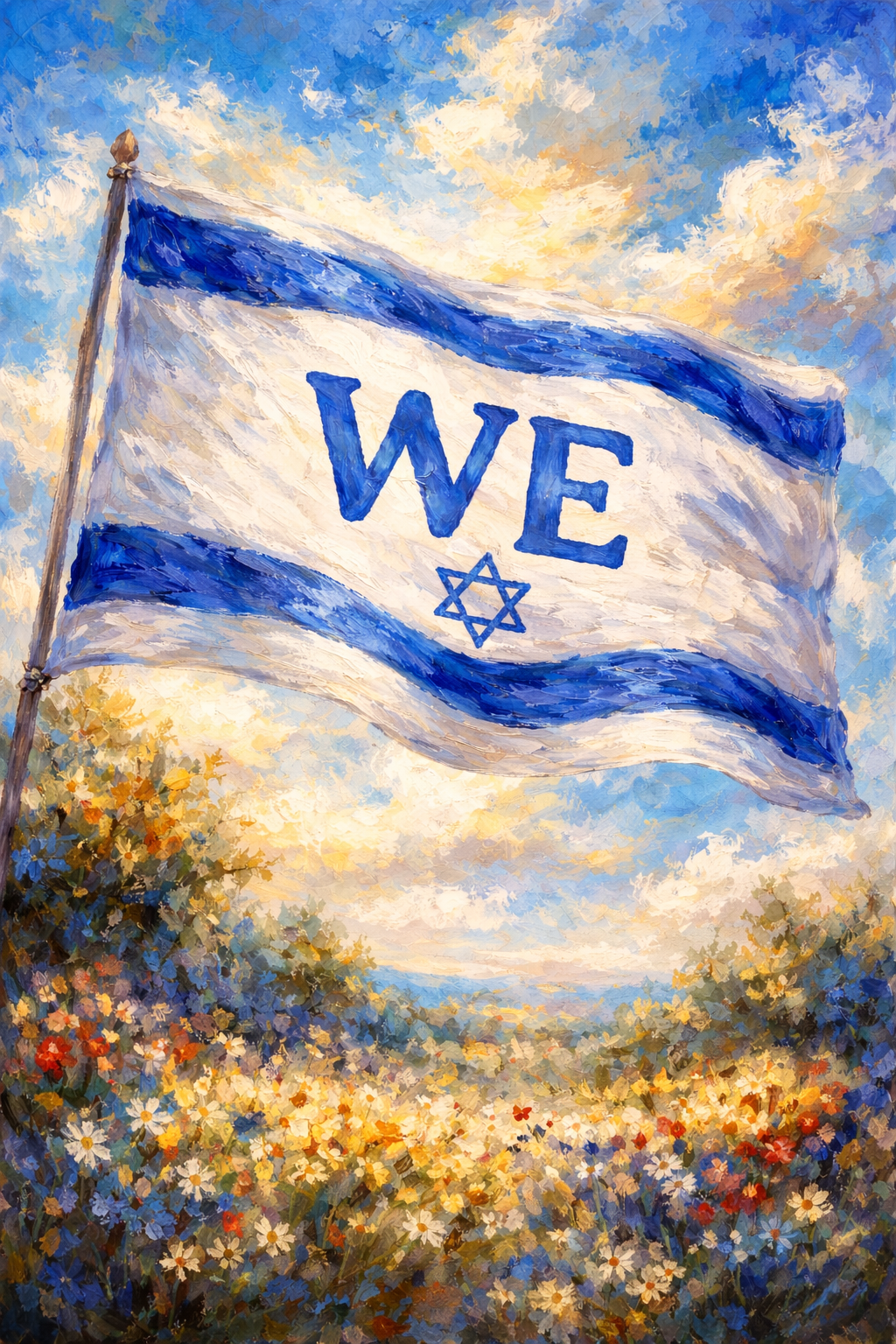
Israel knows how to be “for ourselves.” But Hillel warned us about the next step: If I am only for myself, what am I?
Israel was born in a time when “WE” wasn’t a slogan. It was a survival system.
The pioneers weren’t saints, and the early story wasn’t as tidy as nostalgia makes it. There were deep injustices and enduring wounds. But there was a prevailing ethic that said: we will carry one another because we have no other choice. You could disagree with your neighbor’s politics, his prayers, his accent, his food, his whole approach to life—and still build a road together, guard the perimeter together, absorb immigrants together, bury the fallen together.
That “WE” was forged in scarcity, danger, and shared work. It was strengthened by institutions that made mutual obligation feel normal: the army, the unions, the public ethos of building, the kibbutz and the cooperative spirit even outside it. The sabra myth—with all its flaws—had one central demand: don’t be delicate about the group. The group is the point.
Somewhere along the way, we became a different kind of normal.
Today’s Israel can still summon breathtaking solidarity—but mostly under fire. In routine politics and budgets, we increasingly look like a society of sectors and tribes, each convinced it must take as much as it can while it can. Not because everyone is greedy, but because the system teaches people to fear being the sucker. The commons becomes a buffet, and politics becomes a contest of elbows.
In defense, the “WE” reappears—often instantly. But even there it does not fully hold, because the burdens of defense and service are not shared evenly, and we have turned that fact into an ongoing civil argument rather than a national emergency. We fight external enemies with unity, and then return to internal bargaining with a quiet assumption that someone else will pay for the roof over all of us.
Hillel saw this long before there was a Knesset, long before there were budgets and coalition agreements:
“If I am not for myself, who will be for me?
If I am only for myself, what am I?
And if not now, when?”
Israel mastered the first line. We had to. The Jewish people were not offered the luxury of leaving our fate to the goodwill of others.
But the second line is where nations fail. If I am only for myself, what am I? Not “what am I” as a moral riddle for philosophers, but “what am I” in the brutally practical sense: what kind of society can survive that posture?
A society that lives in “only for myself” becomes a society that cannot do hard things together. It becomes a society that cannot plan for the long term, cannot repair what it breaks, cannot ask people to sacrifice today for a future they will not personally enjoy. It becomes a society that can still fight—but cannot build.
And that is the phase that leads to collapse. Not collapse in one dramatic day—collapse as a gradual thinning of trust, a slow corrosion of institutions, a steady conversion of citizenship into transaction.
The drift: from commons-building to coalition extraction
The old “WE” did not disappear because people stopped loving Israel. It weakened because incentives changed and the national story fractured.
Prosperity and modern life, ironically, make “WE” harder. When the middle class grows and opportunities multiply, it becomes psychologically easier to say: I earned mine. Why should I carry you? In a poor society, everyone knows the roof leaks; in a richer society, people start renovating their own rooms and stop noticing the foundation.
Demographic and cultural complexity also makes “WE” harder. Israel is no longer a small band of pioneers with a relatively shared vocabulary. It is a modern state with multiple communities, multiple historical grievances, and multiple definitions of what the state even is. Some of those grievances are justified. But the political expression of grievance can become a permanent entitlement machine: not “repair what was done,” but “pay my sector forever.”
And then there is the coalition system, which in recent years has felt less like a mechanism for governance and more like a mechanism for extraction. When the survival of a government depends on narrow parties holding disproportionate leverage, the commons loses by default. Budgets become bargaining chips. Public policy becomes a reward structure. “The national good” becomes whatever can keep the coalition intact for another season.
I don’t mean this as a partisan rant. A coalition can be legitimate and necessary in a diverse society. The problem is when coalition logic becomes the dominant ethic: take what you can now, because the other side will take it later.
That is not governance. That is looting with paperwork.
The “WE” cannot be selective
A “WE” that only appears in war is not a “WE.” It’s a reflex.
True commons orientation means we share the burdens even when there is no siren. It means we treat education, public safety, infrastructure, honest budgeting, clean institutions, and a functional civil service as sacred—because they are what keep a society coherent.
It also means we do not allow exemptions from national obligation to become permanent. Every society can carry exceptions. But a society cannot survive a moral structure where some communities declare service optional while demanding full benefits of the collective—especially in a small nation living under genuine threat.
This is not an argument against Torah study. Study can be a pillar of Jewish continuity. But when study becomes a shield against shared obligation—and when political deals sanctify that shield—the message to the rest of society is poisonous: your sacrifice is required; mine is negotiable.
That is how you turn “WE” into resentment. And resentment is a solvent.
Prayer and texts are not enough
I will say something that makes some people uncomfortable: neither prayer nor study of texts will fix this on their own.
Not because prayer is worthless, and not because our texts are not profound. But because spiritual life does not automatically restructure incentives. It does not automatically create fairness. It does not automatically stop a coalition from becoming a coalition of exploiters.
We have learned—painfully, repeatedly—that religious intensity can coexist with social corruption. Jews know this from our own internal histories. Piety is not immunity. Scholarship is not stewardship.
What fixes a society is the hard, unromantic work of building a commons: shared obligations, respected institutions, transparent budgets, restrained leaders, and a culture that treats public life as a responsibility rather than a prize.
Is Israel headed for collapse within 100 years?
It is a frightening question, and it is not melodramatic.
Israel is still young. Young nations can burn brightly and then burn out—especially when internal conflict becomes a way of life. Collapse does not require defeat by enemies. It can be self-inflicted by the steady normalization of “only for me.”
But collapse is not destiny. Israel has immense strengths: civic competence, ingenuity, a deep capacity for mutual aid at the local level, and a public that can still mobilize with astonishing speed when it believes the house is on fire.
The issue is whether we will treat this moment as a fire.
Hillel’s third line is the one we don’t like because it removes the comfort of “later”: If not now, when? Not “when the coalition changes.” Not “when the other side calms down.” Not “when the war ends.” Now—because the habits we practice in ordinary days become the only habits we have when crisis comes.
A country cannot live on emergency solidarity alone. If “WE” is a wartime costume we put on and take off, then we are not a nation—we are a collection of factions sharing a zip code and an air force.
Israel was not built by people who asked, “What can I get?” It was built by people who asked, “What must be done—and what do I owe?”
If we cannot recover that question, we will learn Hillel’s warning not as wisdom, but as epitaph.
And if not now—when?