CFO | Empower Society for Good I Author
What Holds a People Together?
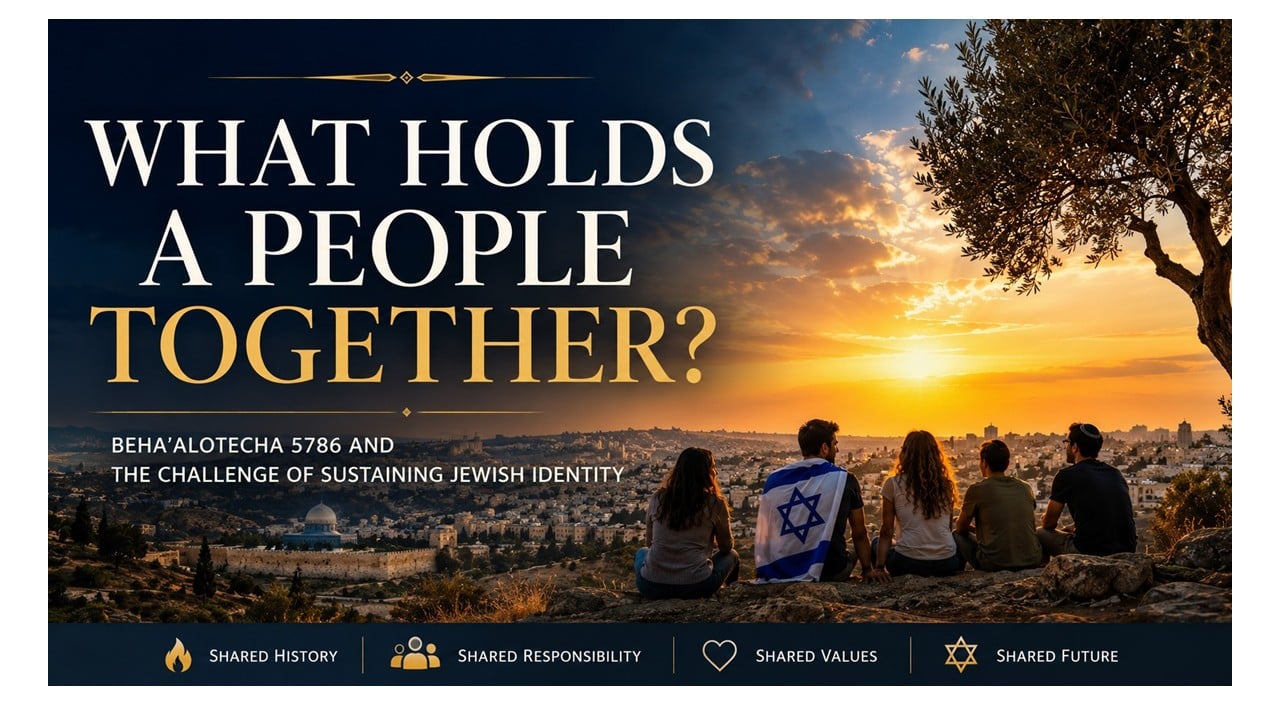
Beha’alotecha 5786 and the Challenge of Sustaining Jewish Identity
This week’s reading of Parshat Beha’alotecha may be one of the most relevant Torah portions for the world we are living through today.
At its core, the Parsha asks a profound question:
What actually holds a people together?
Is it power?
A common enemy?
Shared history?
Religion?
Land?
Leadership?
Culture?
Memory?
Purpose?
Because the Torah portion begins with light and ends with fracture.
In between, we encounter leadership crises, complaints, uncertainty, nostalgia, division, spiritual confusion, and the exhausting challenge of transforming a freed people into a functioning society.
And perhaps that is why this Parsha feels so relevant right now.
Because Israel today is not standing at Sinai.
We are living in the wilderness between redemption and destination.
The Menorah — Sustaining the Flame
The Parsha opens with Aaron lighting the Menorah.
Not creating fire.
Sustaining it.
Rashi famously explains that the flame had to rise on its own.
That may be one of the deepest challenges facing the Jewish community after October 7.
For a brief moment, Jewish identity became unavoidable.
The illusion that history had “normalised” disappeared overnight.
Jews who felt distant suddenly felt connected.
Many rediscovered prayer, community, Zionism, family, and peoplehood.
Others began asking deeper questions:
Who are we?
Why does the world remain so obsessed with Israel?
What is the purpose of Jewish survival?
But inspiration is always easier than continuity.
The real challenge is whether the flame lasts once the emergency fades.
Can Jewish identity sustain itself beyond trauma?
Can Israel remain not only strong, but purposeful?
Can we build a society rooted not only in survival, but in responsibility, morality, and meaning?
That is the opening challenge of Beha’alotecha.
Not merely how to ignite passion.
But how to sustain the flame.
The Leviim — More Than Economics and Power
The Parsha then formally inaugurates the Leviim into national service.
At first glance, modern readers may struggle with the idea of hereditary spiritual roles. But the Torah is introducing something far deeper than privilege.
The Leviim receive no land.
No territorial inheritance.
No independent economic power.
Their role is service.
They maintain the spiritual and moral infrastructure of the nation.
In modern language, the Torah recognises something essential:
A civilisation cannot survive on economics, military strength, technology, and politics alone.
Someone must carry responsibility for: education, memory, values, continuity, teaching, music, holiness, and moral purpose
Israel today embodies this tension powerfully.
We have built an extraordinary state: innovation, medicine, agriculture, science, military capability, and economic resilience.
We made the desert bloom.
But the Torah asks a deeper question:
What sustains the soul of a nation?
Because without shared responsibility and moral vision, even successful societies can fracture internally.
Perhaps that question extends far beyond Israel.
Many Western societies today appear materially successful, yet increasingly divided, anxious, isolated, and uncertain of what actually binds them together.
Pesach Sheni — The Power of Return
One of the most remarkable moments in the Parsha is the request of those who were unable to bring the Korban Pesach.
They ask:
“Why should we be left out?”
And God creates Pesach Sheni — a second chance.
This is extraordinary.
The Torah builds into Jewish life the possibility of return.
Not perfection.
Return.
Perhaps this speaks deeply to our generation.
October 7 was devastating.
The pain remains raw.
The hostages remain in our consciousness.
The trauma has reshaped Israeli society.
But perhaps the moment also forced a painful reckoning.
Many Jews rediscovered identity through crisis.
Many Israelis rediscovered peoplehood.
Many who had drifted from tradition or Zionism suddenly felt the weight of Jewish history again.
Not because suffering is holy.
Judaism never romanticizes tragedy.
But because crises can strip away illusions.
And maybe the deeper question now is:
What do we do with this awakening?
Does it disappear once life stabilizes?
Or does it become the beginning of deeper responsibility?
Pesach Sheni reminds us:
Missing something spiritually is not necessarily the end of the story.
The Wilderness — Freedom is Harder Than Slavery
The Jewish people finally begin their journey from Sinai.
The cloud moves.
The nation moves.
Sometimes quickly.
Sometimes slowly.
The people must learn to live with uncertainty.
Then the complaints begin.
The people long nostalgically for Egypt — not because Egypt was good, but because freedom is difficult.
Slavery removes responsibility.
Freedom demands maturity.
The wilderness generation struggles with uncertainty, sacrifice, and discomfort.
They want redemption without burden.
And honestly, modern societies often struggle with the same challenge.
We increasingly live in cultures that emphasize:
rights without obligations,
identity without responsibility,
activism without accountability,
freedom without discipline.
But covenantal societies cannot survive that way.
The Torah’s vision of freedom is not:
“Do whatever you want.”
It is:
Build a society capable of moral responsibility.
Perhaps that is what truly holds a people together.
Not fear alone.
Not power alone.
But shared responsibility.
Moses, Miriam, and the Fragility of Unity
Then comes one of the Torah’s most human moments.
Moses breaks emotionally.
“I cannot carry this people alone.”
The Torah does not romanticize leadership.
Leadership is burden.
Especially during national crisis.
God responds by appointing seventy elders.
Responsibility must become shared.
This may be one of the great lessons Israel has relearned since October 7.
A nation survives not only through governments or armies, but because ordinary people step forward: soldiers, reservists, medics, teachers, volunteers, families, and communities.
The Parsha ends with Miriam speaking negatively about Moses and being struck with tzaraat.
The nation waits for her healing before continuing their journey.
Speech matters.
Internal division matters.
National cohesion matters.
Before October 7, Israeli society was deeply fractured.
The political and social divisions felt dangerous.
The external enemies of Israel are real.
But the Torah repeatedly warns that internal erosion can also weaken a nation from within.
The Jewish people do not survive through power alone.
We survive through covenant.
What Holds a People Together?
Beha’alotecha is ultimately the Torah’s transition from inspiration to maturity.
Sinai was revelation.
But revelation alone does not build a civilization.
The harder task is sustaining identity in ordinary life through institutions, responsibility, discipline, leadership, memory, shared purpose, and moral courage.
Perhaps that is why the Parsha begins with the Menorah.
The flame flickers.
Sometimes violently.
But the task of the Jewish people has never merely been to survive darkness.
It has been to carry light through it.
Questions for Discussion
Sustaining the Flame
- What sustains Jewish identity beyond moments of crisis?
- Can identity built through trauma survive long-term?
- What does it mean for the flame to “rise on its own”?
Responsibility and Society
- What actually holds a society together?
- Can freedom survive without shared responsibility?
- Who are today’s “Leviim” in Israeli and Jewish society?
Pesach Sheni and Second Chances
- Has October 7 awakened something within the Jewish world?
- Can national crises lead to spiritual renewal?
- What would meaningful collective “teshuvah” look like today?
Unity and Division
- How do we disagree without destroying national cohesion?
- Has social media strengthened or weakened Jewish unity?
- What balance should exist between criticism and collective responsibility?
Related Topics
Related Posts