Educator, Historian, Facilitator, Journalist, Orioles fan
Reflections On A Week In Berlin
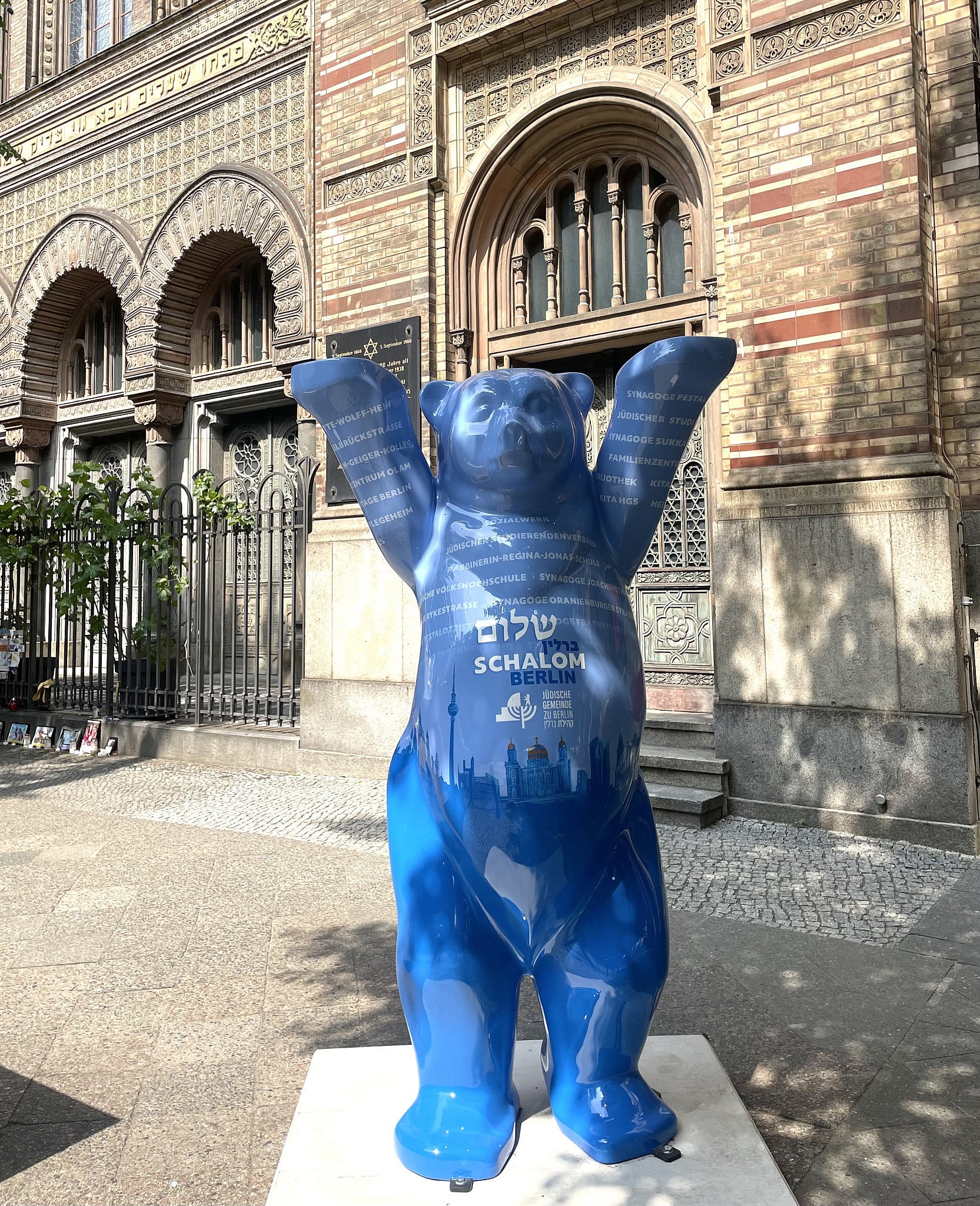
A Jewish version of the ubiquitous Berlin bear greets visitors to the 19th century New Synagogue-Centrum Judaicum building.
You walk down the street – past people of all ages advertising colorful tattoos and piercings, others in natty suits while holding briefcases. A dizzying array of Thai, Turkish, Vietnamese, vegan, German and other dining options confuse the yearning palette. Cafes are busy with friends and family dining, drinking from teeny espresso cups and quaffing liters of beer. Underneath the little red guy on the street sign a crowd gathers to wait for his inevitable transition to green – no jaywalking here. The tram glides by as bicyclists keep to their lane, of which you better be aware. And the architecture offers 18th century buildings with carved statues adjacent to structures sporting the neatly angled chrome and steel of the 21st century. A glance down reveals shiny goldish squares with German writing, one of the city’s 11,000+ stolpersteines (stumbling blocks), markings of where Nazi thugs dragged people away to likely death.
Welcome to 5 p.m. on a Tuesday in Berlin, Germany.
After a week traversing the city’s remarkable array of historical offerings – the old Jewish Quarter, the Berlin Wall’s remnant, the East Germany Museum, imperial palaces financed by court Jews, and abundant spots that witnessed modernity’s greatest human deprivation. There’s one word for it: Complex.
After a month in Israel, the goal was to visit Berlin to investigate Jewish life BEFORE and AFTER the Holocaust. Berlin – legendary for both permissiveness and being the heart of the failed 1,000-year Reich – is not surprisingly a venue of continual contrast, ancient and contemporary. It’s also where modern Jewish studies reached their zenith in the first few decades of the 20th century, housing in its university lecture halls giants such as Heschel, Schneerson, Soloveitchik, Buber, Rosensweig, Scholem and more. It offered the first female rabbi in Regina Jonas – murdered in the Kingdom of Death. It’s fair to say that without 20th century Berlin, 21st century global Jewish life would be sans significant Jewish philosophy, theology and history to guide it. We shouldn’t ignore all that.
Not long after its founding in 1231, Berlin was anomaly of sorts for Jews. None towers more than the 18th century’s Moses Mendelssohn; much of his thought laying the groundwork for what becomes Modern Orthodoxy, which crystalized a century later in Hamburg with Rabbi Samson Raphael Hirsch. Mendelssohn’s legacy lives on in a 500 or so student co-ed Jewish middle school and high school, founded in 1778 by colleagues inspired by his rigorous learning of both Jewish and secular subjects. The school still sits on its original site and has preserved the original stone carved entrance. About 100 feet away marks the spot of Mendelssohn’s grave – destroyed by the Nazis like others in that final resting yard. A little less than a mile or so away, the city marks the location of Mendelssohn’s home, now at the edge of the busy and entertaining Alexanderplatz. A large outline in the sidewalk marks its location and an embedded sign notes “In this house lived and worked the immortal. Moses Mendelssohn. Born in Dessau 1729. Died in Berlin 1786.”
The official city cannot seem to make enough mention of the Jews woven through the diverse fabric that is Berlin’s history. The Berlin City Museum itself is housed in the former mansion of the 18th century’s court Jew, Veitel Heine Ephraim, and is called Ephraim Palais. Before destruction by WW II’s bombing raids, it was hailed as “the most beautiful corner in Berlin.” Its remarkable façade was disassembled, saved and returned home when the building was reconstructed. Every third display in the meticulous four floors seemed to have a notation about a Jew who positively impacted the city’s growth. One sign catching attention noted that in Ephraim’s time about 65% of the Jews were poor and supported by the Jewish community – a wonderful not-so-subtle refutation of all Jews being rich and controlling the world (which, if true, we stink at).
The only Holocaust-related site I knew was a must-see was the stunning outdoor Holocaust Memorial. It’s an outdoor, huge area with different-sized large, dark gray rectangles. Some pillars were as low as two feet and some likely as high as 20 feet high; the stone floor rolled with the ground’s contour. It offered no verbiage, but allowed one to purposely become confused, not sure of where you were, meandering through a controlled form of artistic insanity.
Purposely avoiding most Holocaust references was the goal, but I quickly learned that Berlin without the Shoah is like Ocean City without sand. In a city pulsating with energy, the Holocaust is omnipresent even as Berlin’s famous optimism plows through the 21st century. It’s in the huge squares in front of the once backdrops to those massive Nazi rallies. It’s in the omnipresent public art, statues and historical signage throughout the city. It’s in the amazingly preserved Otto Wiedt Workshop For the Blind, where you learn of the “Berlin Schindler,” a non-Jew whose brush factory employed blind Jews – “essential workers” – and included an Anne Frank-style room hiding a Jewish family. It’s in the vast Bebelplatz, the public square surrounded by huge historic buildings and on which Hitler Youth and accomplices gleefully burned thousands of Jewish books in 1933. (I sat on a bench there, closed my eyes, and felt the fire and heard the cheers.)
No one knows how many Jews live in the capital city today. The official number is 12,000, but it could be as high as 50,000, up to 15,000 of whom are estimated to be Israelis (and Hebrew is often heard on the streets) and some 10,000 others from the former Soviet Union. The mix was evident at a small Shabbat evening service and dinner I attended at the rebuilt New Synagogue; its distinct Spanish-Moorish architecture is a distinguishing feature of the Jewish Quarter’s skyline and its museum of the shul’s history is outstanding. The small congregation of Rabbi Gessa Ederbureg – the Oranienburger Straße Synagogue – was kind and welcoming. At dinner they put up with my incessant questioning about today’s community and its challenges.
At evening’s end, I asked if it was safe to wear a kippah on the 20-minute walk back to the hotel. Assured it was, the rabbi ended with a laugh by saying, “I do it all the time, but nobody here understands what it means when a woman wears one.” On the way back, donning said skullcap, a young couple passed and the man said, “Shabbat shalom.” Mission accomplished.
The next day I took an extended Shabbat walk, making it all the way to the far-away remnant of the Berlin Wall. Purposely meandering to the Jewish Quarter on the way back, I hoped to feel how the always crowded area –loaded these days with restaurants and shops – felt during the ubiquitous phrase “before the war.” Alas, from afar one spotted waving Israeli flags and soon heard the notes of stereotypical Jewish music such as “Shalom Aleichem” and “Hatikvah.” It had to happen, I thought, as a pro-Palestinian march rounded the corner adjacent to the chanting pro-Israel crew. I joined the latter in singing. I felt a little silly, but nothing was odd about the marchers’ cry: “Bye-bye Israel, viva Palestine!” A woman with the pro-Israel crew told me that she wasn’t Jewish, but her parents explained to her the Jews’ fate when they were young; she wasn’t going to let it happen again.
That, too, is today’s Berlin.
Comforting me were the literally 75-100 policemen – some looking quite bored – on the scene. Some sat in the 12-15 large police vans slowly driving in front of the marchers, streets blocked off as they went by, those at cafes along the route ignoring them. Later, I learned this was a monthly scheduled anti-Israel event. Thus, a routine one and one in which everyone perfectly played assigned roles.
Avoiding Berlin, which I did for decades, is a mistake. Go to see, learn, experience, think and, yes, even enjoy (such as truly world class museums). It’s a venue where the a.m. coffee is warm, the afternoon’s sites are inspiring, the p.m. beer is cold and the history is forever tortured.
Related Topics
Related Posts