Cardiologist, professor, and Jewish community lay leader
What I Learned from 5,800 Chabad Emissaries
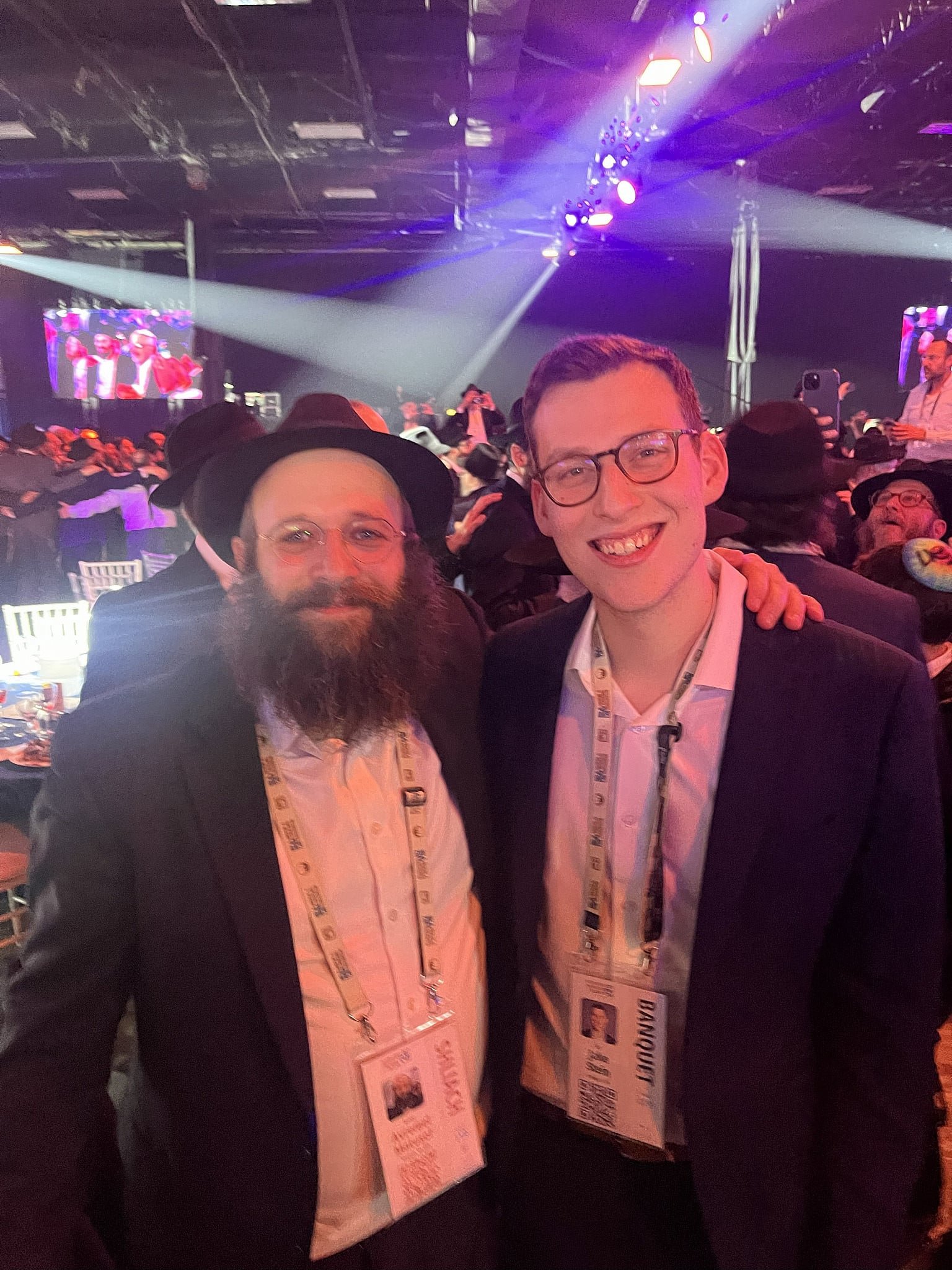
Rabbi Avremel Matusof and my son Jake at the Kinus Gala Banquet.
Yesterday I was honored to attend the Kinus HaShluchim gala banquet, which is part of the annual gathering of Chabad emissaries from around the world. Coming as a guest of the Chabad Madison community offered a powerful window into a movement that often is praised, admired, misunderstood, or questioned – sometimes all at once.
For nearly fifteen years, the Chabad Madison family has played an indispensable role in my life, helping reignite a spark of Judaism I didn’t even realize had dimmed. Still, I wondered whether what I experienced locally reflected something larger or was simply the product of one remarkable family. I had met many Chabadniks on my kids’ college campuses and during several visits to Crown Heights, but even then, I couldn’t fully believe or completely feel the depth of their mission. Being at the Kinus changed that.
Sitting in that gigantic convention hall, I listened to stories from shluchim across the world. Staff Sergeant Benjamin Craig, a U.S. Marine stationed alone in Okinawa, had never had a bar mitzvah and didn’t know what Shabbat was, but in a moment of searching, he visited an Air Force chaplain who happened to be a Chabad rabbi – and his life was changed forever. Young Zalmy Feldman, a boy from Ness Ziona, Israel, who lost both legs to a serious infection, spoke not about tragedy but about purpose and mission. His courage, strength, and conviction were so powerful that we all were brought to tears. And Rabbi Yaakov Raskin, who helped build Jewish life in Jamaica, described surviving a hurricane that destroyed much of what he created, and the responsibility he felt to remain for those on the island.
Listening to them, I realized that moments I’ve experienced in Madison, Wisconsin, are happening daily in thousands of communities across the globe. And what fuels their impact is their conviction and lived belief that every soul matters, that every moment carries responsibility, and that even small acts can illuminate the world.
What struck me most was their sense of mission. The shluchim live as emissaries of purpose, rooted in Hasidic teachings and the life lessons of Rebbe Menachem Mendel Schneerson, z”l, which emphasize positivity, agency, human potential, and an unconditional love for fellow Jews. Witnessing thousands of them, from nearly every continent, united in song, study, prayer, and joy, gave me a deeper understanding of the sincerity and scope of this movement.
One of the most personal moments for me came with my son, Jake. He said mourner’s kaddish for his mother twice – once at the Rebbe’s Ohel and once at the Kinus Gala – and both times, kind, patient Chabadniks guided him through the long Kaddish D’Rabbanan. Watching him reconnect with rabbis from college and experience the same warmth I’ve felt for years reminded me how Judaism is transmitted: through relationships, learning, and lived example. And when we left, he said, “I’ve never felt so much love. This has inspired me to give tzedakah once a month to Chabad.”
Some Jewish people have less positive assumptions about Chabad, and I’ve heard them all. My consistent experience has been the opposite. I have never once been asked for money. I’ve only encountered humility, generosity, a commitment to teaching, a life anchored in Torah and mitzvot, and, most of all, unconditional acceptance. Indeed, the data reflect that what I have experienced is real and widespread: a recent report from the Jewish Federations of North America showed a sustained ‘Surge’ in Jewish engagement after October 7, 2023, with Chabad accounting for approximately 44 percent of that increased engagement.
The Kinus also helped me rethink personal and medical challenges I’m navigating. Chabad chassidus doesn’t frame suffering as punishment or failure. Instead, it offers a demanding but empowering idea: that struggle can be a catalyst for rediscovering purpose, for growth, and for deepened spiritual connection. Watching Zalmy speak about his future with courage rather than despair reinforced that message. The real spiritual question isn’t “Why is this happening?” but “How can this elevate me, and what good can I bring into the world because of it?”
I left the Kinus with even more gratitude for the Chabad shluchim families, for the clarity I felt, and for the reminder that Jewish life flourishes through meaning, connection, and responsibility. Among the many lessons of the Kinus was the realization that each of us has a vital role to play. And I intend to play mine with even greater conviction, starting today.
Related Topics