
What I Learned While ‘Stuck’ in Israel During Operation Rising Lion
On the morning of June 13, I woke up to a dozen missed calls and text messages from loved ones in the U.S. asking if I was safe. “There’s a shelter downstairs,” read a WhatsApp message from the guy I was renting an apartment from.
Groggy from coming out of a deep, uninterrupted sleep (soon to be my last for a while), I quickly searched the news. That’s when I learned: Israel had attacked Iran’s nuclear sites. War had been declared with the Iranian regime.
I had already been in Israel for a week, happily volunteering with Sar-El on an army base in the Negev. Now that the program was over, I was back in Tel Aviv, awaiting the arrival of my boyfriend so that we could enjoy our first trip to Israel together and celebrate his nephew’s bar mitzvah.
Not only would my boyfriend’s flight never arrive, but I would be spending the next 12 days running to bomb shelters to avoid incoming missiles. Here’s what I learned about Israel, the Jewish people, and myself during Operation Rising Lion.
People Look Out for One Another
During times of distress, hardship, or conflict, you sometimes see the best of humanity. When reality feels frightening and the future uncertain, strangers really look out for one another.
As the only tourist in my Airbnb apartment building’s bomb shelter, I witnessed this firsthand. Strangers calmed me down while I was shaking and crying, saying, “Ze beseder, ze beseder.” I may not be fluent in Hebrew, but I knew what they were saying: it’s okay.
In that same shelter, I met a lovely couple who immigrated to Israel from France years ago. They invited me over for Shabbat dinner because I didn’t have a meal to attend.
After the first night of rocket fire, I was too scared to sleep alone. Friends I’d made on the Sar-El program let me crash on the floor of their hotel room, making sure I was fed and that I didn’t miss the free hotel happy hour at 6:00 p.m.
In the weeks leading up to my trip, I was closely monitoring volunteer opportunities through the Swords of Iron Facebook group, and was looking forward to those while in Tel Aviv. These included fruit picking and visiting a Holocaust survivor in a nearby hospital.
With public gatherings canceled due to Home Front Command restrictions, I had to pivot, and was able to find a volunteer opportunity through a local WhatsApp group. A few Tel Avivians had organized an impromptu day camp for young children, giving other parents a much-needed break. Together, we played games and made arts and crafts with the kids, and the parents were so grateful. It was inspiring watching a community come together during an unprecedented time to bring joy to one another.
Through this WhatsApp group, I also was able to borrow a laptop from a generous stranger so I could work remotely from Israel. I hadn’t thought to bring my own since I was just here for vacation!
Any time I told Israelis I was visiting here from New York, they were concerned with my own wellbeing, asking me how I was feeling being here during this historical yet scary time. I even met an army reservist who drove me 45 minutes out of his way so I could be with my boyfriend’s family for the bar mitzvah. I will never forget the kindness shown to me by Jews from all over the world.
Israelis Really are as Resilient as They Say
Before this trip, if I had a shekel every time someone told me how resilient Israelis are, I would have, well, many shekels. But seeing their resilience firsthand was a whole different experience.
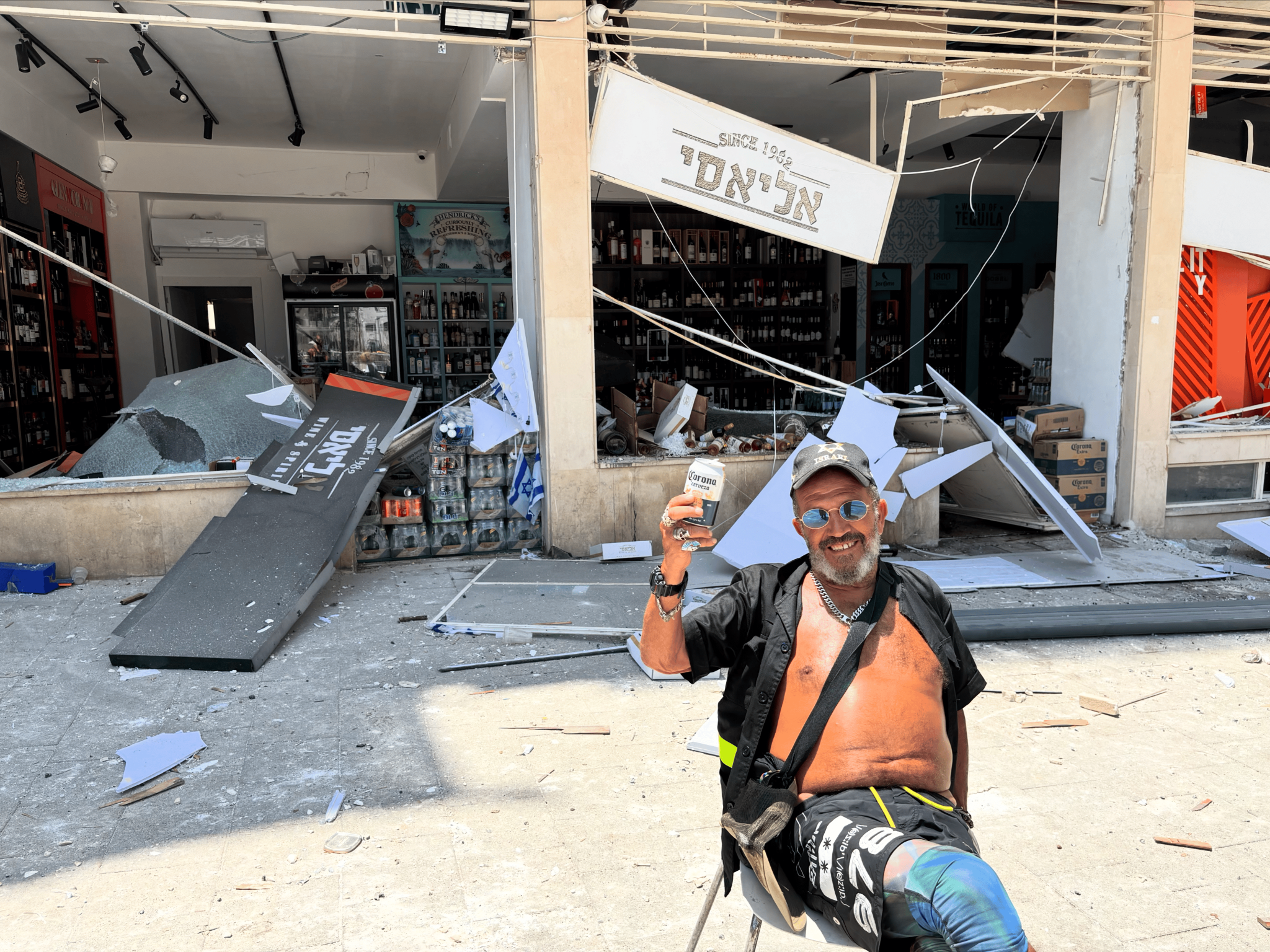
A few days into the rocket attacks, a missile hit a populated Tel Aviv location, destroying apartment buildings and many nearby glass storefronts. This attack occurred just four blocks from the hotel I was staying in.
The large boom was so loud it reverberated in my ear while down in the shelter, and made us tourists scream.
But the next morning, when I walked around surveying the damage, the Israelis I talked to appeared unfazed. Even though they said the barrages were like nothing they had ever seen before, this is their way of life. They expressed that they were not scared, and Israel had to keep fighting the Iranian regime so that both Israelis and Iranians could live in peace.
“We put things to the side and continue forward. That’s the chemistry of the Middle East,” a local told me.
I met someone whose apartment was completely “ripped to shreds” by the missile and remained calm given the circumstances. “I’ll have to find a new apartment. I’m staying with a friend for now,” he said.
I also met a liquor store employee sitting outside the completely destroyed shop with a smile on his face. He fetched me a beer and proudly showed me his necklace that was a map of Israel that bore the words “Shema Yisrael.”
The Israeli spirit of optimism and courage in the face of rocket fire gave me strength while being “stuck” here during this time.
My Jewish Soul Still Stirs
Speaking of being stuck, over those 12 precarious days, many Israelis asked me, “So, you’re stuck here?” Though I was technically “stuck” in lockdown with tight restrictions that limited my movement to the nearest bomb shelter, I didn’t feel trapped in Israel by any means.
During those intense days of running to bomb shelters, I couldn’t shake the feeling that I was meant to be here during this time, despite (or because of) the fact that I originally wasn’t supposed to be in Israel the week of June 13.
You see, in the months following October 7th, like so many Jews in the diaspora, I felt a deep pull to travel to Israel and volunteer. My friends and I applied to the same program, had our interviews, and eagerly awaited to hear back regarding our next steps. While my friends were accepted into their placements, I never received a clear response from the program. For reasons still unknown, the organization simply stopped communicating with me.
Over a year later, when I knew I was going to Israel for a bar mitzvah, I decided to look elsewhere for a volunteer opportunity during my stay. That’s when I applied and got accepted to Sar-El, and came in a week before my boyfriend.
If I had volunteered earlier as I initially planned, I probably wouldn’t have ended up going to Israel when I did. Thank goodness for that, because many Israelis told me they’ve seen a drop-off since October 7, not just in volunteers, but in tourists as well. “Now is the time to come to Israel,” both soldiers and civilians kept telling me.
I don’t consider myself religious, but I am deeply spiritual, one who looks for signs and messages from the universe. So it felt like a personal message for me when I realized that the parsha during the war with Iran was Shelach, when Moses sends spies to scout the land of Israel.
During the bar mitzvah, something stirred within my Jewish soul as I heard the Torah being read: “The land, which we passed through to spy it out, is an exceedingly good land. If the Lord delights in us, he will bring us into this land and give it to us, a land that flows with milk and honey” (Numbers 14:7).
I had been to Israel six times before—for work, with organized group trips, to visit family—but this was the first time I found myself questioning my own purpose for being in that exceedingly good land during this time. And I got chills all over again when I realized that the following Shabbat would be Parshat Korach, my bat mitzvah portion.
Lastly, over that same Shabbat, I decided to pray a little. I opened up a prayer book and was taken by the words on the page I happened to flip to.
It was the Kabbalat Ol Malchut Shamayim, or the “Accepting the Sovereignty of Heaven” prayer from Shacharit (morning prayers). I had never noticed this prayer before.
The words read: “What are we? What is our life? What are our acts of kindness? What is our righteousness? What is our deliverance? What is our strength? What is our might?”
These powerful questions were reminiscent of the questions I was asking myself during this trip. The prayer is about thanking and praising G-d. Considering I was safe and able to celebrate a simcha, I had a lot to thank G-d for.
After the bar mitzvah, I spent a week learning Hebrew on a kibbutz in the south, and then managed to get a flight home by way of Athens.
I may have left Israel (with many tears), but another part of the Kabbalat Ol Malchut Shamayim prayer stayed with me: “We are fortunate! How good is our portion! How pleasant is our destiny! How beautiful is our heritage!”
My trip didn’t go as planned, and I wished my boyfriend could’ve been there. But I’ll never forget the strength, kindness, and shared spirit I witnessed. I now say that prayer each morning, my own daily reminder of my time in Israel during the war.