
CEO of Time to Stand Up for Israel
What If A Miracle Would Happen?
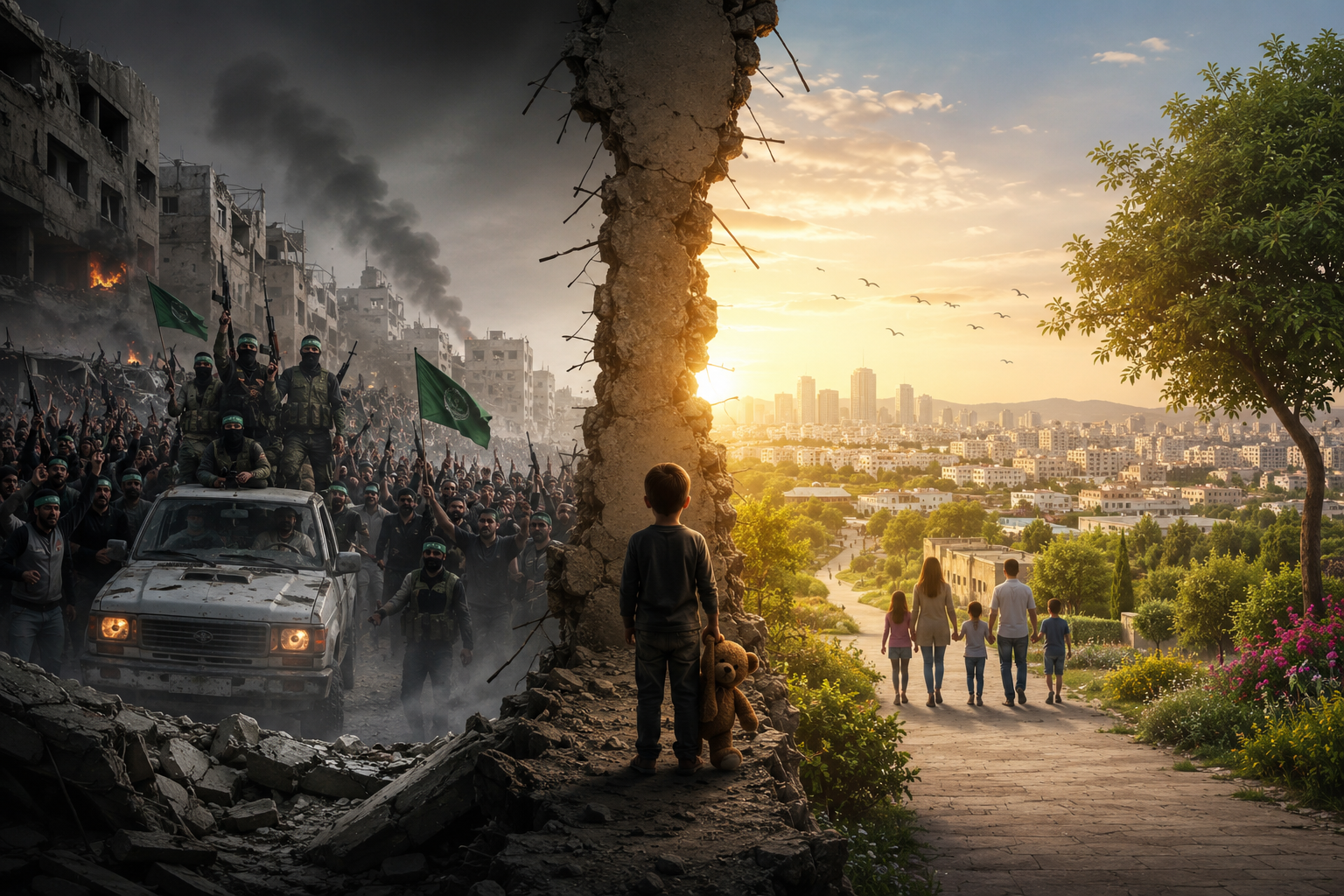
Photo Credits: Sabine Sterk (AI)
The tragedy of the Israeli conflict is not born from a lack of imagination, but from a devastating surplus of reality. For decades, the global community has coddled a fantasy of coexistence built on Western ideals of diplomacy, ignoring the cold, hard numbers and the lived experiences of those on the front lines.
If we are to look at the situation with brutal honesty, we must dismantle the comfortable myths and face the uncomfortable truths about the population we are told to view merely as victims.
Consider the baseline question of innocence. If you were to ask the hostages who have been released from captivity how many truly innocent civilians they encountered in Gaza, the response would be chillingly uniform. To the people trapped in those tunnels, the concept of the innocent civilian is a fiction.
It was not just uniformed militants who crossed the border on October 7; it was everyday citizens. Civilians participated in the kidnappings, civilians held hostages in their private homes, and civilians, including young children, lined the streets to spit on, kick, and humiliate Israelis brought into Gaza. In the months that followed, not a single “palestinian” came forward to inform Israeli authorities about the whereabouts of the captives, despite massive rewards and the obvious devastation of their own territory.
When the raw footage of October 7 was broadcast, it revealed a culture deeply aligned with the atrocities. An estimated 80 percent of the population was seen dancing, cheering, and distributing sweets in the streets while Hamas paraded the bodies of dead and living Israelis. Does this mean every single person in Gaza is an active member of Hamas? Perhaps not technically, but the political and ideological math tells a terrifying story.
Before the war, electoral data showed that roughly 34 percent of the population in Gaza openly supported Hamas, while about 13 percent in Judea and Samaria backed them.
To understand what that support means, one must look at what Hamas represents. Despite a 2017 document that attempted to soften their public relations image for the international community, Hamas has never revoked its original 1988 founding charter. The core ideology remains unchanged: the total elimination of the State of Israel, the rejection of any negotiated peace, and a religious obligation to engage in armed struggle to eradicate Jewish presence between the Jordan River and the Mediterranean Sea.
When we apply these percentages to the mid-2023 population estimate of over 2.2 million people in Gaza, the reality becomes stark. More than 740,000 individuals actively voted for a government whose explicit goal is the annihilation of Jews. While the remaining 66 percent did not vote for Hamas in that specific cycle, their silence and active participation on October 7 demonstrate that they do not reject the core mission.
When you combine those who actively support the regime with those who celebrate its violence, you are looking at nearly 1.5 million people in a concentrated area who are ideologically aligned with a genocidal campaign against their neighbors.
This deep-seated hostility exists despite decades of economic integration that should have fostered goodwill. Before the October 7 attacks, Israel extended significant economic opportunities to the population. Approximately 18,000 Gazans held legal permits to work inside Israel, earning wages far higher than anything available in the Strip.
In Judea and Samaria, the numbers were even higher, with roughly 130,000 legal permit holders and tens of thousands more working in Israeli towns, bringing the total number of “palestinian” workers reliant on the Israeli economy to over 175,000.
These workers walked among Israelis, built relationships, and saw firsthand that the people they were taught to hate were simply trying to live their lives. Yet, information gathered from the subsequent investigations revealed that some of these very permit holders used their access to map out Israeli towns, providing intelligence that Hamas used to execute its massacres with surgical precision. Economic appeasement did not buy peace; it bought access for terrorists.
The ultimate tragedy is that a beautiful alternative has always been within reach. What if a miracle occurred? What if the “palestinian” population in Gaza collectively decided to reject Hamas, hand over the terrorists to law enforcement, recognize Israel’s right to exist, and genuinely engage in peace talks? Within a few short years, borders could slowly open, economies could intertwine, and Arab and Jew could coexist in genuine safety.
But looking at the brutal numbers, the cultural indoctrination, and the widespread support for terror, one must conclude that such a miracle is an illusion. Until there is a fundamental psychological shift within the “palestinian” collective identity, dreams of a peaceful, negotiated coexistence remain a dangerous deceit.
Related Topics