
Middle East Analyst
What Intelligence Analysis Can Teach Us About Reasoning

by author (AI)
The Problem Is Not That We Have Beliefs
Every person has beliefs. They may be religious, political, cultural, philosophical, or simply convictions formed through personal experience. Beliefs are an unavoidable part of being human. They influence how we interpret events, which information we notice, whom we trust, and what explanations seem plausible to us.
The problem is not that we have beliefs. The problem arises when we treat our beliefs as established facts for everyone else.
This distinction is particularly important in intelligence analysis, where judgments about other people’s intentions, capabilities, and likely behavior can have serious consequences. It is also relevant to public discourse, scientific inquiry, business decisions, and international diplomacy. In all these settings, people routinely confuse what they believe with what they can establish, and what they can reasonably infer with what they know to be true.
After a career in intelligence analysis, I have come to regard the distinction among belief, inference, and established fact as a foundational discipline of responsible reasoning. It is not a guarantee of accuracy. Nothing in intelligence analysis can provide that guarantee. It is, however, a practical way to improve the likelihood that our judgments will be sound—and to make those judgments more transparent, examinable, and open to challenge.
Three Categories for Disciplined Reasoning
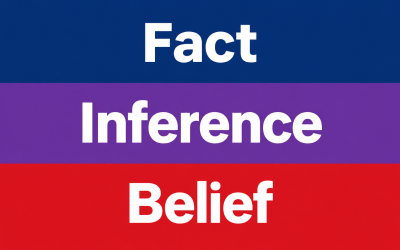
Belief encompasses personal conviction, intuition, religious interpretation, and proposed explanations. Beliefs can be powerful sources of questions and hypotheses. An analyst’s intuition may identify an anomaly worth investigating. A political leader’s religious convictions may help explain decisions that otherwise appear irrational. A citizen’s suspicion may prompt a useful question about government conduct.
But a belief, standing alone, is not a sufficient basis for an intelligence assessment. It must be examined through relevant information and defensible reasoning before it can support an analytical judgment.
Inference is a judgment derived from established information, observable indicators, and reasoning. An inference may be persuasive or tentative, widely shared or disputed. Its defining characteristic is not certainty but an articulable basis. We should be able to explain what information supports the judgment, what assumptions connect that information to the conclusion, and what alternative explanations deserve consideration.
Established fact consists of information sufficiently verified to be accepted as factual for the analytical purpose at hand. In practical analysis, we need a foundation of accepted facts. Two plus two is four. A meeting began at four, if the relevant record establishes that it did. Joe Biden won the 2020 presidential election; the result was certified. These are not invitations to reopen every conceivable philosophical question about the nature of mathematics, time, or political legitimacy.
An analytical framework must be able to establish working premises and move forward. Otherwise, every assessment becomes an endless debate about whether anything can be known.
These categories are not simply three levels of confidence, nor are they necessarily successive stages through which every proposition must pass. A belief may generate a hypothesis that never receives sufficient support. An inference may remain the best defensible judgment without becoming an established fact. An established fact may be relevant to an assessment without supporting every conclusion someone wishes to draw from it.
The governing principle is straightforward: belief may prompt the question; indicators and reasoning must support the inference; established facts anchor the assessment.
Why Facts and Inferences Must Be Distinguished
Consider public opinion polling. It may be an established fact that Gallup published a poll reporting a 38 percent approval rating for a president. That does not mean the president’s actual level of public approval has been established with mathematical precision.
The poll’s reported result is one proposition. The estimate of public opinion derived from its sample and methodology is another. The latter requires an assessment of the sampling, question wording, weighting, response patterns, and other potential sources of error.
This is not an argument for dismissing polling. It is an argument for understanding what a poll can establish and what must be inferred from it.
The same discipline applies to political controversies and international conflicts. An official statement may establish what a government publicly declared, but not necessarily its actual intentions. An intercepted communication may establish what was transmitted, but not conclusively what the speaker intended. A leader’s invocation of religious prophecy may establish that the leader uses that prophecy to explain or justify a position. It does not establish the prophecy’s divine origin or its predictive validity.
A dozen intelligence analysts examining the same intercepted communication may produce ten different assessments of its meaning. That variation is not necessarily evidence of incompetence. The analysts may have different contextual knowledge, assumptions, or interpretations of the indicators. Some interpretations may be better supported than others; some may reflect bias or flawed reasoning.
The purpose of analytical discipline is not to eliminate disagreement. It is to make disagreement productive by exposing the reasoning behind each judgment. Instead of arguing over whose intuition is correct, analysts can examine which interpretation best accounts for the available information and which assumptions remain untested.
Structured analysis cannot guarantee accuracy. Its value is that it can improve the probability of reaching an accurate judgment compared with analysis that lacks equivalent safeguards. It helps analysts identify assumptions, consider alternative hypotheses, test their explanations, and recognize information that does not fit their preferred conclusions.
The SCIF Analogy: What We Can and Cannot Leave Behind
Intelligence professionals have long been familiar with the idea that personal biases and beliefs must not be allowed to distort an assessment. The practical challenge is that we cannot physically separate ourselves from those beliefs.
A useful analogy comes from the Sensitive Compartmented Information Facility, or SCIF. An analyst may be instructed not to bring a personal cellphone into the secure space. The phone can be left outside. The analyst’s memory cannot.
Most analysts retain at least some recollection of what they have read or heard in a secure environment. The protocol does not erase that knowledge. It governs how classified information is protected, handled, and communicated. Compliance depends on professional discipline, institutional procedures, accountability, and trust.
Beliefs present a related but distinct challenge. We cannot leave our religious convictions, political assumptions, cultural experiences, or personal biases outside the analytical workspace. They come with us. The question is whether we recognize them and prevent them from substituting for evidence and defensible reasoning.
The analogy is not exact: classified information is governed by security rules, while beliefs are governed by standards of analytical justification. But both illustrate a fundamental limitation of procedural safeguards. Rules cannot remove the human being from the process. They can establish the responsibilities that the human being must honor.
Analytical integrity therefore requires more than pretending to be unbiased. It requires recognizing that we all have biases and accepting an obligation not to allow unexamined convictions to masquerade as facts.
Why This Matters in the Middle East
The distinction can be especially consequential in the Middle East, where religious narratives, historical claims, national identities, and competing interpretations of justice frequently overlap.
A belief may be central to a person’s identity and may exert a powerful influence on political behavior. An analyst who dismisses that belief as irrelevant because it cannot be empirically verified may misunderstand the actor. But an analyst who accepts the belief’s theological claims as established facts makes a different and equally serious error.
The proper approach is to distinguish the belief itself from claims made in its name, then examine how the belief influences decisions and behavior.
This standard must apply symmetrically. It applies to the religious convictions of a political or military leader, the national narratives of competing societies, secular ideological commitments, and the analyst’s own assumptions. No participant receives an exemption simply because a conviction is deeply held or widely shared within a community.
Imagine the difference this discipline could make if people in a conflict recognized that their individual beliefs are not automatically facts for other people. They would not have to abandon their faith, identity, or historical interpretation before entering a discussion. They would, however, have to distinguish their convictions from claims that can be established through shared methods of inquiry.
That would not eliminate conflict. People can recognize the same facts and still have incompatible interests, values, and objectives. But it could open the door to more rational discussions by removing one recurring obstacle: the assumption that acknowledging another person’s belief requires accepting it as one’s own truth.
The Implications for Artificial Intelligence
AI models do not hold beliefs in precisely the same way human beings do. Nevertheless, they can reproduce assumptions embedded in their training material, favor familiar explanations, overlook contradictory information, and present plausible conclusions with more apparent certainty than their foundations justify. Multiple models can also agree because they draw on similar sources or share the same underlying assumptions. Agreement alone does not establish independent validation.
An AI system designed to support disciplined analysis should therefore do more than produce a persuasive answer. It should distinguish established information from inference, identify assumptions, examine competing explanations, and make clear how its conclusions follow from the information available. It should be able to identify gaps, inconsistencies, and unsupported claims rather than smoothing them into a coherent narrative.
The objective is not to make AI infallible. It is to make the analytical process more rigorous and easier to examine.
This is where AI may offer an important advantage. Disciplined analytical methods can be time-consuming. A skilled analyst working alone may have limited capacity to explore alternative hypotheses, challenge every assumption, or systematically examine all the relevant indicators. AI can help make those processes more accessible and repeatable. It can serve as a tireless junior analyst, generating alternatives, checking consistency, and challenging the human analyst’s preferred explanation.
But responsibility for the final assessment must remain with the human decision-maker. The system’s output is an analytical contribution, not an authoritative conclusion. The human analyst must evaluate the quality of the information, the validity of the reasoning, and the relevance of the alternatives before accepting the judgment.
This approach suggests a different way to think about AI’s potential contribution to intelligence and human reasoning. Its greatest value may not always be raw cognitive superiority. It may be the ability to make disciplined methods of inquiry available to far more people, including individuals and small teams that lack formal analytical training.
A Foundation for Better Reasoning
The broader public rarely receives systematic instruction in distinguishing belief, inference, and established fact. Discussions therefore often move unconsciously from conviction to conclusion. When challenged, people defend the conviction rather than examine the reasoning. Debate becomes a contest between identities instead of an inquiry into what is known and what can reasonably be concluded.
A simple analytical protocol cannot resolve every disagreement. It can, however, improve the terms on which disagreements are conducted. It does not tell people what to believe. It asks them to recognize the difference between belief and fact, justify their inferences, and remain willing to examine the reasoning that connects the two.
The same obligation applies to analysts, citizens, political leaders, and AI systems. No one is exempt from the discipline simply because they are intelligent, experienced, confident, or convinced that they are right.
Perhaps this is one of the most useful lessons intelligence analysis can offer a society struggling with polarization and an information environment increasingly shaped by AI. We do not need to eliminate personal beliefs to reason together. We need shared standards for distinguishing those beliefs from established facts and defensible inferences.
AI may help extend those standards beyond the intelligence community. If it does, its contribution will be measured not simply by how much information it can process or how impressive its answers appear, but by whether it helps people think more carefully, challenge themselves more honestly, and make better judgments.
That is a more demanding definition of superior intelligence. And it may prove more consequential than the ability to produce a faster or more sophisticated answer.
Related Topics
Related Posts