
Middle East Analyst
What Iran’s chemical weapons reveal about deterrence psychology
by author (AI)
Netanyahu’s Admission and the Strategic Puzzle It Creates
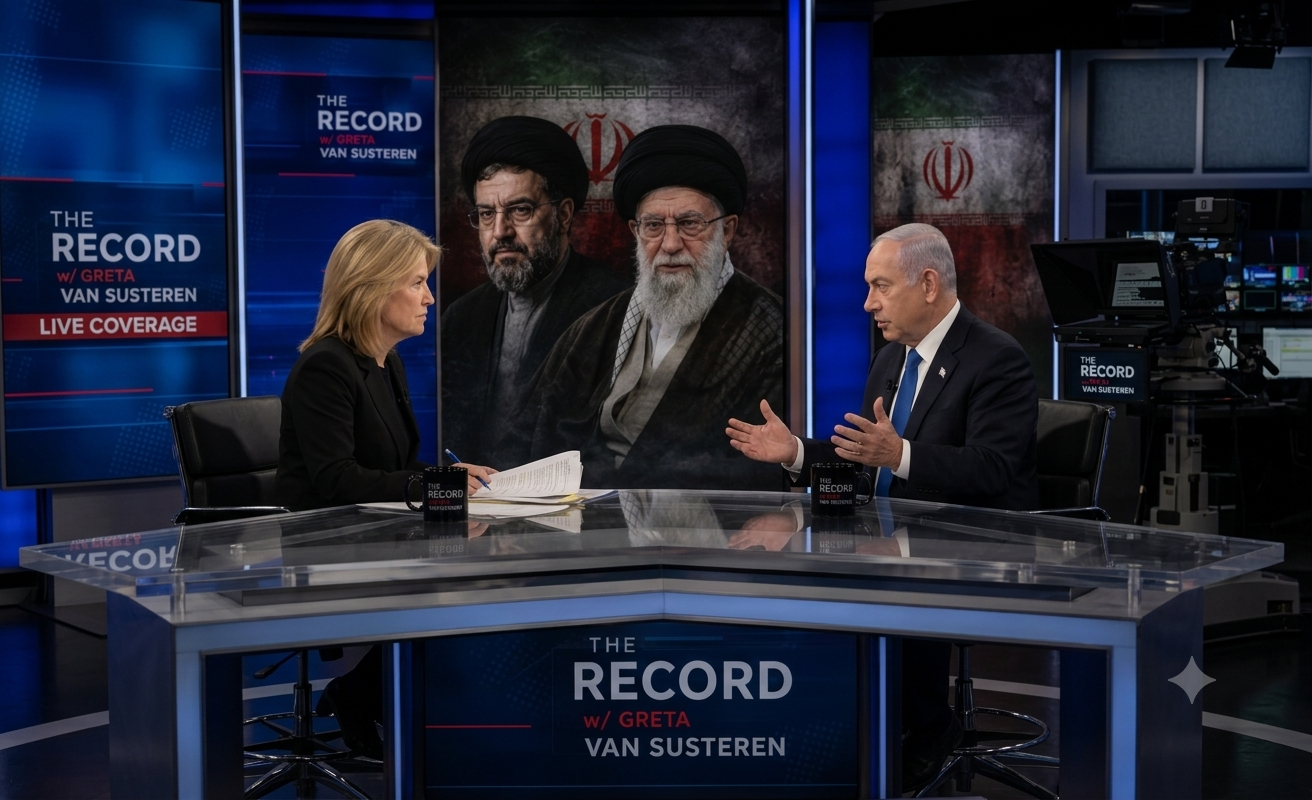
In a July 8, 2026 interview on Newsmax’s The Record with Greta Van Susteren, Israeli Prime Minister Benjamin Netanyahu stated that Iran “definitely” possesses chemical weapons, calling it another threat Iran poses despite not having used CW during the recent US-Israel-Iran war during which much of the regime leadership was killed. This is not new intelligence so much as a headline-grade restatement of an assessment baseline that has existed publicly, and been periodically reaffirmed, for three decades. The Center for Strategic and International Studies — a nonpartisan Washington think tank founded in 1962 whose Middle East military-balance work, much of it authored by longtime defense analyst Anthony Cordesman, has been a standard reference for US and allied policymakers since the Cold War — has tracked Iran’s CW program since at least the 2009 publication of Iranian Weapons of Mass Destruction.
Iran’s chemical weapons capability
The Center for Strategic and International Studies — a nonpartisan Washington think tank whose Middle East military-balance work has been a standard policy reference since the Cold War — has tracked Iran’s chemical weapons program since a dedicated 2009 study, Iranian Weapons of Mass Destruction. Its assessment: Iran remains a declared chemical weapons power, built on a CIA finding dating to 1997 that Iran had manufactured and stockpiled blister, blood, and choking agents along with the means to deliver them. The State Department formally found Iran non-compliant with the Chemical Weapons Convention as recently as 2019.
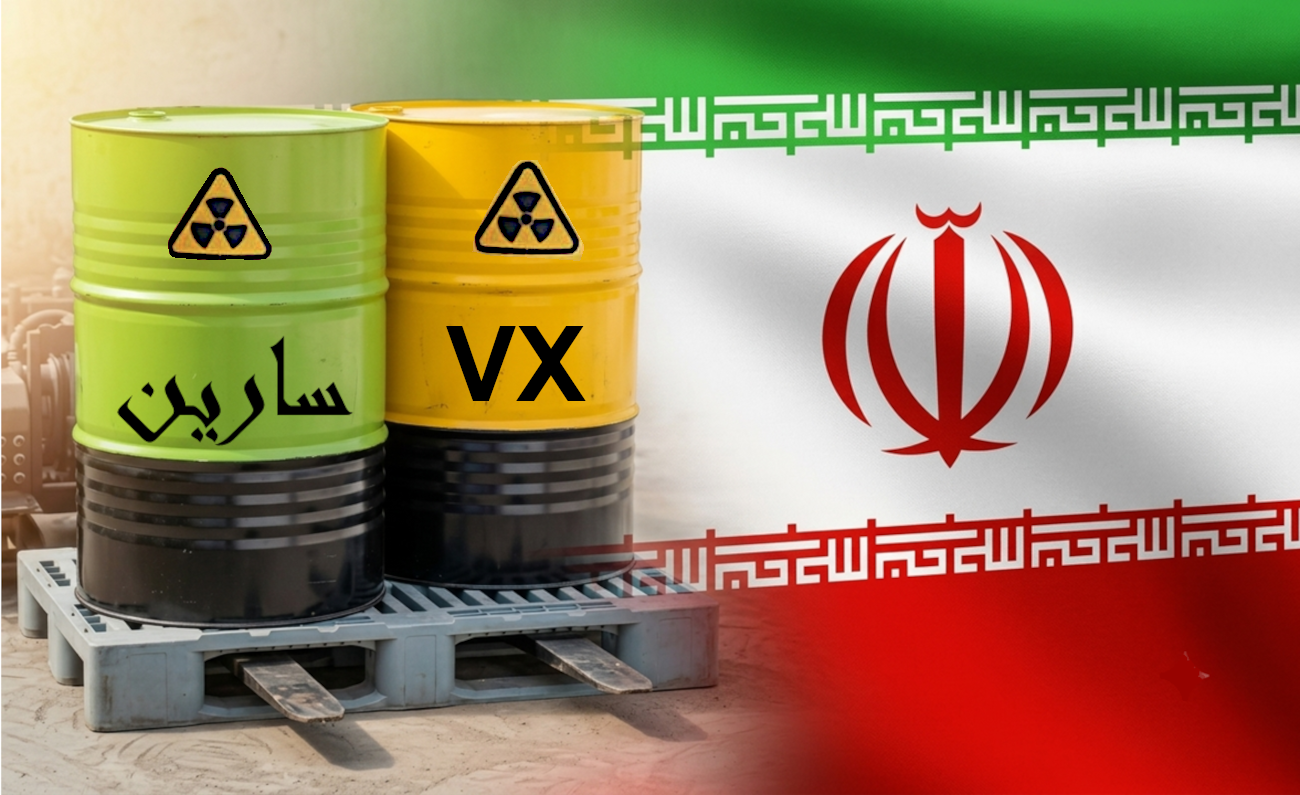
Nerve agents are a longer-running concern. German intelligence assessed in 2005 that Iran probably possessed sulfur mustard, tabun, and hydrogen cyanide, and may possess sarin and VX — a judgment consistent with a documented 1990s procurement trail, including reported Indian assistance equipping an Iranian sarin/tabun-capable facility and a US-prosecuted 1997 case involving an attempted shipment of VX/sarin precursor chemicals to Iran.
Iran’s technical mastery here is corroborated by its own record as a proliferator. By the mid-2000s, Iran was supplying Syria’s chemical weapons program with facility blueprints and precursor chemicals for VX and sarin production — including a documented 2002 transfer of ten tons of a VX/mustard precursor — and was reportedly the program’s primary funder, even covering North Korean technical assistance to Damascus. Syria’s resulting arsenal, some 1,300 metric tons of sarin, VX, and mustard agent, was built in part on that Iranian input. This doesn’t prove Iran keeps agents mixed and ready today — building another state’s arsenal isn’t the same as maintaining one’s own — but it demonstrates Iran had, and exported, real nerve-agent production expertise for at least two decades.
The program has also evolved. A February 2026 Foundation for the Defense of Democracy memo, drawing on declassified US and Israeli assessments, finds Iran shifting over the past fifteen years toward smaller-scale “pharmaceutical-based agents” and undeclared riot-control agents intended for deniable, targeted use rather than mass battlefield employment. Iranian university research — at Imam Hossein University and Malek Ashtar University, both under military control — has focused on weaponizing medetomidine, ketamine, sevoflurane, and fentanyl analogues; Israel cited this research line when it struck the Shahid Meisami Research Complex in June 2025. Iran’s cruise missile and drone programs have also improved its ability to disperse agents over long range.
Taken together: Iran holds probable latent nerve-agent capability built on demonstrated technical mastery, an older confirmed stockpile of blister and blood agents, and a newer program oriented toward smaller, deniable weapons rather than strategic mass-casualty use. That’s a capability profile that has grown more sophisticated over three decades — and one that, per the pattern this essay traces, still hasn’t been employed against Israel or any major power.
Severity and the retaliation threshold
The magnitude of any potential WMD attack has to be considered before drawing conclusions regarding restraint. Chemical weapons do not approach nuclear weapons in destructive potential. A nuclear detonation over a dense urban center like Tel Aviv would be catastrophic by orders of magnitude — mass casualties, permanent destruction of a metropolitan area, national-level trauma. A chemical attack, even a serious one using the modernized delivery and agent profile FDD and CSIS describe, operates on a different scale entirely; its lethality against a prepared, defended population is harder to estimate and almost certainly lower.
That distinction matters, but it doesn’t weaken the deterrence argument — it clarifies what’s actually doing the deterring. Israeli doctrine has long signaled, consistent with its broader posture of strategic ambiguity, that any WMD attack — regardless of category — would draw retaliation disproportionate to the attack itself, rather than a response scaled narrowly to match the attack’s own lethality. If that’s the operative logic, Iran’s calculus doesn’t require believing a CW attack would be “as bad as a nuclear one” for Tel Aviv. It only requires believing that crossing the WMD threshold at all — in any category — invites a response exceeding what the initiating attack achieves. That’s a lower evidentiary bar for deterrence to clear, and it’s consistent with Iran showing the same restraint across categories of very different destructive potential: the retaliation risk, not the comparative lethality of the agents, is the variable explaining the behavior.
The nuclear parallel
This same logic extends to Iran’s nuclear posture, and reading the two together is more meaningful than either alone. The IAEA’s own assessment from May 2025, issued just before the June strikes, found no credible indication of an active, structured weapons program — only concern over Iran’s accumulated 60%-enriched uranium and rhetorical statements from former officials about theoretical capability. That describes a program sitting deliberately at threshold status for years: breakout timelines measured in weeks to months, sustained without the final weaponization step being taken, despite ample time, material, and technical means to do so. That pattern resembles deliberate strategic latency more than either an active weapons drive or an absence of intent — a posture that extracts most of the deterrent value of possession while avoiding the predictable costs of overt breakout.
Laid alongside the CW and PBA evidence, the pattern across all three WMD categories is consistent: capability accumulation and modernization, paired with employment restraint against Israel and other major powers. That’s a considerably stronger basis for inferring calculated deterrence-seeking than any single domain provides on its own, and a poor fit for a leadership genuinely indifferent to consequences or oriented toward national martyrdom.
The Saddam analogy
The Iraq precedent is instructive if scoped correctly. Saddam Hussein used chemical weapons extensively — against Iran throughout the 1980s, and against Iraqi Kurds at Halabja in 1988. What he did not do was use them against direct US-led confrontation in 1991 or 2003, despite prewar expectations that he would. Colin Powell later said he wasn’t worried about that scenario because the consequences had been made explicit: overwhelming conventional retaliation of a scale Iraq could not absorb, not a nuclear threat. Many analysts and policymakers also assessed that Saddam was an irrational actor prepared to lead Iraq into collective martyrdom. The reality is that he stood down in the face of overwhelming US firepower rather than risking the overwhelming destruction of Iraq.
The unknowns of new Iranian leadership
None of this proves Iran is, or will remain, a rational actor. It suggests that for roughly three decades, under Ali Khamenei’s leadership, Iranian behavior across the nuclear, chemical, and biological domains is difficult to reconcile with genuine indifference to consequences, and easier to reconcile with calculated deterrence-seeking — accumulating capability and leverage while avoiding the retaliatory costs of actually crossing a WMD threshold.
Many analysts have argued that Iran’s only interest in nuclear weapons was to deter attacks against Iran while providing a shield from behind which they could escalate conventional or terrorist attacks against Israel and others. That may well be the case, however that is a fundamentally different argument than claiming Iran is a suicidal martyrdom state imminently planning the mutual destruction of both Israel and Iran.
Whether that calculus still describes Iran’s new leadership is a separate and, at this point, genuinely unresolved question. The February 2026 war and its aftermath killed Khamenei and much of the senior IRGC command — the same generation whose decision-making the thirty-year pattern of WMD restraint actually documents. What has followed is ambiguous rather than reassuring. Iran’s willingness to enter ceasefires and negotiations could indicate continuity — a surviving leadership still operating by the same rational, deterrable logic. But available reporting since the war also describes a command structure that is fragmented, with authority dispersed and contested rather than clearly reconstituted, and in some respects emboldened rather than chastened by the experience. Fragmentation and negotiation are not mutually exclusive, and neither is a reliable proxy for the other: a fragmented leadership might negotiate out of necessity while remaining less predictable or less collectively risk-averse than its predecessor, particularly if authority has shifted toward younger IRGC commanders with less direct memory of what shaped Khamenei-era caution.
The honest conclusion is that it is too soon to know. The historical pattern is real and evidentially well-supported; it should shift analytical priors away from the martyrdom-and-irrationality narrative for the Ali Khamenei leadership that generated it. However it should not be automatically extended, without much more evidence about who currently holds authority in Tehran and how they think, into a claim that the same restraint will hold going forward.
Related Topics
Related Posts