
Therapist and Clinical Director of Jerusalem Therapy Mental Health Clinic
What is Autism?
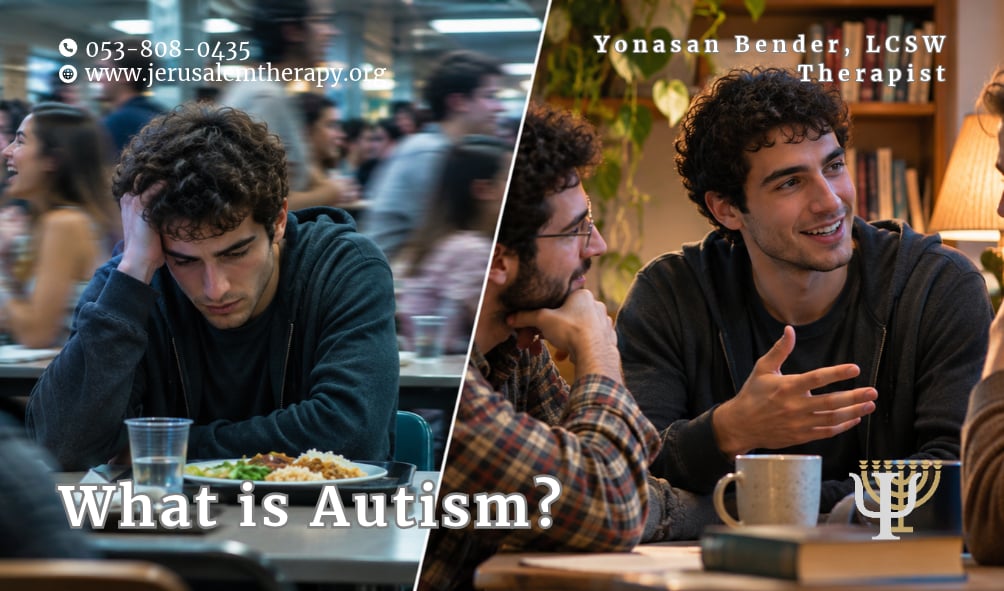
A huge mistake people make about autism is the tendency to confuse social fluency with emotional depth. Someone who struggles to recognize a facial expression still cares profoundly about the person making it. They might avoid eye contact but is listening more carefully than someone staring directly into your eyes but is still zoning out.
Moshe, a twenty-year-old man with autism, has this problem. His teachers frequently complain he doesn’t pay attention because he rarely looks at them while they’re speaking. Yet Moshe remembers every word. When his best friend was crying, Moshe didn’t know quite what to say. His silence was mistaken for indifference. That evening, however, he spent an hour writing his friend a thoughtful letter. Moshe wasn’t lacking empathy. He was struggling with the social language through which people ordinarily expect empathy to be expressed.
Autism is a neurodevelopmental condition, not a personality type or simply a collection of unusual habits. Its defining characteristics emerge during development and involve persistent differences in social communication alongside restricted or repetitive patterns of behavior and interests. These characteristics must be evaluated in context, including their impact on everyday functioning. Being introverted, socially awkward, or particularly sensitive to noise doesn’t automatically make someone autistic.
For Moshe, the school cafeteria is a daily ordeal. The overlapping conversations, scraping chairs, and clattering dishes are unbearable. His classmates think he’s antisocial because he eats alone. Yet when his friends invite him to spend time somewhere quiet, he’s delighted and so are they, for that matter. The difficulty wasn’t the company. It was the environment. Change the surroundings, and an apparent social limitation can diminish dramatically.
Perhaps the most important practical lesson is that understanding autism requires understanding the individual. Some autistic people live independently, being extraordinarily successful while quietly struggling with overwhelming sensory and social demands. Others experience profound disabilities requiring lifelong assistance. Both realities deserve recognition. Compassion shouldn’t require us to minimize disability, and recognizing hardship shouldn’t require us to overlook a person’s abilities.
Moshe will need help navigating certain aspects of life, and some of his difficulties won’t disappear simply because people become more understanding. But he doesn’t need to be taught that his natural way of experiencing the world is fundamentally wrong. There’s an important difference between helping someone overcome a difficulty and teaching them to be ashamed of who they are. After all, the purpose of understanding another human being isn’t to make them more like us. It’s to discover who they actually are.
Related Topics