
CFO | Empower Society for Good I Author
What Is Zionism?
Zionism is one of the most debated—and most misunderstood—ideas of our time.
To some, it is a political movement. To others, a historical necessity. And today, it has become a word of accusation.
But if we return to the Torah, and to the questions raised in this week’s reading Behar and Bechukotai, a deeper and more demanding understanding begins to emerge—one that challenges not only how Zionism is defined, but how it is lived.
Zionism is often defined as a 19th-century political movement. That definition is incomplete.
Zionism is the return of the Jewish people to their ancient land, as promised in the Torah, and the re-establishment of Jewish sovereignty in that land. It did not begin with Herzl—it began with Abraham, continued through the Exodus, and was lived in the ancient Kingdoms of Israel. Even through exile and dispersion, the connection endured, sustained by a continuous return—physical, spiritual, and historical. At its core, Zionism is embedded in a system of laws and values in the Torah, designed to be lived fully in the Land of Israel.
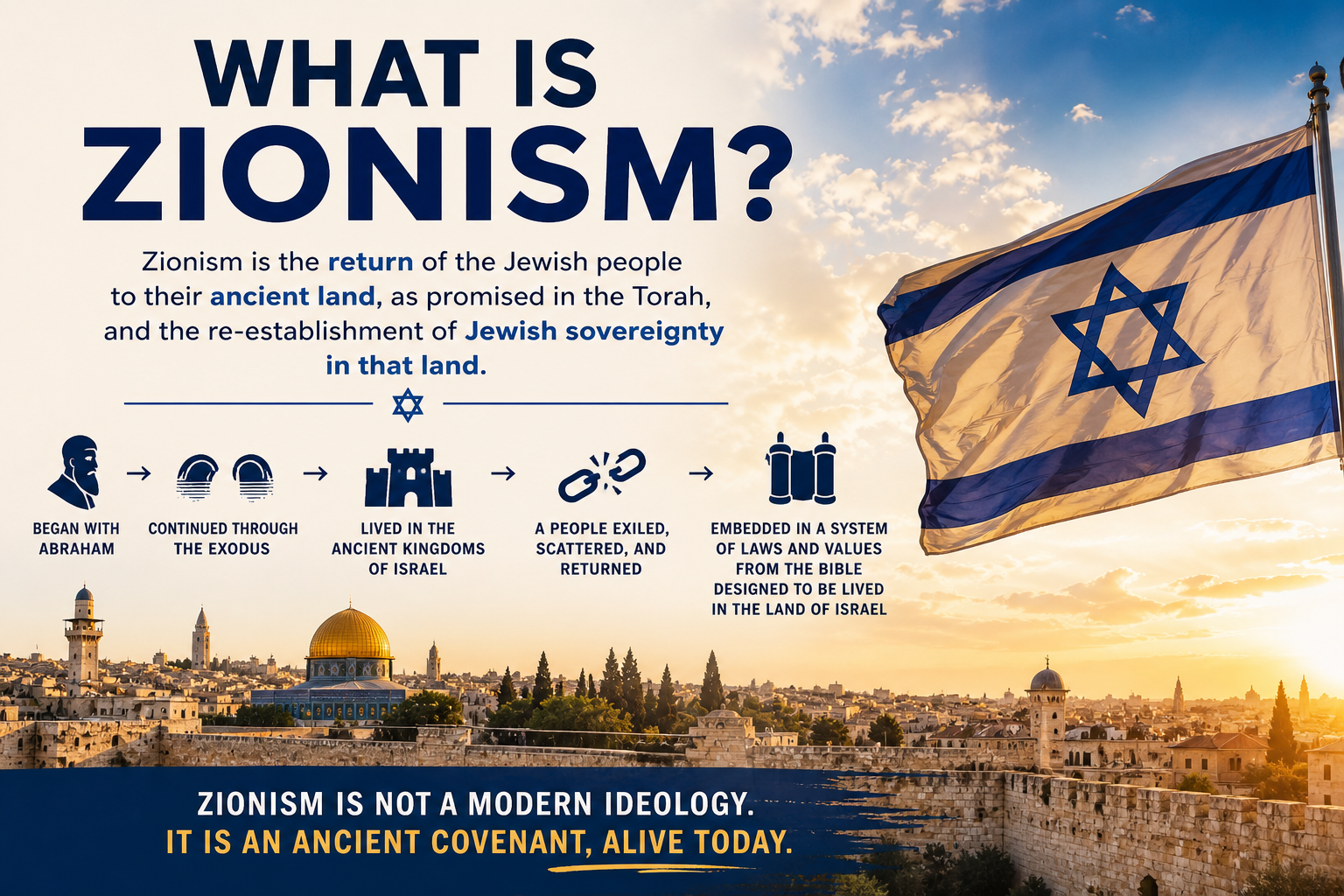
The modern movement did not create Zionism; it gave political expression to an ancient covenant.
But this leads to a deeper question—one that emerges powerfully from Parshat Behar.
Why does the Torah require a land at all?
Parsha Behar opens with a striking instruction:
“Speak to the children of Israel and say to them: when you come into the land that I am giving you, the land shall observe a Sabbath to the Lord.”
The Torah does not begin its vision of life in the land with ownership, conquest, or even settlement—but with restraint. Before the people are told how to cultivate the land, they are told that the land itself must rest.
This is a profound shift in perspective. The land is not merely a possession; it is a trust. It does not belong fully to those who live on it, but ultimately to God. Human beings are not masters of the land—they are stewards within it. The first commandment in the land is therefore not productivity, but limitation; not control, but responsibility.
In this opening, the Torah establishes a principle that runs through the entire Zionist story: the return to the land is not only a right—it is a duty. A duty to build a society that respects limits, protects the vulnerable, and recognizes that sovereignty without restraint is ultimately unsustainable.
The laws of Shemitah and Yovel are not simply agricultural or economic mechanisms. They form a blueprint for a society in which the land must rest, wealth cannot accumulate endlessly, and the vulnerable are protected. The Torah is not a set of abstract ideals—it is a system of life, designed to function within a land.
Without the land, the system cannot fully operate.
Behar answers why the land is necessary. This week is a double reading, and Parsha Bechukotai asks a more demanding question.
What happens if we live in the land correctly—or incorrectly?
“If you walk in My statutes… I will give your rains in their time, the land will yield its produce… and you shall dwell securely.”
And if not—the opposite unfolds: instability, breakdown, exile.
The message is unmistakable. The land is not neutral. It responds.
Zionism, then, is not just the return to a place. It is the return to a covenantal system in which land, society, and morality are inseparable.
This tension did not disappear in modern times—it re-emerged in different forms through the leaders of Zionism.
Herzl saw the urgency. For him, Zionism was a necessity—a refuge for a persecuted people seeking to live as free men on their own soil. It was about survival, dignity, and normalcy among the nations.
Rav Kook saw something deeper. The return to the Land of Israel was not merely political—it was part of a process of redemption, a reawakening of a people to its spiritual purpose. The land was not external to Jewish identity; it was bound to it.
Ben-Gurion stood between vision and reality. Tasked with building the state, he understood that sovereignty introduces a new kind of test. The decision to declare the state was not inevitable; it passed narrowly, under immense pressure, with five Arab armies already poised for war. The Holocaust was a recent memory, and the fear of another catastrophe was real.
He did not choose power as an ideal; he accepted it as a necessity. Yet he understood its danger. The true test, he said, is how a people behaves when it is in power.
A contemporary voice adds another layer. Writers like Howard Jacobson—deeply committed to Zionism—have expressed discomfort with how the very term has become distorted, even weaponized. Zionism, once the language of return and renewal, is now often treated as a term of accusation, a rallying point for opposition. In many circles, it has become a dirty word.
But this modern critique often overlooks the conditions under which Zionism was forced to operate.
Zionism was not built in theory. It was built in the shadow of exile, persecution, and near-destruction. Its leaders were not philosophers alone; they were decision-makers under threat, navigating survival in real time.
And that sense of vulnerability has not disappeared—only its form has changed.
In 1948, the struggle was framed largely in the language of nationalism. A newly declared Jewish state faced the armies of surrounding nations in a battle for sovereignty and survival. It was a war of borders, identity, and political legitimacy. It was because the Arabs nations could not tolerate the existence of a Jewish state. Some things have not changed. Lebanon has still not recognized Israel, and Iran together with its proxies is obsessed with Israel’s destruction.
Today, the language has shifted even further. While national interests remain, the conflict is increasingly expressed in ideological and religious terms—particularly in the confrontation with Iran and its proxies. These are not only geopolitical struggles, but conflicts of identity, belief, and destiny.
In this context, the very existence of a sovereign and powerful Israel challenges long-standing theological narratives within both Christianity and Islam—traditions that, in different ways, developed forms of replacement theology, suggesting that they had superseded Judaism. The return of the Jewish people to their land, and the re-establishment of a Jewish state, stands in tension with these narratives.
It raises a profound question: can a people once thought to be displaced from history re-emerge with renewed vitality and purpose?
For many, Israel’s existence is not only a political reality but a theological disruption—challenging the idea that the Jewish covenant has been replaced, and suggesting instead that the Jewish story continues to unfold in history in a visible and sovereign way.
National conflicts can, at least in theory, be negotiated. Ideological and religious conflicts are far harder to resolve. Maybe impossible.
At the same time, Israel’s internal challenges have become more visible. The divisions within society—so evident in the months leading up to October 7—raise a different kind of concern. Not about borders, but about cohesion, purpose, and shared responsibility.
In this context, the words of Bechukotai feel strikingly contemporary. The Torah does not describe threats disappearing. It describes a society whose stability depends on its internal alignment—moral, social, and spiritual.
Rabbi Jonathan Sacks points to what may be the missing piece. He understood that power alone cannot sustain a society, and spirituality alone cannot govern one. The answer lies in covenant.
A covenant is not a contract. A contract is about interests—what each side gets. A covenant is about responsibility—what we owe one another, and what we are called to build together under God.
This is where Zionism must be renewed. Herzl gave us the political framework. Rav Kook gave us the spiritual vision. Ben-Gurion carried the burden of power. Rabbi Sacks reminds us that these cannot stand alone.
A society survives when it sees itself not just as a collection of individuals, but as a shared moral project.
This is the deeper message of Bechukotai. Blessing is not a reward—it is the outcome of a society aligned around responsibility, restraint, and purpose.
These voices are not in conflict—they form a progression.
Herzl teaches survival.
Rav Kook teaches meaning.
Ben-Gurion teaches the burden of power.
Rabbi Sacks teaches the solution: covenantal responsibility.
Zionism has succeeded in bringing the Jewish people back to the land. But the Torah, through Behar and Bechukotai, reminds us that this is only the beginning.
The land it is entrusted to us.
And our ability to remain in it depends not only on strength, but on how we choose to live.
We have returned to the land.
The question now is whether we can build a society within it that justifies that return.
Related Topics
Related Posts