
What Kind of Fiction Can Holocaust Memory Bear in the Age of AI?
International Holocaust Remembrance Day is a moment when memory returns and becomes present in the public sphere. Yet in recent months, social networks have been flooded with moments that never took place: artificial intelligence-generated images of concentration camps: crying children behind barbed wire, emotional reunions between prisoners and liberators.
On January 13, memorial sites and documentation institutions in Germany published an open letter calling on platforms to label such content, restrict its distribution, and prevent its monetization. The common argument against these images is that they are misleading, and therefore the solution is labeling or removal. But even if we label them, even if we restrict them, the problem runs deeper.
The philosopher Kendall Walton once asked an apparently simple question: how is it possible that we are afraid of a horror movie? We know the monster on the screen does not exist, that it is an actor or computer graphics. And yet our hearts race, our palms sweat, and we jump in our seats. This is not a mistake. Something else is happening here. Walton’s answer is that we are playing a game. Like children who play that tree stumps are bears. They know they are tree stumps, but within the game they run away from them and are genuinely excited. Walton calls this “make-believe,” and the emotions that arise within it he calls “quasi-emotions.” They are psychologically real, but they arise from a conscious game, not from belief.
From this follows an important insight: even when we know that something is fictional, we are still moved by it. Even if an image of the Holocaust is clearly labeled as an AI product, it will still arouse emotion, create a mental image, and shape the way we imagine the Holocaust.
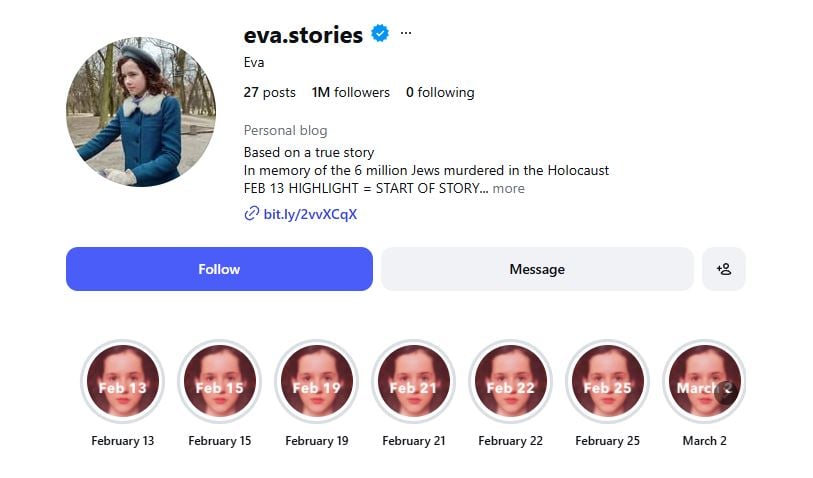
Here a difficult question arises. In 2019, Eva Stories was launched, a series of Instagram videos telling the story of Eva Heyman, a thirteen-year-old Jewish girl murdered in Auschwitz. The project is based on her real diary, but produced with actors and designed as if Eva had a smartphone. Here too, viewers know this is fiction. And yet the project was widely received as a legitimate educational enterprise. So what is the difference?
Both cases present things that did not happen. Both arouse emotion. In both, the viewer can know that it is fiction. If the problem with AI images is falsifying history, Eva Stories also falsifies it: Eva Heyman did not have Instagram. If the problem is arousing emotion through falsehood, feature films about the Holocaust do that as well. The difference is not whether something is fictional, but what kind of game we are being invited to play.
Eva Stories declares itself a game. It explicitly asks what would have happened if a girl in the Holocaust had Instagram. It invites the viewer to enter a game of make-believe with full awareness, and uses it to make an authentic source accessible: the diary of Eva Heyman. Fiction serves memory. AI images do something else. They do not declare a game. They do not ask us to imagine. They simply present an image that looks like a historical photograph. Even if we add a label, their communicative structure is different. They do not invite make-believe, but the consumption of an image.
Roland Barthes argued that photography functions as a “certificate of presence”: it testifies that what we see really was there, really happened. AI images steal this certificate. They look like photographs, carry the same testimony, but behind them there is no “having-been-there.” And in most cases, those who produce them do not seek to educate or commemorate, but to profit from clicks. As the German memorial institutions wrote, some of this content is even intentionally designed to blur facts, to swap victims and perpetrators, or to spread revisionist narratives.
But there is another question: in what space does the image operate? On social networks, images are not received as proposals for interpretation but as rapid emotional units: one image, one impression, one share. Algorithms reward precisely what provokes shock, compassion, or horror, and detach the image from its context, its source, and its history. Thus an AI image becomes an event in itself, one that does not lead to documentation but replaces it with a kind of immediate and flattened memory.
Labeling will not solve this. The problem is that we are creatures who are moved by fictional things. This is not a weakness; it is the trait that allows us to enjoy literature, cinema, and art. But it is also a trait that can be exploited. When someone produces a fake image of a crying child in a concentration camp, they know it will arouse emotion even if it is labeled. They rely on emotion to defeat knowledge.
This is not a call to ban fiction. Films and books are legitimate, and projects like Eva Stories show that dramatization can also commemorate and educate. But each case must be judged by what the fiction does and who stands behind it: does it serve memory or replace it? Does it lead to authentic sources or block the way to them? Does it honor the victims or exploit them?
Against the backdrop of International Holocaust Remembrance Day, the question of which images will shape future memory becomes more urgent than ever. The open letter from Germany touches the heart of the problem, but what is required is a clear distinction between an image as a conscious illustration and an image presented as a substitute for documentation while lacking any source.
One can imagine responsible uses of AI; for example, moving from written testimony to an image based on descriptions and translating them into a visual form, as part of an educational project that declares itself an illustration. In other words, here too the heart of the matter is whether the image invites the viewer into a conscious game and leads them to the authentic source, or whether it is presented as fact and ends with itself.
As the last survivors gradually disappear, the challenge is not only to prevent deception, but to prevent a situation in which fiction replaces documentation.