
CFO | Empower Society for Good I Author
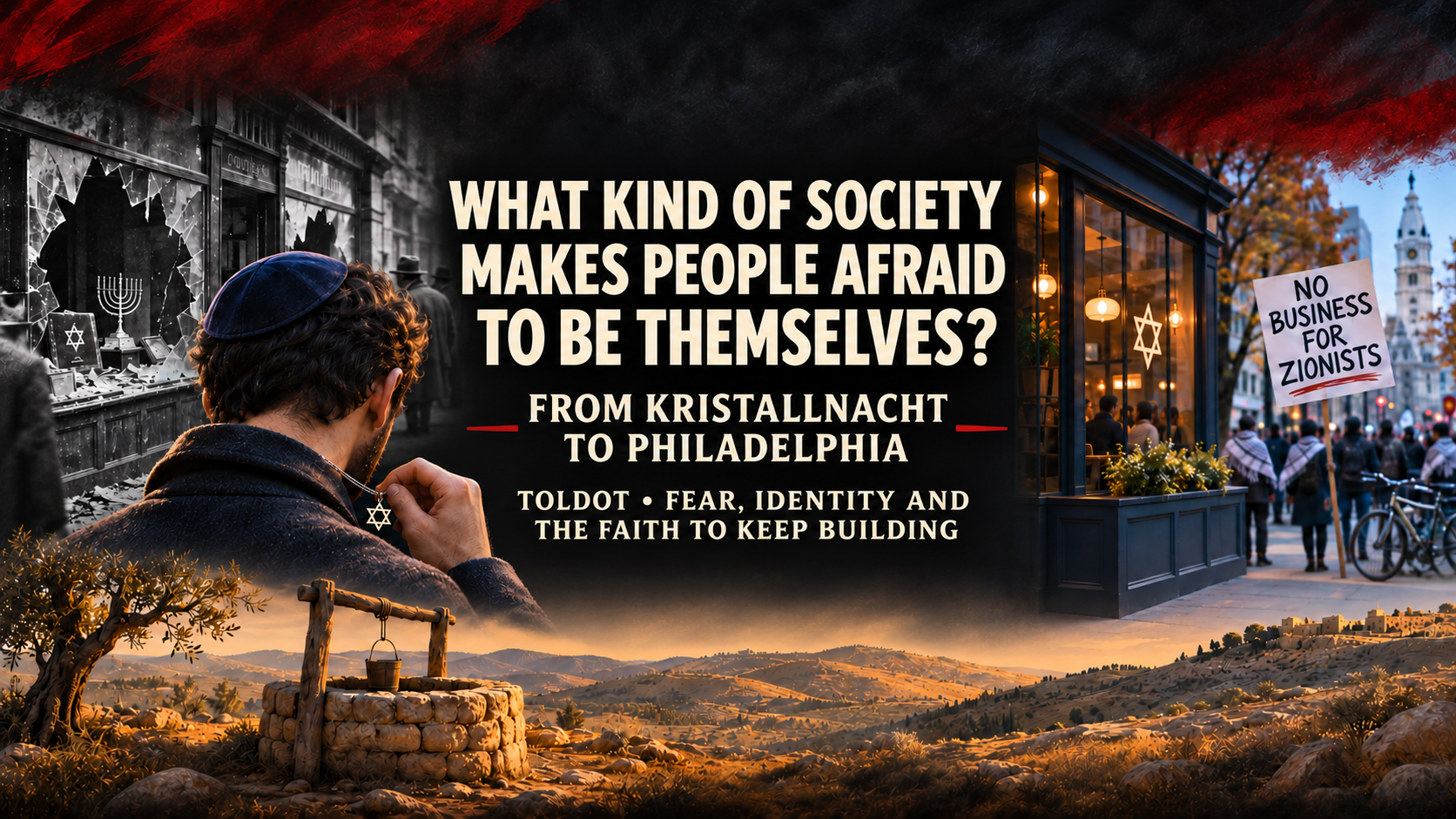
What Kind of Society Makes People Afraid to Be Themselves?
I am an honorary member of a parliament.
Before anyone imagines that I have entered politics, let me explain. Our parliament is a group of older men who gather to discuss politics, religion and the state of the world—and, in our case, we also tell jokes.
One of our members is a retired rabbi. During a recent conversation about Parshat Toldot, I asked him: Why did Isaac feel it necessary to describe Rebecca as his sister rather than his wife?
We have encountered this before, twice in the story of his father, Abraham. But familiarity should not make it less disturbing.
The Torah explains:
“The men of the place asked about his wife, and he said, ‘She is my sister,’ because he was afraid to say, ‘My wife,’ thinking, ‘The men of the place might kill me because of Rebecca, for she is beautiful.’”
—Genesis 26:7, translation rendered here
The explanation was chilling. Isaac feared that someone who wanted Rebecca would kill him to take her.
What kind of society makes a man afraid to acknowledge his own marriage?
Abimelech subsequently orders protection for Isaac and Rebecca. Leadership can restrain danger. But Isaac’s fear remains a troubling window into the environment he believed he faced.
And my question did not remain in the ancient world.
What kind of society makes a person afraid to say publicly: I am a Jew. I am Israeli. I am a Zionist?
Two fears—and a judgment on society
Isaac feared the consequences of acknowledging his marriage. Today, when Jews consider concealing a Star of David, their Israeli origins or their belief in the Jewish people’s right to a homeland, the circumstances differ—but the question of concealment returns.
What might happen to me if people know who I am?
That calculation is telling. It reveals something about the environment in which a person must make it. Nobody should have to purchase safety by concealing their identity or disowning their people.
The shame belongs to those who make their neighbours afraid. The responsibility to challenge them belongs to the wider society.
From remembrance to responsibility
On November 9–10, 1938, Kristallnacht exposed the murderous reality of Nazi persecution. Synagogues burned, Jewish businesses were wrecked, homes were invaded and approximately 30,000 Jewish men were arrested. Jewish identity itself made people targets of state-organised violence.
Eighty-eight years later, on November 8, 2026, a “boycott ride” in Philadelphia targeted Jewish- and Israeli-owned businesses. Promotional messaging included “no business for Zionists” and declared that the establishments “must go.” Pennsylvania’s Human Relations Commission condemned the campaign. Organisers said they were targeting support for Israel and denied antisemitism.
Philadelphia was not Kristallnacht. The scale, violence and role of the state were profoundly different. But remembering that history should sharpen our sensitivity to the public marking of Jewish businesses as unwelcome.
What does “must go” say to an owner, an employee or a customer? What does it suggest about the conditions under which Jews are permitted to belong?
There was also an encouraging answer. Public officials condemned the targeting, and hundreds came to support the businesses, queuing to buy food and standing alongside their neighbours.
A society reveals its character through the hatred that emerges within it—and through the courage with which people confront it.
The glue of animosity
In Echoes of Rashi: Bereishit, Rabbi Moshe Taragin offers a striking reflection entitled “The Glue of Animosity.”
His starting point is the delegation that approaches Isaac:
“Abimelech came to him from Gerar, with a group of his companions and Phicol, commander of his army.”
—Genesis 26:26, following Rashi’s reading
Rashi explains achuzas:
“An expression of a gathering and a band whose members are held together.”
Rabbi Taragin asks what binds that group. His interpretation is unsettling: otherwise disparate interests can find unity in shared hostility toward Isaac.
Isaac’s response gives that interpretation its force:
“Why have you come to me, when you hated me and sent me away?”
—Genesis 26:27, translation rendered here.
Rabbi Taragin sees an early expression of a pattern painfully familiar in Jewish history. People who disagree about almost everything can discover common ground in opposition to Jews.
A common enemy offers an easy sense of belonging. It saves people the harder work of agreeing on what a better society should look like.
Different ideologies, a familiar target
Reading those pages, I thought about elements of the radical left and socialist movements, Islamist movements, and now voices on the American right, including within Republican circles.
Their visions of society may be incompatible. Yet hostility toward Israel—and, in some cases, explicitly toward Jews—can become common ground. Recent monitoring has documented voices on opposing political extremes promoting overlapping claims about Jewish or Israeli control of American politics.
These are factions, not everyone in those political camps. But they need no formal alliance to reinforce one another’s accusations and direct their audiences toward the same supposed culprit.
Criticism of an Israeli government is one thing. Portraying Israel or the Jews as the explanation for another country’s wars, economic difficulties or political failures is scapegoating.
That is the sentiment that worries me: people who cannot agree on how to repair their own societies finding agreement on whom to blame.
Birmingham City Council’s recent review of financial relationships linked to Israel raises a related question about priorities. The council says the amended motion also addresses other conflicts. Nevertheless, Israel’s prominence in the debate deserves scrutiny in a city facing serious problems with its own services.
What does this deliver for residents waiting for their own problems to be resolved?
When leaders add to the fear
The same concern applies to American political rhetoric about Israel, war and aid.
On election day, President Trump publicly said American military assistance to Israel would end, connecting the announcement to political attacks on Republicans.
Vice President Vance’s words addressed something broader. Explaining Republican electoral losses, he cited a pollster’s account of voters’ demands: end the war, address living costs, put America first and “change our relationship to Israel.”
Those last words deserve attention. They place the relationship with Israel itself within an explanation of American political failure.
To my ears, both interventions add to the fear. When the president presents ending aid as an answer to electoral criticism, and the vice president presents changing the relationship with Israel as a lesson from defeat, they risk reinforcing the impression that Israel is the problem Americans must free themselves from.
For Jews already wondering whether identifying with Israel will expose them to hostility, these messages carry weight. Words from the president and vice president help shape the atmosphere in which ordinary people decide whether it feels safe to say who they are.
Americans have every right to debate their foreign commitments and question their leaders’ judgment. There is also a legitimate discussion about Israel becoming less dependent on American assistance. Such a change deserves a rational, negotiated plan that respects existing arrangements, congressional responsibilities and both countries’ security needs. The current assistance framework extends through fiscal year 2028, subject to congressional appropriation.
I cannot blame Americans for voting against an administration in which they have lost confidence. But the United States makes its own decisions. Its leaders must answer for their objectives, their mistakes and the consequences.
Israel has its own security responsibilities. Our interests and those of our allies overlap, but they are not identical.
Political rhetoric becomes dangerous when it erases that distinction and turns Israel into the convenient explanation for decisions made in Washington.
Even when a statement never becomes policy, its sentiment and timing matter. Words help establish what people consider acceptable—and whom they consider legitimate to blame.
The practical test of coexistence
For those of us living here, these questions reach beyond speeches and council chambers.
Coexistence must mean more than goods, workers and vehicles moving between places. It must mean that a Jewish person’s presence does not make them a target.
The danger facing Jewish Israelis entering certain Palestinian-controlled towns cannot be brushed aside. It raises a fundamental question: what are Palestinian leaders doing to challenge that hostility and prepare their people to accept a Jewish neighbour?
I want coexistence to succeed. That requires honesty about what prevents it.
It requires leadership willing to reject violence unequivocally and make acceptance possible in everyday life. A vision of peace must include a future in which Jews can live securely in the region that gave birth to our people.
The detailed political arrangements belong in a larger discussion. But we cannot remain passive, waiting for others to define our history, our legitimacy and our future.
What holds us together?
Here the question turns inward.
What holds Israeli society together?
We argue intensely about leadership, security, religion and the country’s direction. Those disagreements are real. Democratic debate gives them a voice, but it also places responsibilities on those who seek to govern.
Our challenges demand a broad, capable coalition with the strength to make difficult decisions, the judgment to carry them through and the public trust to sustain them. We need leadership whose direction is not dictated by its most extreme voices.
Unity does not require agreement on everything. It requires enough shared purpose to place the country’s future above personal and factional survival.
There is a lesson here in the very question Rabbi Taragin raises. We should think carefully about what binds us together.
Shared responsibility offers something more enduring than shared resentment. It gives us work to do, obligations to one another and a future worth building.
The courage to remain hopeful
There is another reason to resist ending this reflection in despair.
The encounter in Toldot eventually changes direction. Abimelech’s delegation seeks an agreement with Isaac and acknowledges God’s presence in his life. Isaac challenges their earlier hostility, then hosts a feast. They exchange oaths and part peacefully.
Isaac has not forgotten what happened. Yet he remains able to recognise an opening when it comes.
Back at our parliament, I asked another member – a retired judge how he felt about everything happening around us.
He was optimistic.
“I hope God is on our side,” he said.
I have been thinking about his answer ever since. It brings to mind God’s reassurance to Isaac:
“Do not fear, for I am with you.”
—Genesis 26:24
There is humility in that hope. We cannot see the whole picture. We do not know how the next chapter will unfold. Faith allows us to believe that our story has meaning beyond the fear and uncertainty of the moment.
Alongside that hope, I would place a prayer: may we be worthy of His blessing.
May we have the courage to defend our people, the wisdom to recognise opportunities for peace and the strength to build a society worthy of the generations who dreamed of returning here.
Isaac kept digging wells. Despite the hostility surrounding him, he continued making a future possible.
That is the optimism I want to take from Toldot: the faith to keep building.
Related Topics
Related Posts