What makes Judaism really unique – it’s not monotheism
Judaism is God’s Way – Not man’s way.
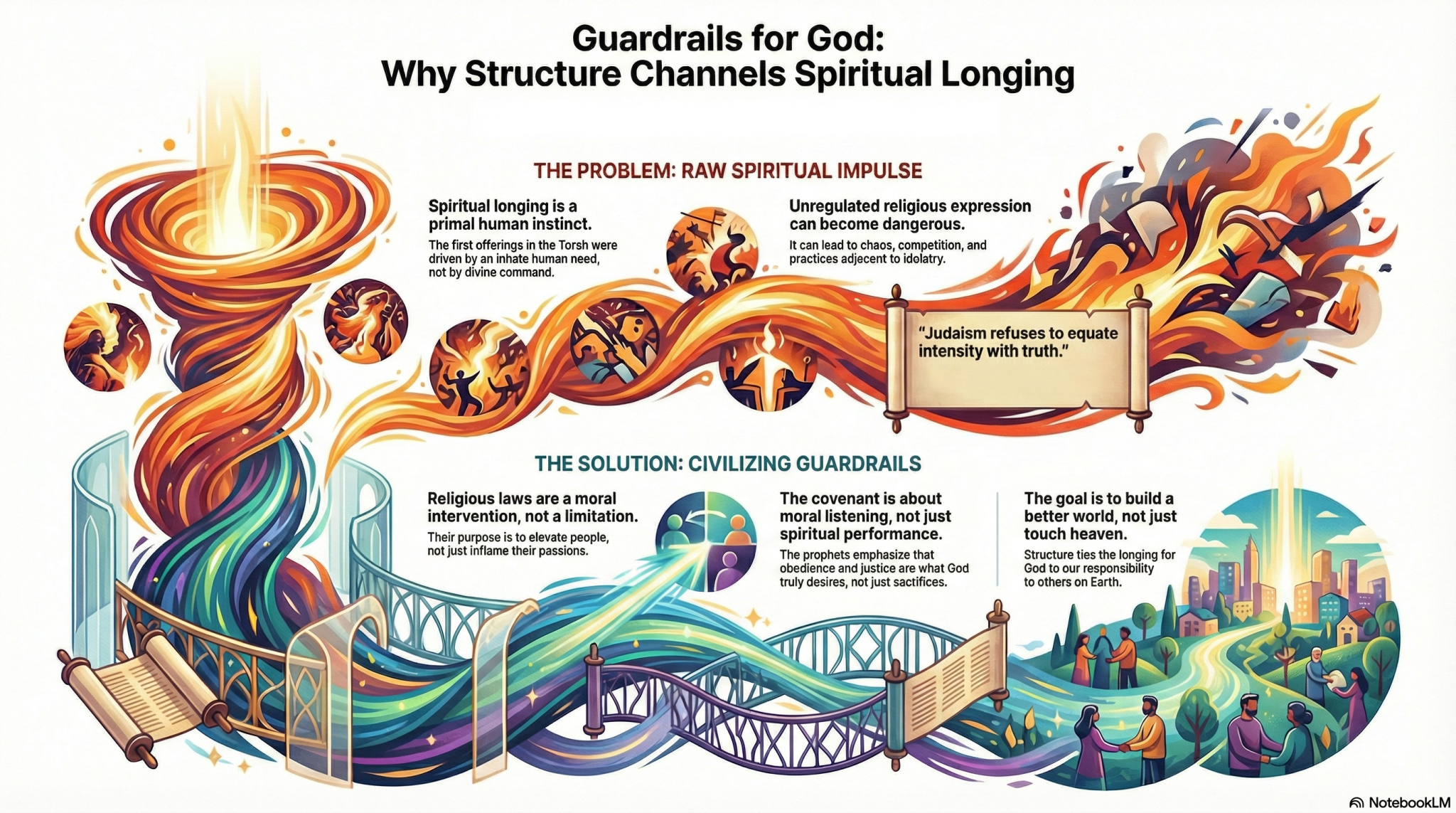
Religion begins as an instinct to enlist higher power for safety.
The Torah’s revolution is to constrain that instinct — and turn it into a moral vocation.
Religion doesn’t begin with commandments. It begins with wiring.
Before there is Sinai, before there is a Temple, before there is anything we would recognize as a “system,” human beings reach for the Divine the way they reach for shelter and allies: urgently, instinctively, sometimes desperately. We are evolutionary creatures, built to survive. And for humans, survival has always depended on connection — on forming alliances with forces stronger than ourselves.
First, it was family and tribe. Then it was kings and armies. And when we confronted what lay beyond human control — drought, disease, infertility, death, catastrophe — we did what humans do: we looked for an even higher power to enlist.
In that earliest register, religion is a survival technology. It is an attempt to recruit the universe to our side.
And the Torah does not hide that truth. Cain and Abel bring offerings (Genesis 4:3–5). Noah, stepping out of the flood into a remade world, builds an altar (Genesis 8:20–21). No command appears. These acts are unbidden, rising straight out of the human nervous system: fear, gratitude, rivalry, awe — and the need to matter to forces beyond ourselves.
But Judaism’s most radical move is not that it sanctifies this impulse.
It interrupts it.
Abraham: the first covenant against instinct
Enter Abraham — and suddenly the Torah shifts from instinctive religion to covenantal religion.
“Go forth from your land, your birthplace, and your father’s house,” God tells him, “to the land that I will show you” (Genesis 12:1).
This is not how survival wiring speaks.
From an evolutionary perspective, Abraham is being asked to do the opposite of what wisdom dictates: leave kinship networks, abandon the protection of familiar terrain, walk toward uncertainty with no detailed plan. God does not say, “Here is how to be safe.” God says, “Follow.”
That is the first crack in survival religion. Abraham’s relationship with God is not a transaction designed to gain advantage. It is a covenant that demands trust, movement, restraint, and — most importantly — moral transformation.
Religion here is no longer mainly about enlisting God.
It is about being enlisted by God.
And once you see that, you begin to understand why the Torah will later become so intent on guardrails.
Why guardrails are necessary
Because the Torah is not naïve. It does not imagine that once Abraham exists, humanity’s older religious wiring disappears. The survival-based impulse persists — fast, powerful, emotionally compelling. In moments of fear, communities will always be tempted to revert to it.
And unbounded survival religion is not neutral. It escalates.
It turns worship into a contest of intensity. It confuses certainty with truth. It makes God a tribal weapon. It shrinks moral concern to the size of “us.” It rewards the religious styles most effective at signaling loyalty and power — even when they trample the vulnerable.
This is why the Torah later constrains sacrifice so aggressively.
Deuteronomy warns: “Take care not to sacrifice your burnt offerings in any place you like,” but only in the place God chooses (Deuteronomy 12:13–14). Leviticus is even more revealing. It describes Israelites already sacrificing “in the open,” and responds not by abolishing sacrifice but by regulating it — demanding offerings be brought to the Tent of Meeting, under communal and priestly oversight, explicitly to stop people from straying after other powers (Leviticus 17:3–7).
Read the sequence carefully: sacrifice is happening first; constraint comes second.
The Torah is not inventing religion here. It is civilizing it.
It is saying: you will reach for God — but you may not do it however your fear dictates.
Not anywhere.
Not anytime.
Not by anyone.
Not in whatever way feels most electrifying.
Because the goal is not religious intensity.
The goal is a life that is good.
Rambam: God works with human nature — and limits it
Maimonides names this dynamic with stunning clarity. In the Guide for the Perplexed (III:32), Rambam argues that sacrificial worship was the dominant religious language of the ancient world. People were accustomed to it. To abolish it outright would have been unrealistic. So God redirected familiar forms toward Himself.
But Rambam’s emphasis is not concession. It is containment.
One Temple. One place. One priesthood.
These are not technicalities. They are boundaries designed to prevent religion from devolving into a survival-driven scramble for power, protection, and advantage.
God works with human nature — but refuses to be ruled by it.
“Favor in God’s eyes” is not survival success
The prophets sharpen the point until it hurts. Jeremiah delivers a line so jarring it still scandalizes religious intuition: “I did not speak with your ancestors or command them… concerning burnt offerings or sacrifice” (Jeremiah 7:22).
Whatever the verse means in its broader context, it clearly aims to break a spell: the belief that God’s favor can be secured through religious performance while bypassing moral responsibility.
Sacrifice is not ultimate. Ritual is not the core. If your worship makes you more pious but not more just, you have not become closer to God — you have merely become better at religion as self-deception.
“Favor in God’s eyes” is not measured by how effectively we enlist God to protect us.
It is measured by whether our God-seeking turns us into people capable of justice, restraint, compassion, and truth — especially when fear insists otherwise.
The Torah’s revolution: from survival religion to moral vocation
Put it all together and Judaism’s claim becomes almost shocking in its realism.
Religion begins in instincts we did not choose — the evolutionary drive to survive by forming alliances, including cosmic ones. The Torah knows this. That is why altars appear before law. That is why sacrifice erupts “in the open.” That is why people will always be tempted to intensify worship when threatened.
But Abraham reveals the next step: God does not merely offer protection.
God calls.
And once God calls, the old wiring is no longer enough. The point is not simply to feel close to Heaven; it is to build a life on earth that can bear Heaven’s name without becoming dangerous.
That is what guardrails are for.
They do not exist to suffocate spirituality. They exist to protect it — from our fear, our ego, our tribal instincts, our hunger to turn God into an amplifier of whatever we already want.
Judaism does not deny that religion begins as a survival strategy.
Its genius is that it refuses to let religion end there.
Because the holiest moment is not when we build the biggest altar.