What Mamdani offers young liberal Jews
Reader Warning: This article is written for those who desire a dialogue with liberal American Jews. I suspect that for those who identify the current reality in New York as similar to Berlin in the 1930s, the words written here may add to existing pain.
One of the central challenges emerging today in American Jewish life is that political candidates who strongly oppose Israeli policies — and especially those who challenge the Gordian knot tying the United States to Israel — are deeply connected to socialist values within American political discourse.
Regardless of one’s position on socialism, and especially our experience with socialism in the modern era, historically, within Judeo-Christian discourse, Judaism was at the vanguard when it came to placing social principles at the heart of ethics. Judaism sees “the Other” — the poor, the immigrant, the orphan, the widow — as those whom it is easy to ignore, allowing the system to harm them while closing one’s eyes to social injustice, and insists that the entire community must take responsibility for them.
As Jews, we are proud to have brought Shabbat into the world, because Shabbat is a day of rest that God demands of us, as a society, not only for those who can economically afford to take it, but also for those who struggle to rest once a week — those stripped of most human rights — as central to our moral obligation.
Consequently, for many American liberal Jews, a profound tension arises between the foundational values of the Judaism they practice and their relationship, as Americans, with Israel. The new leadership in the Democratic camp has forced them to choose: Do we align with those who support Israel but whose broader platform often preserves the power of the rich and the strong — an approach that doesn’t fit the Jewish values that push us to act on behalf of the Other? Or do we align with socialist candidates whose principles resonate with us and who propose adopting those very values — which for us are inherently Jewish values — in our American lives, even though their positions directly oppose the familiar status quo between the United States and the State of Israel, or even call to cut it off entirely?
Living in the United States — a society driven by capitalism on steroids — only heightens my desire to embrace these Jewish, socially conscious values. As someone who lived for years in New York, the world capital of capitalism, seeing the city that I could almost not survive in financially offer the possibility of systemic change (even knowing that much of it will not succeed) — is the fulfillment of the Jewish prophetic vision which claimed that the condition for any society and state, as well as for any religious life, is to focus on social justice. This makes it extraordinarily difficult to choose Israel at the expense of fundamental Jewish values.
But the challenge does not end here. Progressive elected officials raise the question: does serious, ethical Jewish identity require accepting the State of Israel, as it is today, as part of our Jewish identity? I will explain.
Mamdani’s prayers
The day after the horrific murder of Jews at a Hanukkah party in Australia, as someone who grew up in the ultra-Orthodox (Haredi) world and whose inner life remains steeped in prayer, I watched closely to see how American Jewish leaders would respond. Some boarded flights to Australia to comfort the grieving families and the community. Others spoke, as always happens when there is violence against Jews, of the urgent need to bolster security around synagogues and Jewish schools.
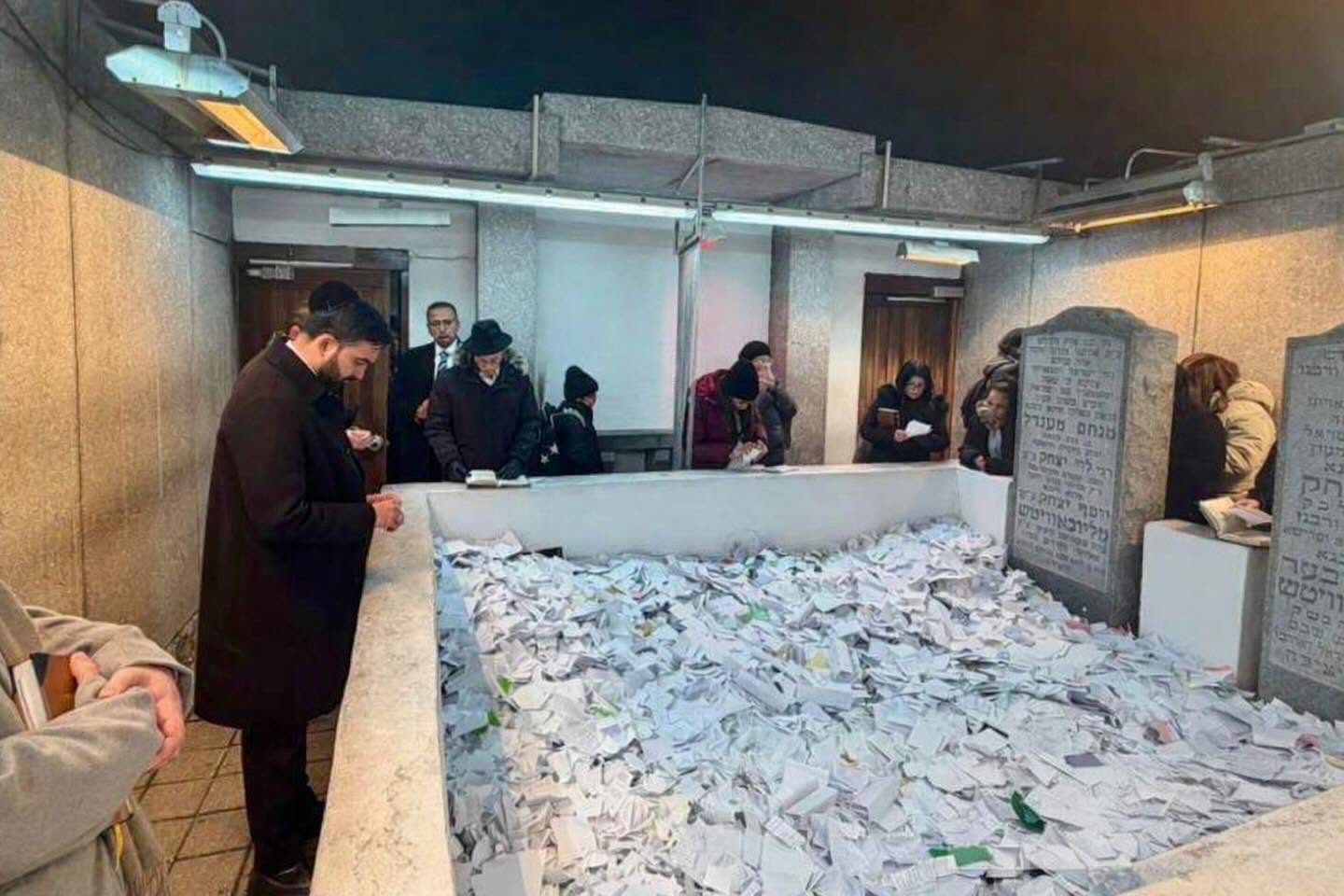
As a former Haredi, I remain an avid reader of the ultra-Orthodox media. There is something about this media that, because it is not Zionist in essence, makes the way they cover reality feel refreshing. The next morning, one article caught my attention: it reported, with a large photograph, on the mayor-elect of New York City, Mamdani — accompanied by a delegation from his staff, many of whom are not Jewish — holding a Book of Psalms (Tehillim) and praying for the recovery of the wounded and the elevation of the souls of the deceased at the grave (Ohel) of the Lubavitcher (Chabad) Rebbe.
It caught my breath. Here was a man soon to be sworn in as mayor, who deeply opposes Israel’s very existence as the national home for millions of Jews, doing the exact thing I had been doing all day: praying. He was performing what throughout most of Jewish history was the ultimate Jewish act in times of crisis. Because that image made me identify with him so intuitively, I rushed to the media to search for pictures of the heads of federations, foundations, and other Jewish organizations — and I did not find a single picture of them publicly praying.
Mayor Mamdani internalized a crucial reality: Jewishness and Jewish sovereignty do not have to be inextricably bound together as a necessary condition for one another. There are many Jews whose Judaism does not rely on the pillar of the modern State of Israel at all. Instead, they center their identity on other pillars of Judaism: core Jewish values, prayers, Halacha (Jewish practice), Jewish learning, connection to Jewish memory (much of which unfolded without a Jewish state), the Jewish family, and even the Hebrew language — as the language of prayer, liturgical poetry (piyyutim), and literature — without any necessary connection to the State of Israel.
Mayor Mamdani’s act, although also a political one, touches on the subconscious sensitivities of many liberal Jews:
First, he showed deep concern for every Jew in the world who suffers because of their Jewishness.
Second, he showed his connection to suffering Jews, even when the suffering was caused by a Muslim.
Third, he expressed his care and responsibility for Jewish suffering through a tool that Jews have used for generations to show their responsibility for suffering – prayer.
Fourth, his choice to pray at the grave of the Chabad Rebbe emphasized his appreciation for the Chabad movement and what it provides to Jews all over the world. Let us remember that the Chabad dynasty is in New York, not Israel. Because the murder took place at a Chabad Hanukkah party – he performed a Jewish act similar to many Chabad Hasidim in New York – praying at the grave of the Chabad Rebbe in New York. By doing so, he shaped the grave of the Chabad Rebbe in New York as a New York cultural asset.
The Chabad movement historically deeply opposed secular Zionism, even after the establishment of the State of Israel. For decades, and similar to other Hasidic communities, it was part of the Haredi ideology to create a division between the Jewish people and the responsibility for every Jew, and opposition to a Zionist liberal Jewish state that they believe stands in contrast to the values of Judaism. Although this approach is changing in the Chabad movement, the division between the Jewish people and the State of Israel is still legitimate in most Haredi discourse.
In other words, the mayor is telling the Jews of New York that he admires their Judaism and cares deeply about every Jew. In his eyes, they are whole Jews, even if their Judaism is disconnected from the State of Israel.
Serious Jews
For many liberal American Jews, Israel, as a state, has become a source of complexity. Life is complicated enough as it is, and not everyone is suited to living with that complexity in relation to the state. For many, Judaism is so rich with gifts that they feel comfortable letting go of Israel. These Jews graciously welcome Israeli immigrants (“Aliyah” to the US); many of them feel love for the Israelis they have met throughout their lives and are sorry for their pain; they delicately avoid political arguments, especially with Israelis who are not willing to hear their opinions, but Israel — at least as it has manifested in recent decades — simply no longer speaks to them.
Before we cry out and claim that if this is the reality, then those Jews are not serious Jews — in truth, many of us, in Israel, do something similar. I will leave aside for a moment Israelis’ attitude toward what has been happening for decades in the West Bank, and take instead a much smaller example, but one that is no less destructive from a Jewish point of view.
How many times have I (as an Israeli, who grew up Hasidic) asked completely secular Israelis why they accept a reality where at the Western Wall — the holiest site for Jews worldwide — Diaspora Jews are forbidden to pray as they do in their own synagogues, men and women together, led by female religious rabbis? How is it that they accept a reality in which women who are religious leaders in their communities, recognized as rabbis throughout the entire world, find that the one place in the world where they are not recognized as religious leaders is the state of “the Jews,” and are forbidden from leading Bar and Bat Mitzvah ceremonies for their community members at the Western Wall?
In other words, as someone who grew up in the Hasidic world and chose to leave, I have never understood how secular people simply “give up” on their right to shape their Jewish identity and leave it only to the Orthodox (mainly in their Haredi version). The answer is almost always: “Forget it, I don’t have the energy to fight with the ultra-Orthodox.” This answer always shocked me, and at the same time is so understandable: as human beings, we are limited in our energy, and we make concessions even if they are painful, on those issues that are in our responsibility that we are unable to deal with. Today, we are seeing growing communities of Jews abroad who simply no longer have the “energy” for Israel either.
Israel’s persistent problems
In conclusion, the choices made by leaders like Mayor Mamdani or Abdul El-Sayed, the Democratic Senate candidate in Michigan, challenge us all. These candidates champion values that Judaism has proudly gifted to the world for millennia: aiding the vulnerable, pointing out areas where there is systemic moral harm by those in power, seeing “the Other” — and especially the immigrant — when everyone else looks away, and confronting systemic injustice from within.
At the same time, they demand that liberal Jews take accountability for what they perceive as decades of injustice committed by the State of Israel. Why specifically Israel? Because there has been an assumption in American politics, from the 1970s onward, that the State of Israel is America’s best friend. Because the State of Israel, and the Israeli military within it, receive different treatment than any other country.
No matter what we think of that relationship, those progressive leaders (I will call them leaders who listen to the prophets of Israel) demand a reexamination of the relationship — and they see that as their duty as American leaders. As Dr. El-Sayed has stated, he opposes providing military aid not just to Israel, but also to Egypt (his family’s country of origin) and other foreign nations, arguing that American tax dollars should be spent on domestic needs like education.
So why are progressive leaders sweeping up so many Jews right now?
Israelis, Israeli-Americans, and many American Jews who love Israel frequently criticize Israel’s policies themselves. Some of us draw a distinction that helps us: between the policy of the Israeli government and the State of Israel. Even when government policy contradicts our Jewish and Israeli values, we believe it is transient, temporary, and does not reflect on the State of Israel itself. The Israeli government is a temporary fact, whereas the State of Israel is timeless. But this position — whether or not it is correct — has held steady over a very long period and does not fit everyone.
In addition, there are acute issues that the State of Israel refuses to decide, regardless of the acting government. The borders of the State of Israel have not been determined by any Israeli government since 1967 — nearly 60 years. Another such issue surrounds the very identity of the state: is there a desire for Israel to be the state of the Jewish people — including those in the Diaspora — or the state of Israeli Jews alone? In other words, today, the only democracy in the world without freedom of religion for Jews is Israel.
Demanding a dialogue
In my opinion, the central reason why this is happening specifically now is the fact that the current Jewish generation grew up to a reality that for every question they asked their leaders and rabbis about Israel, they received the same answer, which is: “that Israel is in trouble right now, and so we should simply support it.” If the leader asked was more sensitive, they replied that as far as Israel is concerned: “it is complicated.” And that is about where the dialogue stops.
So here it is: now reality forces American liberal Jews to hold Jewish leaders to it — to create an honest, open, and incisive dialogue. The reality that Israel is losing the US is perhaps the highest danger for the State of Israel and therefore it is our duty to conduct the dialogue.
As many young people tell me in internal conversations: “We will force the Jewish leadership in the US to talk to us. About our relationship to Israel. About the relationship between the US and Israel. About the question of the use of American bombs by the IDF. About the complex connection between politics and security in Israel (all challenges were raised also by most former heads of the Shin Bet, the Mossad, and former IDF chiefs of staff). About the relationship between religion and state, and our own religiosity in the land of Israel. And about the connection between the Jewish values you raised us with and the values we hear from the Israeli government.
“We know this is complicated. And we know there are amazing Israelis and we want to learn together with Israelis and build a serious relationship with them. This is the task we have asked of you to do for decades, and you have failed to do it. Until that happens — we will support candidates who live the values of the prophets of Israel. Because we are serious Jews.”