
What ‘Moderate Arab Nation’ Really Means
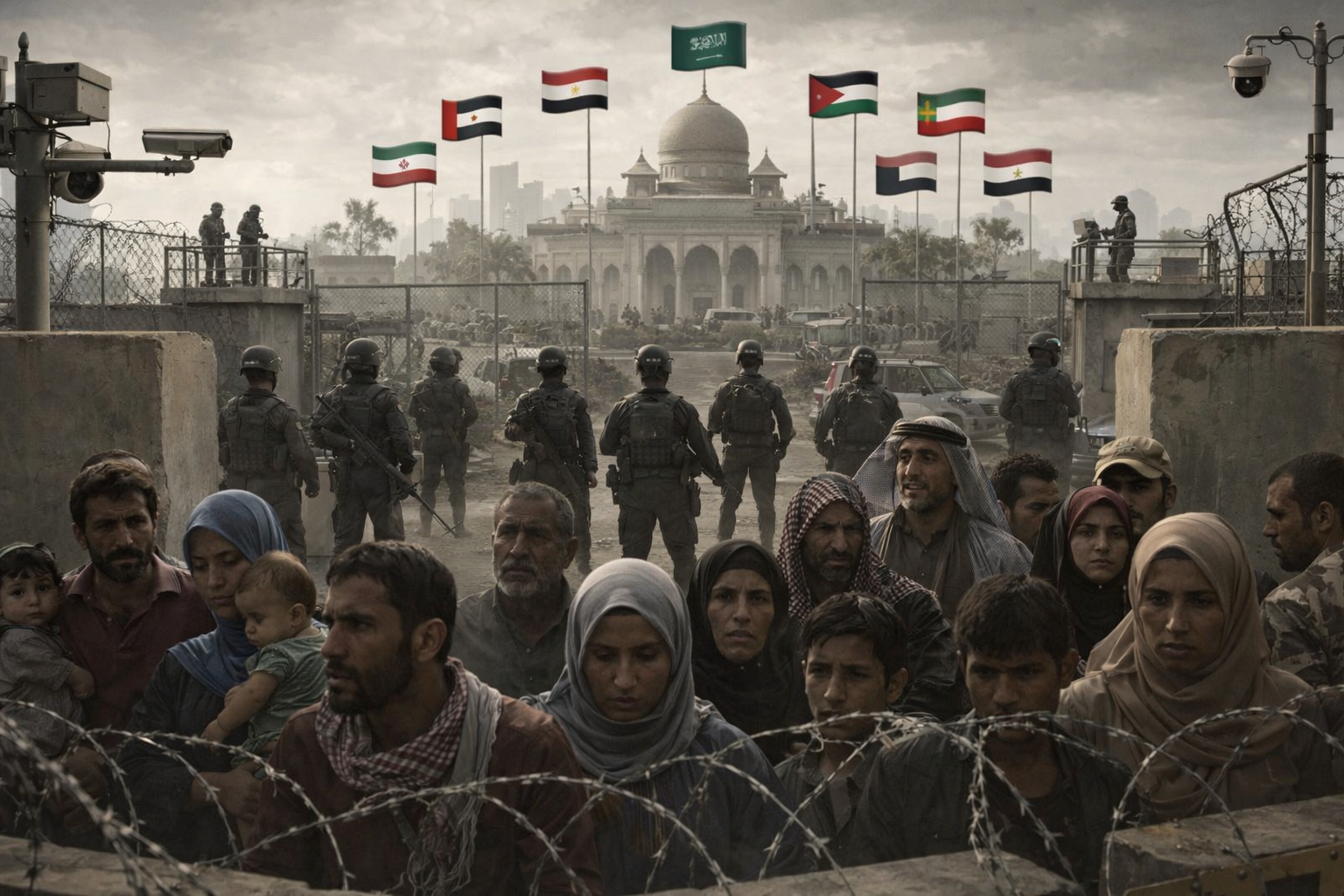
Why “moderate” in the Arab world usually means authoritarian, stable, and useful — not free or democratic.
In Western policy language, the Arab world has four categories: failed states, jihadist states, “moderate” ones, and democratic. “Moderate” simply means oppressive, but still functioning.
That is not a provocation. It is a taxonomy. A taxonomy is simply a way of organizing complex realities into clear categories so they can be understood and discussed accurately.
Western leaders routinely describe certain Arab regimes as “moderate” to signal stability and partnership in an unstable region. But the word moderate here does not describe political values, pluralism, or restraint of power. It describes something far more basic: whether the state still works, whether it controls territory, suppresses challengers, cooperates on security, and can be relied upon.
Once that distinction is made, much of the confusion surrounding Middle East policy disappears.
Category One: Failed States
Syria, Yemen, Libya, and now Lebanon, are failed states.
These are not imperfect democracies or fragile systems. They are states that no longer meet the basic criteria of sovereignty. They lack a monopoly on violence, fiscal capacity, territorial control, or functional governance.
Lebanon belongs in this category not rhetorically, but empirically. The state is bankrupt, politically paralyzed, and unable to disarm or expel Hezbollah (an Iranian-backed terror organization) that operates as a parallel army and dictates questions of war and peace. A state that cannot control its own territory or prevent a non-state actor from dragging it into conflict is no longer sovereign.
Syria represents the most extreme version of this collapse. After Bashar al-Assad fled to Russia, the Syrian state ceased to exist as a unified authority. The country is now governed in parts by militias and jihadist factions, including Hayat Tahrir al-Sham under Ahmed al-Sharaa (al-Jolani), which exercises de facto rule over territory through Islamist courts and security structures.
These are not states in crisis. They are post-sovereign entities.
Category Two: Jihadist States and Regimes
Some political systems are not failed experiments but ideological projects.
Afghanistan under the Taliban is the clearest example of a jihadist state. The regime exercises nationwide control and enforces religious absolutism as state law, suppressing women, minorities, dissent, and political pluralism by design.
Elsewhere, jihadist governance appears not as internationally recognized countries but as territorial regimes embedded within collapsed states. Hamas-ruled Gaza operates as a theocratic quasi-state, combining governance, indoctrination, and terrorism. ISIS once controlled vast territories across Iraq and Syria as a self-declared caliphate, complete with courts, taxation, and police enforced under jihadist law. In Syria, Al Jolani and HTS-controlled Idlib functions as a jihadist proto-state inside a failed country.
These regimes are not moderate, fragile, or transitional. They are irreconcilable by design.
Category Three: “Moderate” Arab States
Authoritarian, but functioning
This is the category Western policymakers praise most and misunderstand most.
Egypt, Jordan, Saudi Arabia, the United Arab Emirates, and Morocco are routinely described as “moderate.” None is democratic.
What these states share is not liberal governance but control. Power is centralized. Political participation is constrained. Media is regulated. Dissent is criminalized or preempted. Minority rights exist conditionally, not equally.
Jordan is often called moderate because it cooperates with the West and maintains peace with Israel. Internally, authority is concentrated in the monarchy, parliament is weak, and speech critical of the state is tightly restricted. Stability is preserved through limitation, not consent.
Saudi Arabia presents itself as reformed through social liberalization and economic modernization. Yet it remains an absolute monarchy with no national elections, no free press, and severe penalties for political dissent. Reform has occurred around authoritarianism, not away from it.
The United Arab Emirates is praised for efficiency, economic openness, and opposition to jihadist movements. Politically, it allows no organized opposition, restricts speech, criminalizes activism, and relies on extensive surveillance. Order is maintained through total political control.
Morocco is often cited as a gentler exception. It holds elections and permits limited pluralism, but ultimate authority rests with the monarchy. Parliament cannot meaningfully challenge royal power, and dissent is tolerated only within strict boundaries. Stability is achieved through management, not accountability.
Across these states, moderation is external, not internal. It describes how regimes behave toward Western interests, not how they govern their own societies.
It is no coincidence that these regimes respond to Iran’s current unrest with silence rather than support. Despite operating under an Islamic regime, Iran is experiencing sustained popular revolt that challenges the assumption that repression guarantees stability. For neighboring authoritarian states, the danger is not ideological alignment but precedent. A successful uprising would demonstrate that even deeply entrenched security systems can fracture. This would be a lesson these governments have spent decades ensuring their own populations never learn.
The Category the West Ignores
There is, however, a fourth category and this one exposes the fiction behind the others:
Democratic, functional societies that reject extremism but lack geopolitical utility.
Somaliland is the clearest example.
For more than three decades, Somaliland has maintained internal security, held competitive elections, enabled peaceful transfers of power, and resisted jihadist control. It has done so without oil wealth, foreign troops, or international recognition.
Its exclusion is not a failure of democracy. It is evidence that recognition is granted for usefulness, not values.
The Asymmetry at the Heart of the Debate
The double standard this taxonomy produces is stark. Arab authoritarian states are excused for repression in the name of stability. Failed states are pitied. Jihadist regimes are condemned. Democratic outliers are ignored.
Israel alone is judged by an entirely different standard. It is expected to be democratic, pluralistic, restrained, and morally exemplary, even under existential threat, while authoritarian allies are praised simply for holding together.
This asymmetry is not accidental. It is embedded in the language.
What Moderation Actually Means
If the word moderate is to retain any analytical value, it must be reclaimed from convenience. Moderation is not repression that works. It is not silence enforced by fear. It is not order without consent. Moderation means restraint of power, protection of minorities, rule of law, accountability, and moral consistency.
By that definition, most so-called moderate Arab states are not moderate at all. They are authoritarian systems that function and are praised precisely because they do. The West’s problem in the Middle East is not a lack of information. It is a refusal to name things accurately.
Clarity is not radical and it is long overdue.