Photographer, musician, aging skateboarder, and sometimes writer
What Nintendo Can Teach Us about Preservation
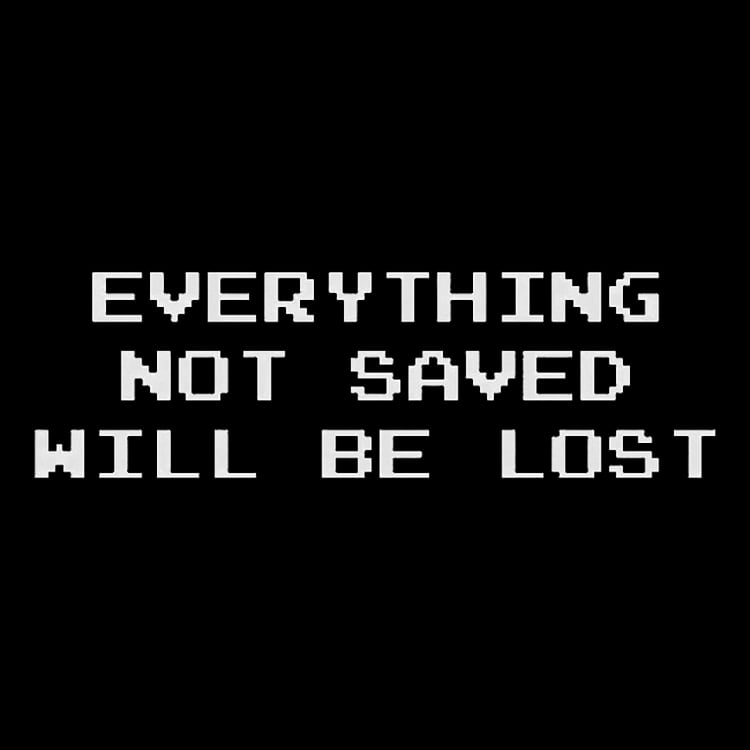
Nintendo Quit-Screen Message
The following was written on December 18th, 2025, in response to the Bondi Beach Hanukkah massacre:
“Everything not saved will be lost.” Profound, no? It’s actually an old Nintendo quit-screen warning the player that any progress they choose not to save on disk will be discarded. My algorithm must have me pinned, correctly, as an 80s millennial with a penchant for video games and Marcus Aurelius. It hit the nail on the head in this case, because that quote landed in my screenshot folder during one of my mindless Instagram scroll sessions. What does this have to do with antisemitism? We’ll get to that.
I’m not Jewish. Well, that’s not entirely true. This past May, I married a Jewish woman, and we celebrate the high holidays, have a mezuzah on our door frame, and a kippah for our cat, so I guess you could say I am kind of, as the joke goes, Jew-ish.
But I wasn’t raised Jewish, and according to the lab that analyzed a tube of my spit, I have no Jewish lineage. So why then, beyond feeling horror and sadness after the December 16, 2025 mass shooting in Bondi Beach, Australia, should I care so much about this particular massacre? It happened halfway around the globe, and we have our own problems here in New York. Well, I do care, and you should too.
I was raised by Baby-Boomers who were recovering from their Catholic childhoods. They grew up during the Hippie era, and engaged in some of its tropes, like concert-going, recreational psychedelic usage, and long hair (my mother’s adorned with wildflowers whenever possible). Their partying diminished with age, but a disdain for their dogmatically religious upbringings, along with their generation’s inclination toward counter-culture, fostered a healthy skepticism of big government and religion. I imagine these factors informed their decision to raise me without organized religion. Regardless, they wanted to raise me with strong values and ethics. My parents tried a Humanist structure for a while, and my father’s Tai Chi and mother’s yoga practices infused me with bits of Eastern philosophy. But the biggest influence in my moral landscape were the Enlightenment values: equality, tolerance, reason, liberty, and rationalism.
My father, a lifelong student of history, believed that the Enlightenment ideas paved the way for much of the relative peace and freedom we now enjoy. Many of these values are Judeo-Christian in origin: inherent human dignity, natural law (morality), and the concept of a covenant, which informs the basis for maintaining a social contract.
I’m still not religious. I don’t believe in a singular, anthropomorphic, personified God, and although I have a strong connection to and practice of spirituality, I reject enough of the tenets of any religion to be comfortable being a member. But I don’t toss the baby out with the bathwater. There are good values – objectively good morals – that religions have codified. The Enlightenment thinkers understood this, brilliantly distilling thousands of years of religious and social values into to a secular structure with personal freedoms. Our Founders did too, when they launched the American project: a remarkably brave and brazen and totally new experiment that resulted in forming what I still believe is the greatest nation in the world.
I’m very much a product of America, and of the values that enabled my family to give me the life I was blessed with. My Sicilian-American grandfather served in Africa and Europe during World War II, and my Irish-American grandfather served in the Pacific Theater, paving the way for my folks to enjoy rock-and-roll and baseball (both uniquely-American inventions). My parent’s hard work offered me a childhood of skateboarding and listening to Grunge (both also uniquely-American). It also allowed me to follow my dream and pursue a career in the arts.
As a freelance portrait photographer in New York City working in the celebrity, music, and culture industries, I rarely post anything political on social media. There is a canon of thought; an orthodoxy into which – if I want to keep working – I must fall in line. I’ve frequently been tempted to speak up about a current event, candidate, or cause, but have chosen to hold my tongue. Speaking up was a luxury for the financially stable. To opine outside the norm is to invite ostracism.
Why then, my wife asked me yesterday, did I choose to repost a slew of articles about the Bondi Beach massacre? Why risk my entire career, and even some of my friendships? I had to pause for a beat to consider. Besides now having a Jewish family whom I’d protect at any cost, I sensed something larger motivating my choice to become visible. I opened the Photos app on my phone – an all-too-involuntary spasm these days – and came across the screenshot of the Nintendo quit-screen warning. Everything not saved will be lost.
What happened in Sydney is about more than simple hatred of Jews. Some may point to current geopolitics in explaining motives, but that’s shortsighted (to be generous), and naïve.
Many radical Islamists follow an interpretation of Islam which seeks to destroy – along with Jews – the Western world. It’s no coincidence that Western societies, Israel included, have been home to what is frequently referred to as the Golden Age for Jews. It turns out that the values I was raised with – those of the Enlightenment and of America – provide fertile soil for Jewish flourishing. A society’s treatment of Jews is often a good litmus test of its values. Mistreatment of Jews – or worse, their slaughter followed by political doublespeak to explain it – is just the beginning. They are the proverbial canaries in the coal mine, unfairly bearing the burden of alarm-ringing when freedoms deteriorate.
The two Sydney murderers were inspired by ISIS, the largest of many global Islamic-jihadist terror groups who explicitly name Israel, America and The West as enemies. They call for a global caliphate – for the globalization of the Intifada – and are well-documented in infiltrating Western institutions, non-profits, and universities.
Protesters chanting “Globalize the Intifada” act, often unwittingly, as proof of this infiltration. The First and especially the Second Intifada both concluded with large numbers of dead Jewish civilians. The frail assertion that “Intifada” only means resistance or civil uprising is simply false: there is not a single non-violent definition attached to it, and perhaps more tellingly, the most brutal extremists on the globe shout it with glee. Intifada means violence, specifically toward – but not reserved solely for – Jews, and we are seeing it play out all over the world. We saw it in Berlin in February, in Washington D.C. in May, a week later in Boulder, and in Manchester in October. We have watched it percolate in Australia for years as Jews have rung the alarm for plugged ears. It will continue to metastasize until there is a concerted campaign to face its sick reality and extinguish it unapologetically.
America, like Australia and the rest of the West, has had its problems, and continues to. Some of our past is downright disgusting. People often point out correctly that our Founders lived lives rife with moral contradiction. But despite their faults, they produced a foundation for government which has enabled generation after generation to thrive in relative safety, including, for the first time in thousands of years, Jews. I love my country, and I love my family. I refuse to see either of them lost to violence, intolerance and bigotry. And everything not saved will be lost.
Recently, American Jews – New Yorkers – were verbally assaulted entering a Temple on Park Avenue in Midtown Manhattan, by an increasingly-aggressive crowd shouting “From New York to Gaza, Globalize the Intifada!” One protester told a reporter for the New York Post “We need to make them scared, we need to make them scared. We need to make them scared.” If this happened at any other spiritual institution – a Christian church, a mosque, hell – even outside an Alcoholics Anonymous meeting – it would draw immediate and fierce outrage by public and private voices alike.
Zohran Mamdani, the next mayor of America’s largest city, has been chronicled refusing to denounce“Globalize the Intifada” and other slogans widely understood to be a call for violence toward Jews. Asked by Jewish and secular leaders for his public condemnation of the events at Park Avenue, his representative said“The mayor-elect has discouraged the language used at last night’s protest and will continue to do so. He believes every New Yorker should be free to enter a house of worship without intimidation, and that these sacred spaces should not be used to promote activities in violation of international law.” Political word-mincing, rationalizing, and cowardice. How about “This is unacceptable in the City of New York. Protests are allowed, but harassment and calls to violence are not.” Full stop.
New York, sadly, is not unique in this way. Nor is Berlin, Washington D.C., Boulder, Manchester, or anywhere else in the West right now. The same kind of political acrobatics and rationalizing are happening in response to Bondi Beach’s slaughter.
So the next time you see someone advocating to Globalize the Intifada, ask yourself: Do you want Coney Island or Santa Monica to look like Bondi Beach? Do you want Chicago, or Miami, or any other American city or town, to look like Israel on the morning of October 8th, 2023? Because if you don’t, you might consider what we stand to lose here in the West, and here in America.
Marcus Aurelius reminds us “to stop talking about what the good man is like, and [to] just be one.” Our Jewish countrymen and their rights need protecting. The West and its freedoms need protecting. What we have can be lost – and everything not saved will be lost.
Related Topics
Related Posts