The Institute for Safety in the Criminal Justice System
What Nobel Laureate Yisrael Aumann Taught Me Beyond Game Theory
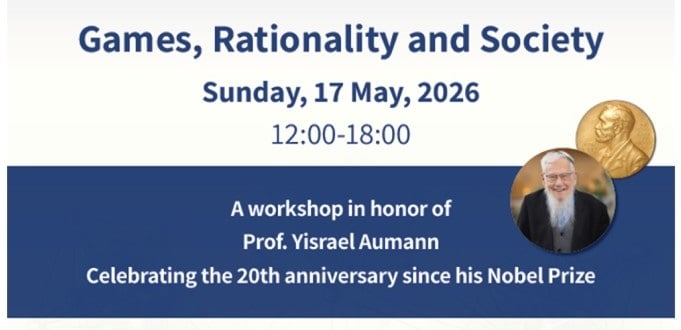
“Games, Rationality and Society” held in honor of Yisrael Aumann, celebrating 20 years since his Nobel Prize. his special gathering will highlight the remarkable academic legacy of Prof. Aumann through his academic descendants-his students and their students- and their contributions to the study of game theory, rationality, and society. Source: The Federmann Center for the Study of Rationality
A Personal Reflection on the Man Who Taught Me the Meaning of True Mentorship
On Sunday, May 17, I attended a workshop at the Center for the Study of Rationality on the Givat Ram campus, held in honor of Professor Yisrael Aumann and marking twenty years since he was awarded the Nobel Prize in Economics.
At the close of the workshop, Aumann shared meaningful memories from his life with us, some moving to the point of tears, which he called “snapshots.” Alongside the moving memories, there were also many moments of typical Aumann humor. Referring to his approaching birthday, he smiled and demonstrated it with a sign bearing the number 96: “At 96, it no longer really matters, whichever way you turn it, it still reads 96.”
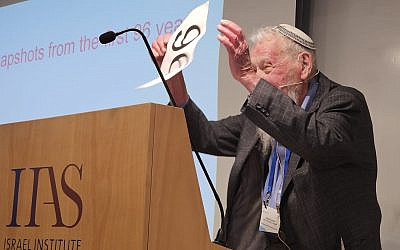
During the evening, one remarkable aspect of Professor Aumann’s character came up again and again: his ability to separate the person from that person’s opinions. Aumann is known for his firm views, yet among his close friends and students are people whose political views are very far from his own. Precisely for that reason, and especially in these polarized times, this offers an important lesson in humanity, friendship, and true mentorship.
The event was inspiring, to say the least. In that same human, open, and collegial spirit, I would like to share something of the special experience I had in his presence, as someone who is, in his own words, “my youngest academic child.” I am not sure whether this title is an honor or a source of embarrassment. There is no doubt that being Aumann’s doctoral student is an immense honor. But being his last doctoral student raises the unsettling question of whether I wore him out to such an extent that he no longer wished to take on any more students…
And this is how it happened. In 2007, I sent Professor Aumann an email with a strange idea about plea bargaining and positive feedback dynamics. I had no idea that this email would change my life. I had been studying independently the phenomenon of confessions in police interrogations and in courts, and I wrote to Professor Aumann that, in my view, the prevalence of plea bargains could be explained as a positive feedback mechanism: the more a legal system relies on plea bargains, the more the pressure to rely on them continues to grow. The idea was inspired by the work of Thomas Schelling, Aumann’s co-recipient of the Nobel Prize in Economics in 2005, on social segregation.
To my great surprise and joy, shortly afterward I was invited to meet him. In that meeting, I described my thesis, and I remember Professor Aumann leaning back and casually resting his feet on the table. I felt embarrassed, but I reminded myself that perhaps his casual demeanor was actually a positive sign.
One of the conclusions that followed from my thesis, if it was correct, was that a legal system that systematically allows the truth-finding process to be bypassed through plea bargains may, sooner or later, be left almost without trials. Aumann asked to continue speaking with me about it.
At our second meeting, I came with a diagram describing the thesis of the feedback-cycle dynamics of plea bargaining. I remember Professor Aumann striking the table enthusiastically with his palm and telling me, “You should write down the date of this idea.” He did not wait. He took a pen and wrote the date at the top of the page. That page is now framed and hanging on the wall near my desk.
Then I said to him: “Professor Aumann, just before you decide whether to accept me as your student, you should take into account that a serious indictment has been filed against me.”
I told him that my father, Moshe Zohar, had passed away in 2002 after a heroic battle with Lou Gehrig’s disease, ALS. About a year later, while I was feeding our third daughter, who was then two months old, police officers entered our home and arrested me on suspicion of having murdered my father. At the time I met Yisrael, the trial was already nearing its end, and I was under house arrest, with certain restrictions eased during the daytime.
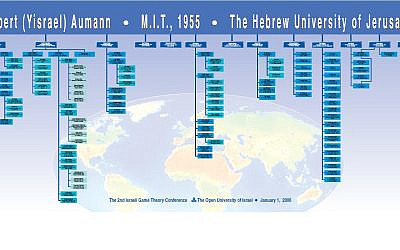
Yisrael listened intently and led me toward what he called “my academic family tree.” On the wall opposite his desk hung a poster listing his students, his students’ students, and their students. As he introduced me to them, I understood that despite the shocking accusation against me, he was accepting me as his student.
In 2014, Channel One produced a documentary about him, and Aumann invited me to join him and speak with him about that first meeting between us.
Israel Broadcasting Authority | Against All Odds: Professor Yisrael Aumann, Game Theory Scholar
But my registration encountered difficulties, and I was forced to appeal. On October 31, 2007, I sent the appeals committee my explanation of the novelty of my research, in which I wove in the following argument:
“As an economist, I found that my perspective on the phenomenon differed from that of lawyers and legal scholars. Whereas lawyers examine the case, the economist examines the phenomenon, or the effect of the case on the behavior of the system.”
I would later discover that Aumann was very fond of this argument and even quoted me.
About two weeks later, on Thursday, November 15, 2007, I was fully and unanimously acquitted. Aumann sent me his blessing and quoted from that week’s Torah portion, Vayetze: “With mighty wrestlings have I wrestled with my sister, and I have prevailed” (Genesis 30:8). Since then, when I reach the reading of that verse, I am reminded that another year has passed.
For me, being supervised by Yisrael sometimes felt like an impossible challenge. He required me to meet standards that he regarded as essential, and he did not let me off when he thought it was necessary. At certain stages, the task felt so difficult that I would repeat to myself the saying, “He who spares the rod hates his son.” If so, Yisrael must have cared for me very deeply, for he certainly did not spare me…
It took me time to review the literature on this topic and to study the economic model of courts in which plea bargains are understood as taking place “in the Shadow of the Expected Trial Outcome.” In the original model, prosecution resources were assumed to be fixed. I realized that if that assumption is relaxed and prosecution resources are allowed to vary, plea bargaining may create a positive feedback loop. This became the theoretical foundation of my thesis.
Professor Aumann was pleased with my progress. When he heard me say that in Supreme Court rulings justifying the plea-bargaining framework, one finds again and again the statement that “there is no dispute that plea bargains save resources,” and that in my view this was a mistake based on a perceptual illusion, he responded in Aramaic: “Leit man de-palig? Is there no one who disputes it? There is someone who disputes it!”
Later, he surprised me by telling me that although he is a mathematician, a mathematical model is not the most important thing. In his words, a model alone is not enough; one must be able to express it in words. But words alone are not enough either. They must rest on logical foundations, otherwise one can say anything. And so, in his gentle way, he required me to formulate a formal mathematical model.
Aware of my limitations, he connected me with his doctoral student at the time, now Dr. Moti Michaeli of the Department of Economics at the University of Haifa. Our collaboration led to the publication of articles in which we formulated the feedback-cycle dynamics of plea bargaining and developed an alternative theory for understanding the phenomenon of plea bargains, which we called: “Criminal Trial in the Shadow of Bargaining”.
Later, Professor Aumann worked closely with me to tighten the mathematical formulation of the model. From these working sessions emerged another important insight: as plea bargaining expands, the bargaining range expands as well — that is, the range within which the parties can reach an agreement — and this expansion may aggravate sentencing disparities.
Together with another colleague, Uri Weiss, also a doctoral student of Aumann, we conducted a game-theoretic analysis of the prosecutor’s decision to file an indictment and showed that plea bargaining may operate as a mechanism of pressure bordering on coercion, and that it not only increases sentencing disparities but also amplifies discrimination among defendants.
But Aumann was still not satisfied. He urged me to validate these conclusions through an empirical study.
Fortunately, I was later introduced to an empirical study conducted by Professor Oren Gazal-Ayal, another of my doctoral supervisors, together with Dr. Hagit Turgeman and Professor Gideon Fishman. I quickly realized that my model could explain irregularities in their study, and that the dataset could help validate my hypothesis: that as plea bargaining expands, sentencing disparities expand as well.
To my delight, they agreed to share their dataset with me, and with the help of another doctoral student at the Center for the Study of Rationality, Uri Isserles, we developed innovative metrics for estimating sentencing disparities. After we tested them, the data analysis confirmed my hypothesis. I had a validated model.
At that point, I thought I could present Aumann with a complete doctoral project. But even then, the road was not simple. Doubts were raised about the degree of novelty in the work, and I was even advised to consider stepping aside gracefully. I, for my part, insisted on continuing, out of an inner conviction that there was a real contribution here.
This time, rescue came from Professor Alon Harel, who suggested a way out: let journals in the field determine the quality of the research, and the test would be whether I could publish the articles. Once my empirical study was accepted for publication in a leading Israeli journal, I was approved to submit the dissertation for review. Later, I developed the research together with Yehonatan Hasson, and it was also published in the Harvard Negotiation Law Review. Yehonatan, a gifted scholar and beloved person, was killed two years ago in a tragic accident while he was a research fellow at the Max Planck Institute in Germany. This is a fitting opportunity to remember him and express my gratitude to him.
Even so, Yisrael insisted on going over my writing thoroughly and sent me many comments for revision. Aumann, who is known for his wonderful ability to describe complex matters clearly, did not hesitate to comment on places where I had written about simple things in a complicated way…
In June 2017, as I arrived at the parking lot after meetings at the Knesset concerning the amendment of Section 12 of the Evidence Ordinance — the requirement of corroboration for confessions — I received a phone call from a mobile number I did not recognize. An older voice asked, “Have I reached Dr. Zohar?” Embarrassed, I replied, “With whom do I have the honor?” “Yosef, this is Yisrael. I called to congratulate you on the approval of your doctorate.”
Some time later, my three supervisors, Yisrael Aumann, Alon Harel, and Oren Gazal-Ayal invited me to dinner to celebrate the completion of my PhD. Aumann seated me at the head of the table, poured wine for those present, and blessed me cheerfully like a father at the Torah reading of his son’s bar mitzvah: “Blessed is He who has relieved us of the punishment of this one.”
About a year later, I was invited to deliver the valedictorian address at the University of Haifa graduation ceremony, and Yisrael came especially from Jerusalem.
From the doctorate, a path of research and teaching opened before me: postdoctoral research under the supervision of Professor Michal Alberstein at the Faculty of Law at Bar-Ilan University. As part of that work, we instructed students to observe preliminary hearings in magistrates’ courts and conducted a comparative study with the continental legal system. These studies helped formulate proposals for reforms in criminal procedure, based on the conclusion that the right to trial must be a non-waivable constitutional right — one that cannot be waived even if the defendant himself is willing to waive it as part of plea-bargaining negotiations.
Later, I joined the Department of Criminology at the Western Galilee Academic College as a faculty member, and together with Professor Boaz Sangero and Dr. Hagit Turgeman, we established the Institute for Safety in the Criminal Justice System, based on the vision that the legal system, like other systems critical to human life, needs institutional safety mechanisms.
None of this would have been possible without a devoted teacher who might have given up on me, but did not. Aumann opened for me the possibility of becoming part of the Center for the Study of Rationality at Givat Ram without being a regular student, and exposed me to a kind of multidisciplinary intellectual interaction I had never known before. Without his faith and support, none of this would have happened, and I myself would not today be a scholar and teacher.
I believe that his recognition of the importance of my research enabled me to redirect my life toward something of value after an experience that had so profoundly shaken my world. It planted in me a renewed sense of meaning and commitment, and in doing so turned the entire experience of the arrest and the trial on its head. Without his recognition and support, I do not know how I would have found the strength to rebuild my life. In that sense, I believe he saved me.
The irony is that the very person who set before me what seemed an impossible challenge — to complete a doctorate successfully under his supervision — was the one who made its success possible. I said to myself: in my own smallness, I might be allowed to fail. But I could not allow Yisrael’s faith in me to fail. If Yisrael had seen in me someone worthy of being his student, then I had to find a way to prove that his faith had been justified.
From this I understood something profound: a great teacher does more than transmit knowledge. He sees in a student something the student himself is not yet able to see. He demands more from the student than the student believes he can give, yet does so in a way that ultimately enables him to become more than he thought he could be.
Out of this, a deep responsibility toward my own students was born in me. When they struggle, I feel Aumann behind me, reminding me of my own journey. This obliges me to support them as long as they do not give up, but also not to let them off too easily; to help them find their way, while never ceasing to demand that they meet a standard they themselves do not yet know they are capable of reaching.
Looking back, I realize that beyond the theories, models, and papers, the greatest lesson Professor Aumann taught me was what true mentorship means. In a kind of closing of a circle, Yisrael recently honored me by writing a moving personal inscription in my book, The Seventh Beggar – Notes from Prison Cells, a gesture I carry with deep emotion and profound gratitude.
Professor Aumann, I feel privileged to have been one of your students. I thank you from the bottom of my heart for teaching me that true scholarship requires not only intellectual brilliance, but also deep commitment, patience, humanity, and faith in one’s students.
You once told me that you had taught your grandchildren to ski. They continue to ski, and in that sense, you continue to ski through them. You taught us game theory. We continue to study it and teach it; and in that sense, you continue, and will continue, to teach through us.
I would like to wish you many more years of good health, clarity of mind, joy, and satisfaction from your children, grandchildren, great-grandchildren, and great-great-grandchildren; from your students, your students’ students, and all the wide circles of influence you have created in Israel and around the world.
As I write these words, I am overcome by a deep sense of gratitude for all that you have done for me.
Thank you, from the depths of my heart.
Your youngest academic son,
Yosef Zohar
Related Topics
Related Posts