


What Olympic Champions, My Mother-in-Law, and Israel’s Election Taught Me
Days before Israel’s election, fear is being used to shape how we vote. On a mountain in Greece, two Olympic medalists, a group of Israelis living across different worlds, and an unexpected snowstorm offered me another way to think about fear, leadership and what holds a country together.
Fear is having a busy election season in Israel.
Fear of the Arabs, the Palestinian state. Fear of Benjamin Netanyahu and of what another term might mean for Israel’s democracy. Fear that changing the government could put the country’s security at risk. Fear that keeping things as they are will bring us closer to a future we may not recognize.
The fears are different. Some are rooted in real dangers; others are arguments about what might happen next. But fear is a powerful political instrument, and in the final days before an election, it is everywhere.
But a few weeks ago, I found myself facing a fear that could not be managed with a political planת I was preparing to climb Mount Olympus.
At roughly 3,000 meters, Greece’s highest mountain was a different kind of proposition. I could train for the physical challenge, I could prepare my equipment but I could not know how I would react when the climb became difficult, when the weather changed, or when my mind began telling me that I could not continue.
And there was a sobering detail, an Israeli hiker had recently died on Olympus after going missing during his climb. The mountain was no longer an abstract adventure or a backdrop for an inspirational story, It was a real place, with real risks.
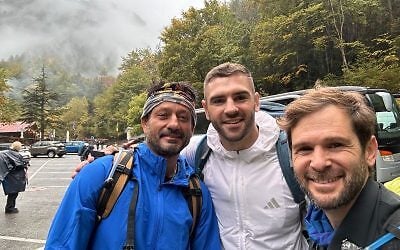
I had seen that Olympic medalists Oren Samadja and Peter Paltchik were going on the expedition. I pushed myself to arrange a meeting and join them.
I am 45 years old , a father of three, and about to head up a mountain with a group of people I did not know well. I had trained on demanding trails in Israel and done better than expected, physically, I felt ready emotionally, I was less certain.
The man who learned to live with fear
“Dare, and don’t be afraid to fail” Oren Samadja knows what it means to perform under pressure. But the most powerful lesson he shared with me was not about an Olympic match, It was about his son.
Omer Samadja was 25 when he was killed in combat in central Gaza on June 20, 2024. A reservist serving with the Alexandroni Brigade, he died during Israel’s war following the October 7 Hamas attack. His father, an Olympic bronze medalist and national judo coach, had to face a loss no parent should have to endure.
In our conversation, Oren told me about a phrase associated with his son that had stayed with him: “Dare, and don’t be afraid to fail.”
The words carry a different weight when you know the story behind them. This was not a slogan about winning at all costs. It was about the willingness to try, knowing that life offers no guarantee of success or protection from pain.
Samadja also told me that fear itself can be useful. “The fear was always there, and that was a good thing,” he explained. It can sharpen your senses, like a warning light. The challenge is not to eliminate it, but to stop it from paralyzing you.
I had spent years trying to anticipate what could go wrong. Here was a father who had experienced a loss beyond anything I could imagine, telling me about the courage to try.
https://www.instagram.com/reel/De49NMTvP4M/?utm_source=ig_web_copy_link&xtok=MzRlODBiNWFlZA==&srtk=MzRlODBiNWFlZA==
Ten meters at a time
Peter Paltchik offered another way to approach the mountain: focus on the progress you have already made, appreciate the scenery and look ten meters ahead instead of staring at the entire climb.
It sounds simple, It is harder when the summit seems impossibly far away.
Paltchik’s advice made me think about Israel, too. We are so accustomed to measuring the country against the future we fear that we sometimes overlook what has already been built the communities, institutions, achievements and relationships that make this place what it is.
Recognizing progress does not mean ignoring what is broken. Nor does it excuse political leaders from responsibility. It means that the distance still ahead should not erase everything we have accomplished along the way.
Samadja described a similar principle in athletic training: break a huge goal into milestones. You cannot treat four years of preparation as one enormous test. You need smaller achievements that help you learn, improve and keep going.
Perhaps we need that perspective in public life, too. Elections matter enormously, but no election can solve every problem overnight. And no political camp can build the country’s future entirely on its own.
A group of strangers
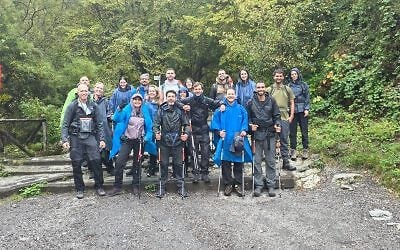
Our expedition brought together Israelis from different backgrounds and stages of life. We had little in common beyond the mountain and the decision to take on a difficult challenge.
As the climb progressed, some people struggled. One woman asked others to help carry her backpack, another was in pain, and we stopped to help.
I found myself speaking openly about my own fear not something that came naturally to me, having grown up in a family where vulnerability was not encouraged.
Something shifted when we began acknowledging our limitations. We were no longer just individuals trying to reach the same summit, we had begun to take responsibility for one another.
Some of the Israelis on the trip had moved to the United States. In our conversations, they spoke emotionally about how much they missed Israeli life: the friendships, the spontaneous connections, the feeling of belonging without having to explain yourself.
They had built lives elsewhere, yet they missed something that could not easily be recreated.
It made me wonder whether, amid all our arguments about Israel’s future, we sometimes underestimate what we have already built together — and how much people can miss it when they are far away.
The summit we didn’t reach
An unexpected October snowstorm forced us to abandon our attempt to reach the summit.We had prepared, travelled and committed ourselves to the goal but the conditions had changed, and determination alone could not make the climb safe.
For someone who had hoped to prove he could manage his fear, turning back was not the ending I had imagined. Yet the mountain had offered a different lesson: preparation matters, but it does not give us control over every outcome.
The group had to recognize reality, adjust and accept that the summit was out of reach.
That is not the same as failure, nor is it a reason to pretend the outcome does not matter. Sometimes the responsible decision is to stop, learn and try again when conditions allow.
What happens the morning after the election?
Israel votes on October 27. The campaign has given us plenty of reasons to fear what might happen if the other side wins. But the morning after the votes are counted, Israelis who disagree will still have to live together, make decisions together and face the same uncertain future.
A mountain expedition cannot resolve our political divisions. Security threats are real, democratic concerns are serious, and our disagreements are not merely misunderstandings that can be solved with a group exercise.
But the climb left me with a question about leadership and about ourselves.
Can we recognize danger without turning every disagreement into an existential threat? Can we acknowledge progress without denying our failures? Can we make room for people who move at a different pace, or do we insist that everyone keep up with us?
Samadja’s words about his son stayed with me because they point to something beyond politics: we cannot guarantee that we will not fail, but we can decide whether fear will stop us from trying. Paltchik’s advice reminds us to recognize the progress already made while continuing toward a difficult goal.
We did not reach the summit of Olympus. We returned with something less dramatic than a victory photograph, but perhaps more useful: a reminder that the way forward depends not only on individual strength, but on how we respond when others struggle and when the plan no longer works.
Israel’s voters will soon choose their leaders. Whatever the result, the climb will continue. The question is whether we will spend the next chapter frightening one another about the mountain ahead or start taking responsibility for the next ten meters.
And, of course, I owe a final thank-you to my mother-in-law, who helped prepare me for the climb by checking my gear, inspecting my backpack and making sure I was dressed like a model in an outdoor-adventure catalogue. She told me to walk at my own pace, focus on my breathing and expect moments when I would wonder why I had come.
She was right about all three. I may not have reached the summit, but I came back with a new appreciation for the people who help us face our fears and the wisdom of listening to your mother-in-law.
Perhaps making peace really does start at home.