
Sports, Politics, Broadcast and Media Specialist
What Our Government Knew and Didn’t Do: Antisemitism’s Road to Bondi
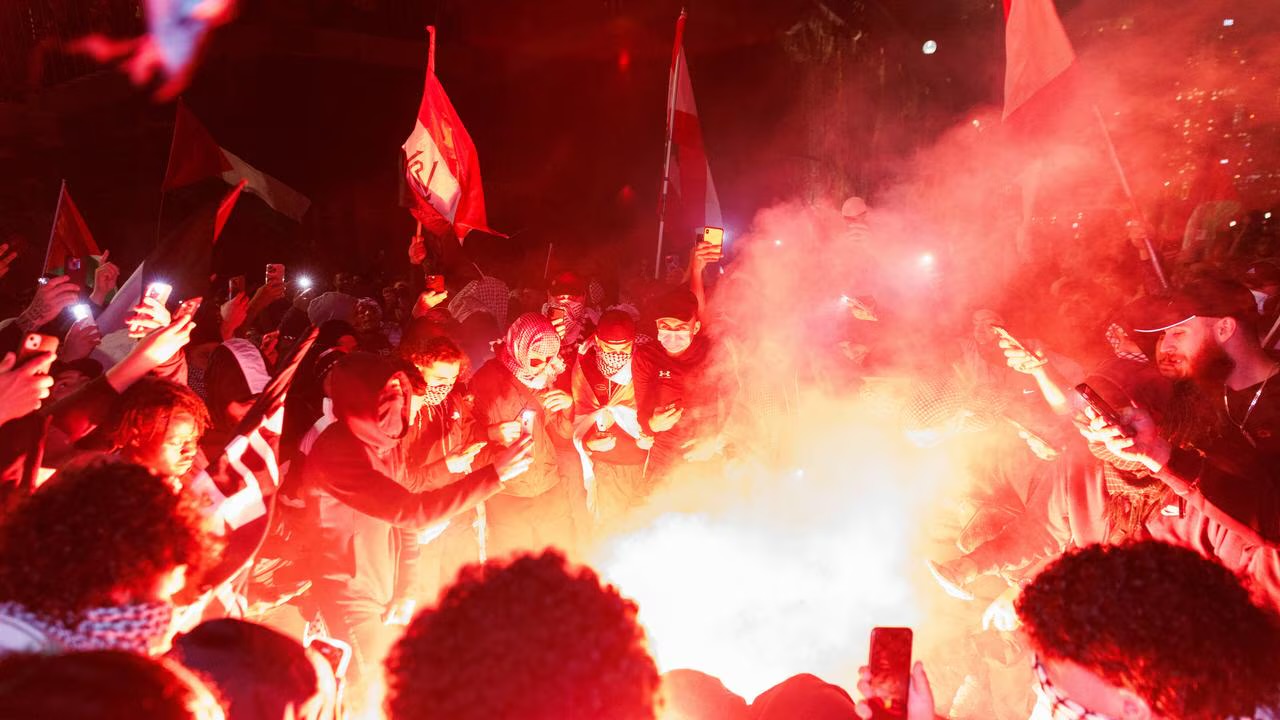
Pro-Palestine supporters set off flares and fireworks on the forecourt of the Sydney Opera House. Picture: David Swift
Bondi is not a place Australians associate with fear. It is a place of routine, ritual and beauty: morning swims, surfing, skin browned by the Australian sun, kids enjoying the sand and beauty with their families, laughter and a carefree vibe that can only be experienced at Bondi. It is where differences dissolves into the rhythm of the coast, where people gather without needing to ask who belongs.
That is precisely why what happened at the shores of Bondi Beach matters.
At a public Hanukkah gathering in a park overlooking the shores of Bondi Beach, Jews were targeted not behind walls or under guard, but openly – visible, gathered, unafraid, spreading light on our festival of lights. Fifteen people were murdered, dozens and dozens injured. Extended impact on every single person that was at the event. Families were shattered in a space meant for light, yiddishkeit and on one of the most beautiful and recognisable places on earth. What unfolded was not only an act of terror, but the violent rupture of an Australian assumption: that here, ‘down under’, in our slice of heaven on earth safety was almost a guarantee.
For more than two years, antisemitism in Australia gathered momentum – quietly at first, then openly, then violently. Bondi was not the beginning. It was where the accumulated weight of warning, neglect, and delay finally collapsed.
Let me break it down. Two years of unrelenting warnings. Two years of escalation. Two years of words rather than meaningful action. Two years in which every single minor and major escalation that was not decisively acted upon led to atrocities not seen before in Australia.
The scale of antisemitism since October 7, 2023
In the twelve months following October 7, 2023, Australia recorded more than 2,000 antisemitic incidents, the highest number ever documented nationally. The following year brought a further 1,600 incidents, confirming that this was not a temporary surge tied to overseas events, but a sustained and embedded crisis.
These incidents extended beyond rhetoric to threats, harassment, vandalism, intimidation, arson attacks, and coordinated acts of violence. Jewish Australians did not merely observe this rise – they adjusted their lives around it, how they dressed, where they gathered, and how/when they moved through public space.
Sydney, particularly its eastern suburbs, emerged as a focal point not by chance, but because Jewish life here is, visible, established, and unapologetic.
The numbers told a story. But what they failed to convey was our lived experience – fear in the mundane, anxiety in routine, and the creeping sense that Jewish Australians were no longer beyond the reach of hatred.
Let’s break down a few of the major escalations that in no small part illuminated what tragically occurred in Bondi Beach.
1. October 2023: The Sydney Opera House protest – The first warning
Within days of October 7, crowds gathered near the Sydney Opera House. Jewish community members were advised by police not to attend for their own safety – an extraordinary instruction in a democratic society. Still reeling and mourning from Hamas’s deadly attack and the greatest loss of Jewish life since the Holocaust. It is important to note at this stage Israel had not yet responded and there were still hundreds of hostages including women and children in Gaza.
Antisemitic chants rang out beneath a national landmark. What should have been a moment of mourning and solidarity became a display of hostility directed at Israel and Australian Jews (who are almost all zionists).
Government response: The Prime Minister, the NSW Premier, and senior ministers condemned the chants as antisemitic and unacceptable. NSW Police announced that footage would be reviewed to determine whether offences had occurred.
Failure: No immediate arrests were made on the night. Subsequent investigations did not result in swift or visible legal consequences. Protest policing protocols were not materially altered, despite repeated demonstrations in the months that followed where Jewish communities continued reporting feeling unsafe. The NSW Police then came out with what can only be described as a pathetic and insulting statement. They explained that the main chant in question being “Gas the Jews” has been infact analysed and found to be instead “Where’s the Jews”. That statement is beyond absurd and insulting. First of all, either of those chants directly imply that the protests were not Israel based in nature but infact had become Anti-Semitic in nature. The justification that somehow one chant was better than the other insulted the intelligence of every Australian. This became the first major red-flag that what we were about to see would be a government and authorities willing to excuse, neglect, justify and minimise antisemitism.
The event became more than a demonstration – it became a signal that public spaces could be co-opted for antisemitic expression without immediate interruption.
2. 2024: escalation through repetition –Vandalism as intimidation
Throughout 2024, antisemitic graffiti became a recurring presence across Sydney. Swastikas, threats, and slogans appeared on walls near synagogues, schools, Jewish homes, and businesses, often cleaned away only to return in days following.
Government response: Local councils prioritised rapid removal. Police opened investigations into individual incidents. The NSW Government announced its intention to strengthen laws governing Nazi symbols and religious vilification. Whether they had any meaningful impact can only be illustrated in the fact that the graffiti would simply return within days or weeks following.
Failure: Legislative reform was delayed until 2025 despite months of repeat offences. Graffiti was largely treated as isolated property crime rather than as an early indicator of extremist escalation. No escalation protocol was triggered even as the same suburbs were targeted repeatedly. The councils and further government would swiftly remove the graffiti, however if the perpetrators ever faced any meaningful punishment was very rarely if ever seen.
3. Jewish schools targeted
Jewish schools were vandalised with explicit threats. For families, concern became calculation – whether uniforms were safe, whether drop-off points needed changing, whether children should be visible at all for their own safety.
Government response: Senior federal ministers visited affected schools. Additional funding was later announced for fencing, cameras, and guards. A lot of words and hollow promises were made.
Failure: No national framework was introduced to proactively protect Jewish educational institutions. Responsibility remained fragmented across jurisdictions, leaving schools reliant on private security while hostility continued unabated.
Vandalism was not just paint on walls – it was an attempt to rewrite safety into fear.
4. Sydney-specific attacks: escalation to destruction in the Eastern Suburbs
In the Eastern Suburbs of Sydney, antisemitic attacks escalated sharply. Vehicles were torched. Homes were vandalised. Jewish businesses were damaged in coordinated overnight attacks that left entire streets waking to devastation.
Government response: NSW Police increased patrols. State and federal leaders condemned the attacks and pledged investigations. These investigations often occurred behind closed doors and findings are still yet to be known to a large extent.
Failure: The East was targeted again weeks later after each incident. There was no visible disruption of those responsible between attacks. Condemnation was repeated, but interruption did not occur.
5. Bondi arson attacks – Not the first time for Bondi
In Bondi, kosher businesses were deliberately firebombed. These were not symbolic acts, but attacks capable of causing mass casualties had circumstances differed slightly.
Government response: Police investigations intensified. Intelligence agencies later confirmed foreign state involvement. Australia responded with diplomatic expulsions and counter-intelligence measures. A vague and reactionary response to a far greater problem
Failure: At the time of these attacks, there was no public recalibration of threat assessments. Jewish public gatherings continued without additional protective frameworks, despite the escalation from vandalism to arson.
6. December 2024: A synagogue burned to the ground
The firebombing of a Melbourne synagogue while occupied marked a decisive threshold. That lives were not lost was a matter of chance, not restraint.
Government response: The attack was treated as terrorism. Joint Counter-Terrorism Teams were activated. Federal funding was allocated for repairs and enhanced security was deployed.
Failure: Preventative disruption lagged behind investigation. Antisemitic incidents continued nationally, demonstrating that response remained reactive rather than pre-emptive. Instead of proactive policing this incident simply became a footnote in a growing list of antisemitic incidents across the country.
Sacred spaces, meant to be safe, were no longer immune.
7. Early 2025: institutional fractures widen – More threats at synagogue doors
Jewish worshippers were subjected to direct intimidation outside synagogues, including gestures designed to mimic violence including fake guns and other weapons as well as nazi salutes and abhorrent verbal vilification.
Government response: Police made arrests in individual cases and laid charges. Many were merely a ‘slap on the wrist’.
Failure: No consistent buffer zones or enhanced protections were introduced around synagogues despite repeated incidents. Protection remained case-by-case, not systemic. An extreme sense of imminent danger grew within the community after years of ongoing attacks.
8. Online incitement – Almost a constant daily occurance
Antisemitic content portraying Jews as legitimate targets surged online, circulating with speed unmatched by enforcement. Jews were subjected to abuse, doxxing, mis/disinformation campaigns and threats of actual violence. Across every main social media application posting anything related to your Judaism or support of Israel could have dire consequences. Your comment section was almost inevitably flooded with antisemtic or anti Israel comments and your inbox full of death threats and hate mail. Jews began to hide their Judaism not only in the real world but online too. Multiple cases were reported of Jews losing their jobs or being ostracised from friends or social groups due to their online support for Israel.
Government response: Government engagement with platforms occurred through existing online safety mechanisms including the e-saftey commissioner. These attempts at quelling online hate had absolutely no significant impact on stopping it.
Failure: Content removal was inconsistent and slow if ever occurring at all. No emergency regulatory measures were introduced despite mounting evidence that online incitement was translating into real-world violence. I could only imagine that the Bondi attackers and associates had posted or been involved in these targeted online hate campaigns. If only the government actually took action on such people at that time maybe the attackers would have already been under close watch and plans distributed by Police.
9. Antisemitism within institutions – Government and Private
Violent antisemitic rhetoric emerged from within professional environments, revealing that hatred was not confined to the fringes. We have all seen the infamous Bankstown nurses video in which they literally threaten to kill Jews and Israelis. Their punishment? You tell me.
Government/Employer response: Immediate suspensions and disciplinary processes followed exposure and sometimes brought about an ‘investigation’. In almost all cases no meaningful action actually happened. At worst the employee was suspended (often with pay), made to apologise or made to sit before an ‘internal review’ board which usually surprise, surprise found little to no wrongdoing and a warning was sufficient.
Failure: No systemic review addressed how such views had gone undetected within regulated institutions or how similar risks might be prevented elsewhere. Internal reviews and disciplinary boards across governments, universities and private institutions lacked firstly any real actionable power and secondly rarely acted on the power they did have.
10. July 2025: coordination made visible
A synagogue was set alight while, elsewhere, an Israeli-linked business was violently attacked on the same night. Same story as in previous months and years before but increasing the panic and fear in the Jewish community.
Government response: Condemnations were issued. Charges were laid and lord knows the outcomes. Security funding was reiterated as per usual.
Failure: The recurrence of coordinated attacks underscored that existing measures had not dismantled the networks or ideologies driving the violence. The money and words thrown at the issue were almost insulting, wholly insufficient and lacked in any meaningful way the ability to prevent or deter future attacks.
11. Smaller antisemitic incidents that mattered
Beyond the headline attacks, a pattern of everyday antisemitism eroded Jewish life long before Bondi. The little jokes amongst friends, the weird messages received on social media from people you thought were your friends, the sudden ostracising from social group or just the blatant antisemitism yelled at you from a passing car as you walked down the street with your kippah on. For example, NSW police recently charged a man who made antisemitic threats on a flight from Bali to Sydney. This incident that began as a personal attack but became a broader warning about how emboldened hatred had become in ordinary spaces. A man on a flight gets angry and all of the sudden starts spewing hatred towards Jews? That does not just happen. It happens because these people have been emboldened by years of policing inaction to do anything about it.
Earlier, a private doxxing incident targeted hundreds of Jewish creatives and academics when their group’s membership was published, exposing individuals to threats and harassment that later triggered changes to doxxing laws in Australia that to a large extent did nothing.
There are so many incidents. Message any Jew you know in Sydney or even in Australia that has been here for the past 2 years of what they have experienced. You’ll find a long laundry list of things that wont shock you but will definitely appall you. These smaller incidents, occurring in planes, workplaces, and online spaces, were not marginal blips. They were artefacts of a broader climate of normalised hate, a society where casual bigotry turned into overt hostility with diminishing friction.
12. A neo-Nazi protest at NSW Parliament
In November 2025, approximately 60 individuals affiliated with a neo-Nazi group known as the National Socialist Network, operating under the banner “White Australia,” gathered outside the New South Wales Parliament in Sydney. They held a large banner reading “Abolish the Jewish Lobby” and chanted slogans with clear antisemitic intent an explicitly racist and conspiratorial attack on Jewish civic participation and safety. Even after two years of incredible antisemitism we could not believe what we were seeing. Neo-Nazis protesting Jews outside of parliament? What timeline are we living in?!
Government response: The protest was authorised under NSW protest laws – police deemed it lawful and did not intervene. Some MPs and community leaders, including federal and state members, condemned the rally and called for stronger enforcement against hate groups. Many asked the question that we still do not have the answer to. Even if this ‘protest’ was approved, once seen by law enforcement for what it really was in broad daylight how was it not instantly shut down?
Failure: NSW Police permitted the demonstration outside the very seat of state government. Critics noted that the legal pathway used by the organisers, submitting a standard protest notification should not have been sufficient for a rally so overtly antisemitic. The lack of preventative action by police and the absence of immediate and unequivocal enforcement sent a message that even neo-Nazi agitation could unfold unimpeded in sight of legislative power.
This was not fringe theatre. It was a warning in stone and iron – permitted, if contested, in the heart of our state’s democracy.
Our sense of abandonment
For many Jewish Australians in Bondi and beyond, there is an overwhelming pervasive feeling of abandonment. Not necessarily of disinterest, but of complete and utter inaction. When assaults on Jewish identity moved from graffiti to arsons, and from rhetoric to rifles, the community’s warnings were met again and again with statements of concern but too few concrete safeguards. It was as if every act of hatred was recorded, discussed, and then archived as to simply sweep it under the rug.
Families watched as Jewish-owned businesses closed after sustained harassment. Shops once open to the neighbourhood shuttered their doors. And even after the massacre, cries for active protection are being met with debates about protest law reform rather than immediate, sweeping deterrent action. There is a profound sense that Jewish Australians were left telling authorities what was coming, only for tragedy to become the proof they were right. Pain is to a degree measurable. Loss is not. Yet again we ask the question…. Do we really have to ‘rest in peace’ so we can live in peace?
The cost of delay now has a name
The Bondi attack stripped away the last remaining ambiguity about how far antisemitism in Australia had risen. Jew-hatred was visible, escalating, and repeatedly warned about. The failure was not ignorance, but hesitation – the belief that condemnation, funding announcements, and taskforces could substitute for decisive action.
At the federal level, antisemitism remained framed too long as a social issue rather than a security threat. Recommendations were commissioned but not implemented. Online incitement was acknowledged but not disrupted. Security funding was reactive, insulting and insufficient.
At the state level, responses were too often reactive. Legislation lagged behind escalation. Repeat targeting of the same suburbs did not provoke strategic change. Police enforcement failed to prevent an authorised neo-Nazi rally outside the state’s parliament, and synagogues, schools, and public gatherings remained vulnerable.
From graffiti to firebombs, from chants to rifles, the pattern was unmistakable long before it became lethal. But the warnings were not wounds… until Bondi. Now they have names. 15 of them. Is that enough for our government to actually do something?
History does not judge nations by what they condemn. It judges them by what they stop, how they act next and if they have the sufficient moral fibre to eradicate in every sense the ability to let something occur again.
Related Topics