What the Kabbalists Knew Before the Physicists Said It
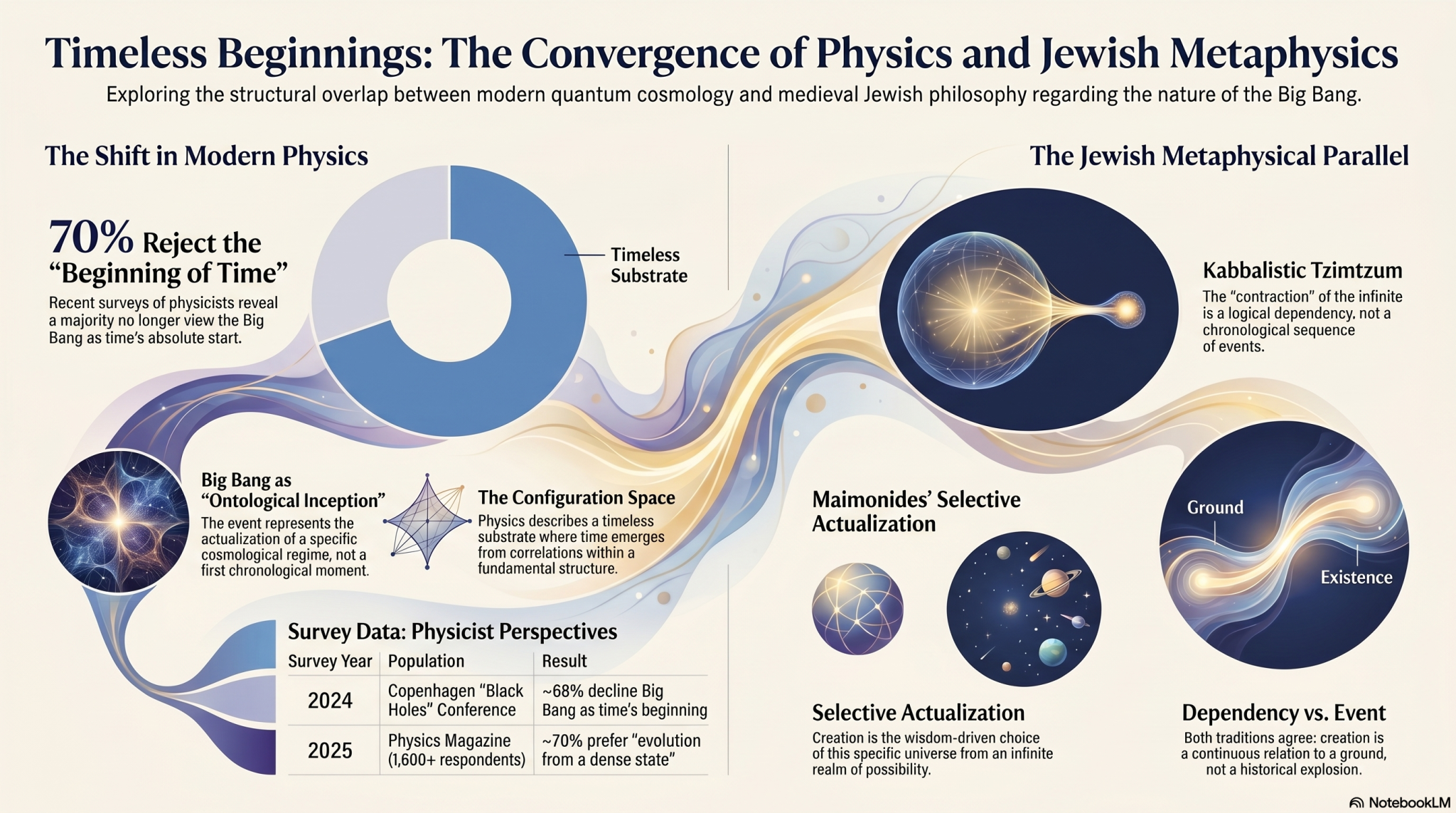
The Big Bang names not a first moment within time but the ontological inception of this cosmological regime — the constitutive actualization of spacetime, its laws, and its initial conditions, in atemporal dependence on the structure of possibility itself.
That sentence is not a theological proposition. It is, increasingly, what working physicists are willing to say when pressed.
In a 2024 survey of physicists at the “Black Holes Inside and Out” conference in Copenhagen, and again in a larger 2025 Physics Magazine survey of more than 1,600 respondents, roughly 68 to 70 percent of physicists declined to identify the Big Bang as the beginning of time. They preferred to describe it as the evolution of the universe from a hot, dense state — leaving open whether time itself had an absolute beginning. This is not a fringe view. It is now the closest thing to majority opinion in a field famous for its lack of majorities.
The popular understanding of the Big Bang has not caught up. In bookstores and documentaries, “the Big Bang” still means the moment time began, before which there was nothing because there was no “before.” But the physicists have quietly walked away from that picture. What they are converging on — without quite naming it — is something Jewish thought has been articulating for at least eight centuries.
Consider what the survey result actually implies. If the Big Bang is not the beginning of time, then it is the beginning of something else — this cosmological regime, this spacetime, these laws, these initial conditions. And whatever stands in relation to that regime cannot be located within it. The dependency runs from outside the temporal order to within it. The cosmos depends on a structure that is not itself temporal.
This is precisely what the Lurianic Kabbalists meant by tzimtzum — the divine contraction or self-withdrawal that makes space, in the ontological rather than spatial sense, for a created order to exist. The classical commentators were explicit: the “sequence” of tzimtzum, shevirat ha-kelim (the breaking of the vessels), and tikkun (repair) is not chronological. There is no clock running during tzimtzum, because the clock is among the things tzimtzum makes possible. The sequence is logical, ontological, structural. It describes a dependency, not a story.
Maimonides, working in a very different idiom seven centuries earlier, had reached an adjacent position — and one that answers a question the bare structural claim leaves open. If the cosmos depends atemporally on a ground beyond itself, why this cosmos? Why these laws, this spacetime, these initial conditions, rather than any of the indefinitely many others that the structure of possibility might have hosted?
Maimonides’ answer, developed across the Guide of the Perplexed, is that God is necessary existence whose intellect contains the full range of intelligible possibility, and that creation is the selective actualization of one configuration among those infinite possibilities by divine will and wisdom. The created order is not the only order God could have made; it is the order God did make, and the selection is neither arbitrary nor mechanical. It is, in Maimonides’ framing, an act of wisdom — a choice grounded in what the chosen order makes possible, including the existence of beings capable of recognizing that they were chosen.
This is a structurally significant move. It distinguishes the realm of possibility (vast, perhaps infinite) from the realm of actuality (this regime), and it locates the selection between them in something that is itself outside the temporal order — not a moment of decision, but a constitutive act that grounds the very distinction between actual and merely possible. The atemporal dependency the physicists are gesturing toward gets, in Maimonides, a content: it is dependency on a ground that selects, and the selection is the actualization.
Aquinas, Maimonides’ Christian student in this respect, sharpened a related point: creation is a dependency relation, not an event. A universe eternally old could still be eternally created, because to be created is to depend on a source of being, not to begin at a moment.
These traditions were not doing physics. They were doing metaphysics — asking what kind of relation existence stands in to its ground, and what kind of selection makes this actuality actual rather than merely possible. They reached, by very different routes, three convergent conclusions: that the ground cannot be temporally prior to what it grounds; that the actualized cosmos is one selection among possibilities, not the only thing the ground could have produced; and that the selection is itself constitutive of the temporal order, not located within it.
The physicists are now arriving at the same structural shape from the other direction. Quantum cosmology — the Wheeler-DeWitt equation, the Hartle-Hawking no-boundary proposal, the Page-Wootters mechanism — describes a wavefunction of the universe defined on configuration space, not on time. Time emerges from correlations between subsystems. In these frameworks, what we experience as temporal flow is downstream of a more fundamental structure that is not itself temporal. The configuration space is the realm of possibility. The actualized history is one trajectory among many. What selects the trajectory — what makes this actuality actual rather than another — is precisely the question contemporary physics has no resources to answer from within itself.
Maimonides offered an answer eight centuries ago. One does not have to accept his theology to notice that the structural question he was answering is the structural question physics now faces.
This is not a claim that Kabbalah or medieval Jewish philosophy predicted quantum gravity. The histories are independent, the vocabularies are incommensurate, and anyone who tells you the Zohar contains hidden equations is selling something. The claim is structural: when serious traditions of inquiry, working on the same question with entirely different methods, converge on the same shape of answer, the convergence is data. It tells us the question has a structure that constrains its answers.
The structure both traditions are pointing at is roughly this: existence and time are not equivalent. Existence is the more fundamental category. Time is a feature of how existence manifests within a particular regime — this regime, the one we inhabit, the one the Big Bang names the inception of. The regime is one selective actualization within an indefinitely larger structure of possibility. The Kabbalists called that structure by various names, none of them perfect. Maimonides located it in the divine intellect. The physicists call it the configuration space, the wavefunction, the eternal objects, the timeless substrate. The names differ. The work the names do is recognizably the same.
This convergence matters for how Jews think about our own intellectual inheritance. The standard secular framing treats Jewish mystical and philosophical traditions as pre-scientific — quaint, perhaps profound in their own register, but superseded. The convergence with contemporary cosmology suggests a different reading. The Jewish thinkers were not doing bad physics; they were doing real metaphysics, asking questions physics is only now mature enough to ask back. The traditions are not in competition. They are addressing the same structural reality from different angles, and the angles are starting to meet.
It also matters for how we understand what kind of universe we live in. A universe whose existence depends atemporaly on a structure of possibility — and whose particular character is the selective actualization of one configuration among many — is not a universe in which we are cosmic accidents in an indifferent void. It is a universe with a constitutive ground that selects, and the selection includes us. Whether one reads that ground theologically or philosophically, the structural fact remains: the cosmos is grounded in something it does not contain, and grounded selectively. That is the oldest claim in Jewish metaphysics. It is now, increasingly, the working assumption of the physicists who take seriously what their equations do not require them to believe.